





Today, business aviation is increasingly understood for what it truly represents - a productivity enabler, a connectivity bridge, and a resilience asset for a rapidly evolving economy
 | By RAJAN MEHRA, CHIEF EXECUTIVE OFFICER & ACCOUNTABLE MANAGER, CLUB ONE AIR |

India’s civil aviation story is among the most compelling global growth narratives of the decade. Record aircraft orders, sustained airport expansion, and rising passenger volumes have firmly positioned the country as one of the fastest-growing aviation markets in the world. Yet, while scheduled airlines and airport infrastructure dominate headlines, another segment—quieter, leaner, and strategically vital—has remained under-represented in public discourse: business aviation.
For decades, business aviation in India operated on the margins, shaped as much by perception as by policy. Long regarded as a mode of travel reserved for the rich and famous, it struggled to gain recognition as a legitimate component of national mobility. That perception, however, is undergoing a decisive shift. Today, business aviation is increasingly understood for what it truly represents: a productivity enabler, a connectivity bridge, and a resilience asset for a rapidly evolving economy. With the right ecosystem support, it is poised to move into a phase of accelerated—indeed exponential—growth.
AN UNDERSUPPLIED MARKET, NOT A WEAK ONE
India today operates approximately 350–400 business jets and turboprops, complemented by a civil helicopter fleet of around 250 aircraft. For a nation of 1.4 billion people, a vast and diverse geography, and a rapidly decentralising industrial base, these numbers remain disproportionately low.
This is not a reflection of inadequate demand. On the contrary, demand exists across corporate India, state governments, infrastructure developers, healthcare providers, energy companies, and emergency services. What has constrained growth historically is an operating ecosystem that has not yet evolved in step with India’s economic ambitions.
IN A COUNTRY WITH VAST COASTLINES, MOUNTAINOUS TERRAIN, DENSE URBAN CENTRES, REMOTE HABITATIONS, AND RECURRING CLIMATERELATED EMERGENCIES, HELICOPTERS ARE NOT A LUXURY—THEY ARE A NATIONAL CAPABILITY
In mature aviation markets, business aviation scales naturally with economic complexity, regional dispersion, and time-critical decision-making. India has entered precisely that phase of development. The current gap between economic reality and business aviation capacity is not a weakness—it is the clearest indicator of future opportunity.
FROM EXCLUSIVITY TO EFFICIENCY
Perhaps the most important transformation underway is perceptual. Business aviation is no longer viewed merely as a symbol of exclusivity. Increasingly, it is recognised as a time-efficiency and execution tool—one that allows senior leadership teams to compress travel schedules, conduct multicity operations in a single day, and access Tier-2 and Tier-3 cities that lack reliable scheduled airline connectivity.

For sectors such as infrastructure, manufacturing, pharmaceuticals, energy, financial services, and governance, time is not a convenience—it is a cost. Delayed decisions, missed site visits, and fragmented oversight have tangible economic consequences. Business aviation enables decisionmakers to deploy time as a strategic resource, improving responsiveness, accountability, and execution speed.
As Indian corporate become more globally integrated, compliancedriven, and outcome-oriented, business aviation increasingly shifts from being discretionary to being operationally rational.
HELICOPTERS: INDIA’S MOST UNDERVALUED AVIATION ASSET
If fixed-wing business aviation is under-penetrated, the helicopter segment is even more so. Helicopters play a role far beyond executive transport. They are indispensable for medical evacuation, disaster relief, offshore logistics, infrastructure inspection, pilgrimage circuits, tourism, and access to terrainchallenged or remote regions.
In a country with vast coastlines, mountainous terrain, dense urban centres, remote habitations, and recurring climate-related emergencies, helicopters are not a luxury—they are a national capability. Yet India’s civil helicopter fleet remains modest by global benchmarks.
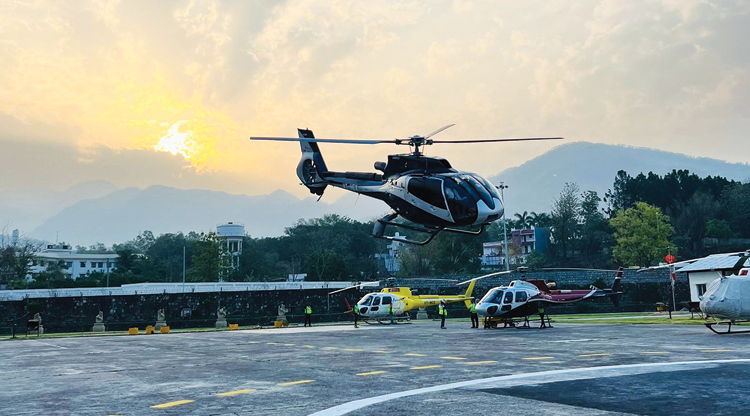
The reasons are structural: limited heliport and helipad infrastructure, fragmented policy frameworks, procedural complexity, and challenging operating economics. Addressing these constraints would unlock one of the fastest-growing segments within Indian aviation—delivering immediate public value while also strengthening national resilience.
STRUCTURAL TAILWINDS ARE NOW FIRMLY IN PLACE
Several long-term forces are now aligning decisively in favour of business aviation growth.
First, economic decentralisation is accelerating. Growth is no longer confined to metropolitan centres. Industrial corridors, manufacturing clusters, logistics hubs, renewable energy projects, and state capitals increasingly require direct, point-to-point connectivity—precisely where business aviation delivers maximum value.
Second, airport infrastructure expansion continues steadily. With over 150 operational airports and ambitious plans for further development, the physical footprint required to support business aviation is improving, even if BA-specific facilities still lag at certain locations.
Third, corporate maturity is deepening. Indian enterprises are more global, more regulated, and more time-sensitive than ever before. Executive productivity, risk management, and governance oversight are now board-level imperatives.
Finally, financial innovation—particularly through emerging aircraft leasing and financing structures linked to IFSC frameworks—offers the potential to reduce capital costs and align Indian operators with global best practices.
Together, these factors create a strong foundation for sustained and scalable growth.
FRICTION THAT CONTINUES TO LIMIT SCALE
Despite these tailwinds, business aviation in India continues to face friction that limits its ability to scale.
Operational constraints remain a primary concern. Limited hangar availability, inconsistent parking access, restricted operating windows at congested airports, and variability in ground handling standards undermine the very flexibility that defines business aviation’s value proposition.
Cost and taxation structures also remain misaligned. Business aviation is still frequently categorised as discretionary consumption rather than as productivity infrastructure. This perception influences tax treatment, operating costs, and the pace of reform.
Regulatory complexity further compounds the challenge. Aircraft induction, crew licensing, maintenance approvals, and security clearances often involve multiple agencies and extended timelines. While digitisation and reform efforts are underway, the industry still lacks a truly predictable, single-window operating environment.
In the helicopter segment, the absence of a structured heliport and helipad ecosystem significantly weakens utilisation economics and restricts fleet expansion.
MRO: THE STRATEGIC IMPERATIVE OF SELF-RELIANCE
One of the most encouraging developments in recent years has been India’s renewed focus on building a strong domestic Maintenance, Repair and Overhaul (MRO) ecosystem.
Historically, Indian operators have relied heavily on overseas MRO facilities, resulting in higher costs, longer aircraft downtime, and significant outflow of foreign exchange. Strengthening domestic MRO capability is therefore critical—not only for cost efficiency, but also for technical self-reliance and longterm capacity building.
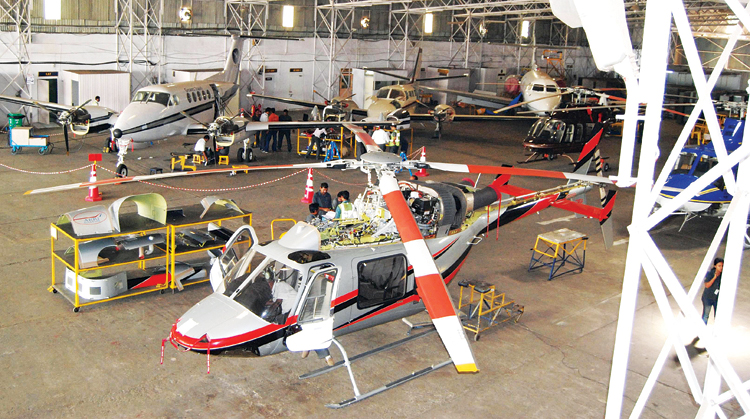
Recent approvals allowing complex checks to be carried out within India mark an important shift. Such developments reduce overseas dependency, conserve foreign exchange, shorten aircraft downtime, and build indigenous technical expertise. Equally important, they signal growing regulatory confidence in Indian operators and maintenance capability—an essential ingredient for long-term sectoral growth.
GLOBAL CONTEXT: HOW FAR INDIA CAN GO
Globally, business aviation is deeply embedded into economic infrastructure. In the United States and Europe, business jets and helicopters are routinely used by corporations, governments, and emergency services as productivity tools rather than symbols of luxury. Even smaller economies in Asia-Pacific operate significantly larger fleets relative to population and geography.
India, by contrast, is still at an early adoption stage. This gap represents headroom, not disadvantage. As infrastructure improves and operating frameworks mature, India has the potential to leapfrog stages of growth rather than follow a linear path. The opportunity is not merely to catch up—but to design a business aviation ecosystem aligned with India’s unique scale, diversity, and development priorities.
THE GROWTH OUTLOOK: WHY THE NEXT DECADE MATTERS
Market indicators already suggest steady mid-single-digit growth in India’s business jet segment over the coming decade, with the helicopter segment offering even greater upside if infrastructure and policy bottlenecks are addressed.
Crucially, India remains at an early adoption stage. Even modest shifts in corporate travel behaviour—from scheduled airlines to business aviation for time-critical missions—would necessitate the induction of hundreds of additional aircraft. This is not incremental growth. It is structural expansion.
CONCLUSION: FROM THE MARGINS TO THE MAINSTREAM
Business aviation in India is no longer waiting for validation. The perception that it exists only for a privileged few has given way to a clearer understanding of its role as national productivity and connectivity infrastructure.
With changing mindsets, evolving policy frameworks, strengthening MRO capability, and a maturing corporate ecosystem, business aviation stands at the threshold of its next chapter.
The runway is laid. The engines are warming up. Business aviation in India is ready for take-off!