




Dassault’s Falcon 10X Completes its Maiden Test Flight, Opening a New Chapter in Ultra-Long-Range Business Aviation
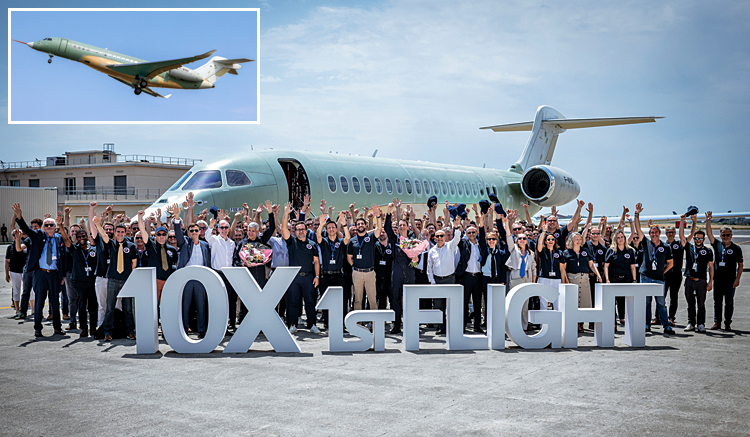
The most ambitious aircraft in Dassault Aviation’s 110-year history lifted off from Bordeaux-Mérignac on June 19, 2026 for a two-and-a-half-hour debut flight — and the programme’s sights are firmly set on entry into service by late 2027.
At 11:10 on June 19, 2026, test pilot Sébastien Dupont de Dinechin and co-pilot Fabrice Dougnac rolled the Dassault Falcon 10X down runway 23 at Bordeaux-Mérignac Airport and lifted it into French skies for the very first time. What followed over the next two hours and thirty minutes was not merely a test flight. It was the culmination of years of engineering ambition by thousands of men and women across Dassault Aviation and its global network of partners — the moment at which the largest, fastest, heaviest, and most technologically advanced business jet ever produced by a French manufacturer stopped being a project and became an aircraft. The 10X touched back down at Bordeaux- Mérignac at 1:40 p.m. The crew reported a smooth landing. The aircraft had performed as planned from start to finish.
“Today’s flight was the culmination of years of work by thousands of Dassault employees and partners,” said de Dinechin after stepping off the jet. “It paid off in a flight that went as planned and was a delight to fly.”
Dassault Aviation Chairman and CEO Eric Trappier was equally direct in marking the significance of the day. “This inaugural flight is another milestone for Dassault,” he said in the company’s official announcement issued from Saint-Cloud. “It is a reflection of the dedication and high skill of our engineering, production, and flight teams, and also the quality of our global network of partners. All of us are excited to see this day as we launch into a new phase for the 10X.”
THE FLIGHT, STEP BY STEP
The first flight of any new aircraft is a carefully structured progression through the lower reaches of the performance envelope — and the Falcon 10X’s debut was no exception. The crew began by evaluating handling qualities and systems at 15,000 feet, methodically checking the aircraft’s responses before committing to the next phase. With that evaluation complete, they retracted the landing gear and all movable surfaces, confirming the clean aerodynamic configuration that defines the aircraft at cruise. They then climbed to 40,000 feet and accelerated to Mach 0.82 — well into the high-speed regime where the 10X will spend much of its commercial life.
“THIS INAUGURAL FLIGHT IS ANOTHER MILESTONE FOR DASSAULT. IT IS A REFLECTION OF THE DEDICATION AND HIGH SKILL OF OUR ENGINEERING, PRODUCTION, AND FLIGHT TEAMS, AND ALSO THE QUALITY OF OUR GLOBAL NETWORK OF PARTNERS.”
—ERIC TRAPPIER, CHAIRMAN AND CEO, DASSAULT AVIATION
The disciplined sequence communicated something important: the team’s confidence in the aircraft they had built. You do not climb to 40,000 feet and push to Mach 0.82 on a first flight unless the data from years of simulation, wind tunnel work, ground testing, and bench verification has given you good reason to do so.
BIGGER THAN ANYTHING THAT CAME BEFORE
The Falcon 10X is Dassault Aviation’s largest aircraft to date by virtually every measure. It stretches 109 feet 7 inches in length, with a wingspan of 110 feet 3 inches. Its maximum takeoff weight is 1,15,000 pounds — substantially heavier than the Falcon 8X that currently anchors the top of the Falcon family — and it carries 51,700 pounds of fuel at maximum fuel weight, enabling the range performance that sits at the heart of its commercial proposition.
That proposition is built on a single headline number: 7,500 nautical miles at Mach 0.85. Dassault frames this in terms of the city pairs it unlocks — nonstop from New York to Shanghai, Los Angeles to Sydney, Hong Kong to New York, or Paris to Santiago. These are connections that currently require a fuel stop, either adding hours to a journey or constraining the airports available. The 10X eliminates those constraints on connections that span a significant portion of the globe.
Speed, however, is where Dassault believes the 10X sets itself most clearly apart. Its Maximum Mach Operating number is 0.925 — the highest in the Falcon family’s history, and a figure that places it firmly at the frontier of what is achievable in civil business aviation aerodynamics. The maximum certified altitude is 51,000 feet.
The aircraft was designed from first principles around this performance target. Its wing is constructed from carbon fibre composites for maximum strength and minimum weight, with a very high aspect ratio, high leading-edge sweep, and low section thickness to minimise drag at high Mach numbers. Retractable high-lift devices on the wing’s trailing edge ensure that the speed machine can still operate from shorter runways — Dassault specifies a landing distance of less than 2,500 feet and a takeoff distance of less than 6,000 feet at maximum takeoff weight. This balance of capability is a signature Falcon characteristic: extraordinary performance at the top end of the envelope, combined with the field accessibility that Falcons have always offered their operators.
THE ENGINE PARTNERSHIP: A FIRST FOR TWO ICONIC NAMES
The Falcon 10X is powered by a pair of Rolls-Royce Pearl 10X turbofan engines, each producing more than 18,000 pounds of thrust. The partnership is historically significant in its own right: this is the first Rolls-Royce engine to power a Dassault Aviation business jet — a collaboration between two of Europe’s most storied engineering institutions, one French and one British.
The Pearl 10X is the most powerful member of the Pearl family. It is built around the Advance2 engine core — the most efficient core available across the business aviation sector, according to Rolls-Royce. A new ultra-low-emissions combustor, produced using Additive Layer Manufacturing (ALM), is fully compatible with 100 per cent Sustainable Aviation Fuel. A new accessory gearbox allows for higher power extraction by the aircraft’s systems. The airborne phase included a six-month campaign on Rolls-Royce’s Boeing 747 flying testbed that encompassed more than 25 flights and covered 36,000 nautical miles — a distance equivalent to one and a half circumnavigations of the earth — validating the engine’s performance and reliability in real flight conditions before it ever turned a blade in the aircraft it was designed to power.
A CABIN THAT REDEFINES THE CATEGORY
Inside the aircraft, the case for the Falcon 10X is made in different terms. The four-zone cabin is 53 feet 10 inches long, 9 feet 1 inch wide, and 6 feet 8 inches tall. The width figure is the one Dassault most prominently highlights — it makes the 10X’s cabin approximately 8 inches wider than the widest purposebuilt business jet cabin currently in service, a difference that is immediately tangible to anyone standing inside it.
The 38 windows that line the cabin are designed to deliver what Dassault describes as the brightest interior in business aviation. The cabin maintains an altitude of just 3,000 feet when the aircraft is cruising at 41,000 feet — a level of pressurisation that meaningfully reduces the fatigue associated with long flights. The NeXus Flight Deck, which manages both flight operations and cabin systems through advanced touchscreen interfaces, carries technology that draws directly on Dassault’s parallel expertise in military aviation, including the FalconEye® combined vision system — the first in business aviation to offer both enhanced and synthetic vision capabilities simultaneously. A single Smart Throttle controls both engines. The total cabin volume is 2,780 cubic feet. Baggage volume stands at 198 cubic feet.
Customer aircraft will all be finished at Dassault’s completion centre in Little Rock, Arkansas — an operation the company describes as its centre of excellence for interior work — before delivery to their owners. Entry into service of the Falcon 10X is expected by late 2027.