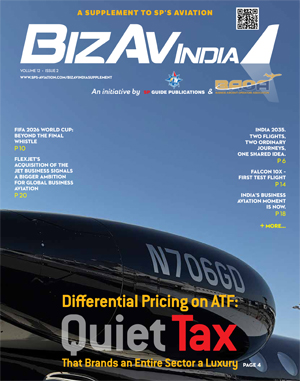





We begin 2026 with cautious optimism for India’s business aviation sector, looking ahead to gradual yet meaningful progress during the year. This follows a transitional 2025 marked by intensified regulatory engagement and growing recognition of business aviation as productivity infrastructure even as cost and infrastructure challenges continued to shape industry outcomes.
Dear Reader,
At the outset, the BAOA President’s message in this issue outlines a phase of intensified engagement aimed at strengthening India’s General and Business Aviation ecosystem. It highlights constructive dialogue with the Directorate General of Civil Aviation through a high-level meeting that addressed key regulatory and operational challenges, including flight duty time limitations, aeromedical processes, pilot utilisation, and infrastructure constraints, with follow-up actions expected. A major concern is the sharp and unintended increase in GST on privately registered aircraft, which has raised effective taxation to nearly 48 per cent, placing significant pressure on private and corporate aviation. BAOA is pursuing relief through representations to the Ministry of Finance and industry bodies. The message also underscores the importance of BizAvIndia 2026 as a platform to advance discussions on ownership models, infrastructure, financing, and advanced air mobility, reinforcing BAOA’s commitment to collaborative reform and sustainable growth.
Rajan Mehra’s article positions business aviation as a productivity and connectivity enabler rather than a luxury. The article notes growing requirements from corporate, government, and emergency services, alongside a perceptual shift that values time efficiency, multi-city access, and connectivity beyond major hubs. Helicopters are highlighted as an underutilised national capability, critical for healthcare, disaster response, and infrastructure support. Structural tailwinds such as decentralised growth and airport expansion support optimism, even as regulatory friction, taxation, and infrastructure gaps persist. Strengthening domestic MRO capability is identified as a strategic priority.
Jayant Nadkarni’s contribution traces the cautious evolution of fractional aircraft ownership in India, arguing that while the business case is strong, success depends on disciplined execution, patience, and operational credibility rather than marketing-led growth. The article highlights a shift from early scepticism to measured confidence, with fractional ownership increasingly recognised as a distinct operating model rather than a variant of charter. It emphasises that fractional and charter models will coexist, serving different user needs. Early growth is expected to be uneven, with sustainability hinging on transparent cost structures, conservative utilisation, and trust-building.
Sanjeev Choudhary examines why globally proven ‘first-of-its-kind’ aircraft struggle to enter India. He argues the challenge lies not in safety or capability, but in regulatory complexity, ecosystem readiness, and coordination gaps. The article concludes that structured collaboration and proportionate, risk-based validation processes could ease aircraft induction and accelerate the adoption of modern business aircraft in India.
We also have extensive coverage of the Boeing Business Jets with their fact file, the first flight of Gulfstream G300 and the how Pilatus is embedding environmental stewardship into every aspect of its business through their sustainability initiatives.
All this and more in this issue of BizAvIndia. Welcome aboard and we wish you many happy landings!