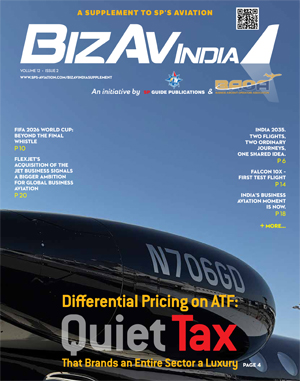





India’s business aviation sector is grappling with a steadily rising and unpredictable tax regime that now significantly impacts growth. The debate is no longer about lowering GST, but about aligning taxation with the sector’s economic role and ensuring policy clarity.
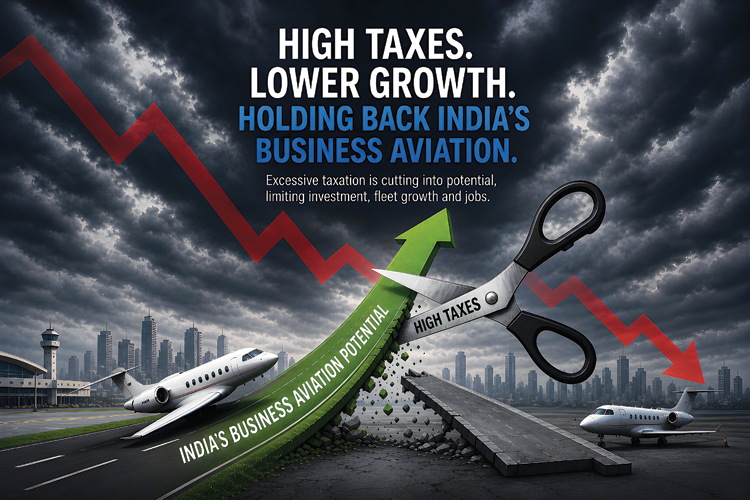
At a recent industry discussion, the conversation turned — inevitably — to tax. Not as a side issue, but as the defining factor shaping how India’s business aviation market is evolving. The question was straightforward - would rationalising GST unlock demand? The answers pointed to something deeper.
There was a time — not too long ago — when the tax burden on general and business aviation was effectively negligible. In the pre-2007 era, aircraft imports operated in a relatively open environment, with limited fiscal friction. That changed gradually, then decisively.
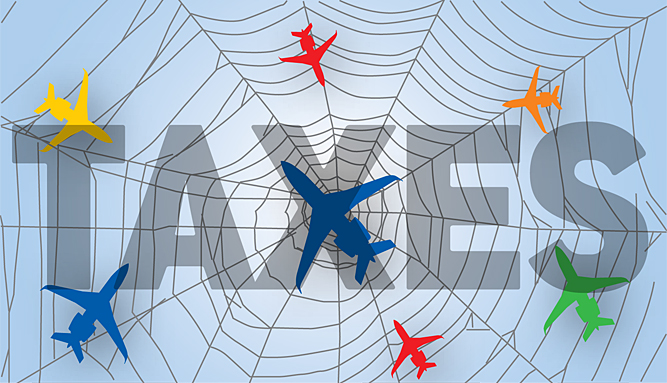
Over the last two decades, the sector has moved from near-zero incidence to a structure where effective taxation can approach 40 per cent, particularly for private, non-commercial aircraft. The progression has been steady — 25 per cent, then 31 per cent, and now, in certain cases, significantly higher.
For the industry, the concern is not simply the rate — but the direction. As one participant observed during the discussion, “Experience has shown that the more you push for rationalisation, the higher it seems to go.”
That sentiment reflects a growing unease — not with taxation itself, but with the absence of a clear longterm framework.
There is, of course, a counter-view. In policy circles, comparisons are sometimes drawn with periods when even essential commodities saw significant distortions in pricing and trade policy — occasionally expressed in exaggerated terms such as “600 per cent on wheat.” The implication is that business aviation is not uniquely burdened.
But such comparisons, while provocative, miss a key distinction. Because business aviation is not a consumable. It is an enabler of economic activity.
India’s own policy history offers a useful reminder. In 2007, the government procured wheat domestically at around ₹850 per quintal, while paying nearly ₹1,600 per quintal for imports during a supply shortfall. The decision was driven by necessity — but it also illustrated how policy design, rather than market fundamentals alone, shapes economic outcomes. The relevance for business aviation is clear.
The industry is not seeking subsidies, viability gap funding, or preferential treatment. Unlike sectors such as regional connectivity, where support mechanisms are built into the model, business aviation is asking for something more fundamental — a rational and predictable tax structure that reflects its evolving role in the economy. Because the ask is not for support. It is for alignment.
The industry is not arguing against taxation. It is asking whether the current structure is aligned with the role business aviation is now playing because that role has changed.
Business aviation today supports corporate mobility, connects regions beyond airline networks, enables emergency response, and underpins time-sensitive economic activity. In that context, taxation becomes not just a fiscal tool, but a strategic one. The question, then, is not whether the sector should be taxed — but whether it should be taxed in a way that enables growth or constrains it.
There is also a practical dimension. As aircraft management models evolve, some operators may move into structures that mitigate the highest tax incidence. But that is not the same as systemic clarity. It is adaptation — not resolution. And adaptation has its limits.
Globally, the pattern is clear. In markets such as the United States, taxation frameworks are designed to support utilisation. In Europe, fiscal policy broadly aligns with operational realities. The result is scale — in fleets, infrastructure, and ecosystem depth.
India has the ingredients to follow a similar trajectory — demand, capital, and expanding use cases. What it needs is alignment. Today, the risk is not that growth will stall. It is that growth will be structured elsewhere.
Aircraft ownership is already becoming more flexible. Registries are becoming more global. Capital is increasingly mobile. And aviation, by its nature, responds quickly to friction.
If India’s objective is to emerge as a leading business aviation hub in Asia, the path is clear. Not lower taxes alone — but rational, predictable, and consistent ones. Because in the long run, the choice is not between taxation and growth, it is between capturing that growth within the system — or watching it move beyond it.
In aviation, the system that enables movement ultimately determines where growth resides.