

The insightful articles, inspiring narrations and analytical perspectives presented by the Editorial Team, establish an alluring connect with the reader. My compliments and best wishes to SP Guide Publications.

"Over the past 60 years, the growth of SP Guide Publications has mirrored the rising stature of Indian Navy. Its well-researched and informative magazines on Defence and Aerospace sector have served to shape an educated opinion of our military personnel, policy makers and the public alike. I wish SP's Publication team continued success, fair winds and following seas in all future endeavour!"

Since, its inception in 1964, SP Guide Publications has consistently demonstrated commitment to high-quality journalism in the aerospace and defence sectors, earning a well-deserved reputation as Asia's largest media house in this domain. I wish SP Guide Publications continued success in its pursuit of excellence.
The accelerating global AI race and contrasting US and Chinese strategies are rising concerns over data sovereignty and national security.
 |
The Author is Former Director General of Information Systems and A Special Forces Veteran, Indian Army |
The expected global market value of AI in 2025 ranged from $254.5 billion (Statista) to $757.58 billion (Yahoo Finance). By 2040, AI's projected global value is estimated between $15.5 trillion and $22.9 trillion from AI software and services alone. Meta is focused on building large-scale AI data centres on Earth; investing hundreds of billions of dollars in AI superclusters for superintelligence. There have also been generic theoretical discussions about space-based data centres. During his last visit to the US, Prime Minister Narendra Modi mentioned AI as an acronym for 'America and India', signalling that both countries could cooperate in AI. However, US President Donald Trump has embraced Pakistan and looking down upon India.
By 2040, AI's projected global value is estimated between $15.5 trillion and $22.9 trillion from AI software and services alone.
The US presently in overall AI development, foundational AI models, advanced semiconductor design, attracting top global talent including Indian-origin researchers, championing open-source AI to set global standards. But America faces potential brain-drain because of Trump's policies and funding cuts for basic research. With its state-driven approach, China leads in the number of AI patents and research papers, massive number of data centres, with companies like Alibaba and Baidu pushing the industrial deployment of AI in the manufacturing and logistics sectors. The success of models like DeepSeek is significant. American export controls on high-end GPUs are a significant hurdle, forcing China to focus on self-reliance on domestic alternatives and advanced chips. China aims to become the global leader in AI by 2030 and high degree of technological self-reliance in AI chips by 2027. Beijing recently rolled out the 'AI+ Action Plan', focusing AI on education, healthcare, entertainment and every aspect of Chinese life. The scale of China's surveillance over its 1.4 billion population is unparalleled.
India is working to establish itself as a developer of indigenous AI capabilities and has a high rate of AI adoption in its businesses. The 'India AI Mission' launched in March 2024, with a budget of over $1.2 billion, aims to boost indigenous R&D and build infrastructure like data centres and supercomputers. The primary challenge, however, remains significant funding gap in R&D compared to the US and China, brain drain of top talent to other countries, and reliance on foreign technology for core hardware. According to the 13th edition of the India Skills Report 2026, India now accounts for 16 per cent of the global AI talent, projected to reach 1.25 million professionals by 2027. Also, India leads globally in AI skill penetration, with AI a baseline competency in most digital roles. Over 90 per cent employees across sectors use generative AI tools, while 70 per cent of IT and 50 per cent of banking, financial services and insurance organisations have adopted AI-based recruitment.
China aims to become the global leader in AI by 2030 and high degree of technological self-reliance in AI chips by 2027.
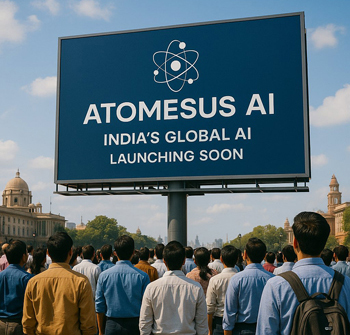
India is preparing to launch its own AI platform 'ATOMESUS AI', a next-generation intelligence platform developed under the Indus Valley Group, designed and led by young innovators trained in ISRO-linked institutions. ATOMESUS AI is to serve India's 1.4 billion citizens with advanced cognitive capabilities, near real-time performance, and full data sovereignty. Despite having more than 900 million internet users, India still depends heavily on foreign technologies; with attendant critical vulnerabilities related to data sovereignty, affordability, and contextual understanding. ATOMESUS AI proposes the world's lowest-cost AI platform, offering high-accuracy responses and lightning-fast performance with trials starting from ₹0.
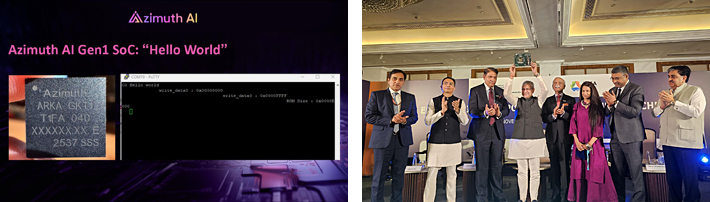
Concurrently, 'Azimuth AI and Cyient Semiconductors' have jointly launched the 'ARKA GKT-1', India's first-generation intelligent-power platform-on-a-chip. The unveiling, held on November 17, 2025, in New Delhi, was presided by Union Minister for Electronics and Information Technology, Ashwini Vaishnaw. The initiative strengthens India's ambition to emerge as a global hub for semiconductor design, innovation, and manufacturing. The platform is positioned to address critical needs in smart energy systems, advanced edge computing, and AI-driven control hardware sectors that demand low-latency analytics, high computational power, and energy efficiency. The ARKA GKT-1 integrates multiple subsystems traditionally distributed across separate silicon components into a single, high-efficiency chip.
The 'India AI Mission' launched in March 2024, with a budget of over $1.2 billion, aims to boost indigenous R&D and build infrastructure like data centres and supercomputers.
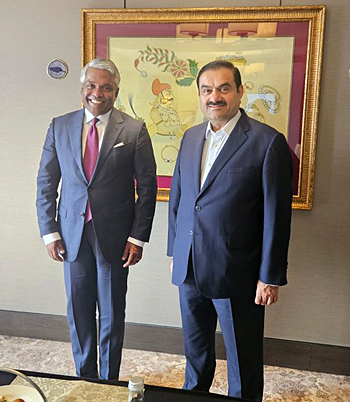
A significant development is the $15 billion Adani-Google AI deal to build India's largest AI data centre in Visakhapatnam, Andhra Pradesh over five years (2026-2030). Google is partnering with AdaniConneX, a joint venture between Adani Enterprises and EdgeConneX, along with Airtel, to create a hub for AI workloads that includes a 1-gigawatt data centre, a subsea cable network, and green energy infrastructure. The hub will be supported by a new international subsea cable network, new transmission lines, and large-scale clean energy generation and storage systems to power the facility sustainably. AdaniConneX will co-develop the data centre, while Airtel will build a new Cable Landing Station and high-capacity fiber network to provide low-latency connectivity. The initiative aims to support AI-powered solutions, drive technological transformation, and help India become a leader in the AI era by providing the necessary digital backbone.
In his article 'Why AI Isn't a Bubble — It's India's Next Competitive Advantage', published on November 17, 2025, Mark Lennon writes AI isn't a passing trend or a speculative bubble; AI is not a bubble but the foundation of the next wave of economic growth – one that fuses human intelligence, AI and ethical ambition. At the same time Alphabet CEO Sundar Pichai, referring to an AI bubble burst, said, "no company is going to be immune, including us." Pichai also cautioned users not to blindly trust everything AI tells us, pointing out that AI models are prone to errors and urged users to balance them along with other tools.
Chinese covert spyware in laptops, cell phones, apps and even CCTV cameras in India is well known; compromising national security and user privacy
Chinese covert spyware in laptops, cell phones, apps and even CCTV cameras in India is well known; compromising national security and user privacy by illegally collecting and transmitting data to third-party servers in foreign locations. Some devices from Chinese manufacturers have been found to have pre-installed apps or firmware (like the ADUPS software found on some Lenovo and other Android phones in 2016) that can monitor text messages, call histories, and location data without user permission, sending information to servers in China. The primary concern is data of millions of Indians transmitted to Chinese servers, while under China's National Intelligence Law, private companies must share information with national intelligence agencies. According to a survey in October 2024, 25 per cent Indian households have one or two Made in China gadgets while 54 per cent households have more than three.
After PM Modi visit to Israel in 2017, the first Indian Prime Minister to do so, India imported 'Pegasus', a very sophisticated covert spyware, developed by Israel's NSO Group, which can remotely infiltrate smartphones (both iOS and Android) without the user's knowledge; transforming the infected device into a 24-hour surveillance tool, giving the operator extensive access to personal and location data.
Notably, after Israel remotely exploded thousands of pagers of the Hezbollah in Lebanon on September 17, 2024, Prime Minister Benjamin Netanyahu said there was "a piece of Israel in every phone." Recently, when Chinese President Xi Jinping gifted a cell phone to South Korean President Lee Jae Myung, the latter joked, "What security need I be worried about?" to which Xi calmly replied, "You can check for Backdoors!". Xi was referring to Korean phones (not Chinese) since Samsung phones have an Israeli-built backdoor termed 'AppCloud' that takes control of your phone. Called an "app recommendation" service, it is an unremovable backdoor. Moral of the story is that some Peeping Tom is always watching over you.