
The insightful articles, inspiring narrations and analytical perspectives presented by the Editorial Team, establish an alluring connect with the reader. My compliments and best wishes to SP Guide Publications.

"Over the past 60 years, the growth of SP Guide Publications has mirrored the rising stature of Indian Navy. Its well-researched and informative magazines on Defence and Aerospace sector have served to shape an educated opinion of our military personnel, policy makers and the public alike. I wish SP's Publication team continued success, fair winds and following seas in all future endeavour!"

Since, its inception in 1964, SP Guide Publications has consistently demonstrated commitment to high-quality journalism in the aerospace and defence sectors, earning a well-deserved reputation as Asia's largest media house in this domain. I wish SP Guide Publications continued success in its pursuit of excellence.
Ministry of Defence (MoD) is preparing to order 10 additional Russian S-400 long-range air defence (AD) systems and is also scheduled to begin formal discussions with Russia for procuring the S-500 long-range AD system
 |
The Author is Former Director General of Information Systems and A Special Forces Veteran, Indian Army |
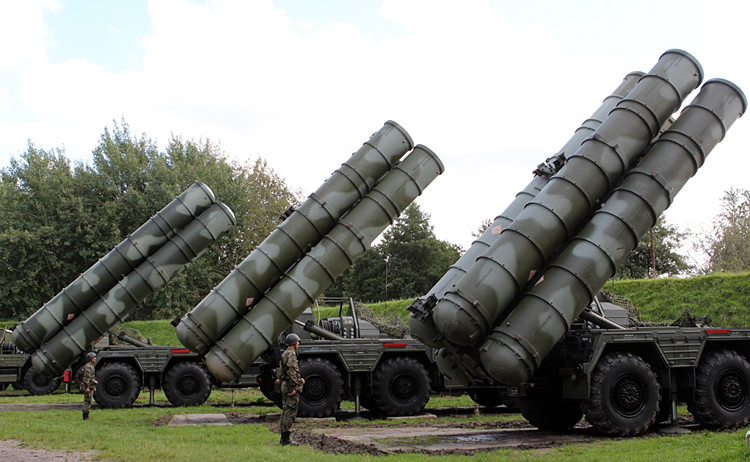
According to news reports of March 3, 2026, the Ministry of Defence (MoD) is preparing to order 10 additional Russian S-400 long-range air defence (AD) systems, after the system's performance drew considerable praise of the previously ordered 10 systems in October 2018 under a $5.43 billion contract, although the last of the S-400 systems ordered in 2018 are yet to be received by India – likely delivery in 2026.
The S-400 was operationally tested in May 2025 during Operation 'Sindoor', its only combat uses other than in the Ukraine war. India shot down at least five Pakistani fighters and one ELINT or AEW&C system at 300-km range, highlighting the particularly long reach of the S-400's unique 40N6 missiles.
The S-400 was operationally tested in May 2025 during Operation 'Sindoor', its only combat uses other than in the Ukraine war
Entering service in 2007, the S-400 forms the backbone of Russia's AD capabilities. The system is prized for high mobility, long engagement range, and the high speed of its longest-range missile that engage targets at speeds exceeding Mach 14 to shoot hypersonic targets. Multiple complementary networked radars operating in separate wavebands provide a high degree of situational awareness, including detecting large aircraft up to a distance of 600-km.
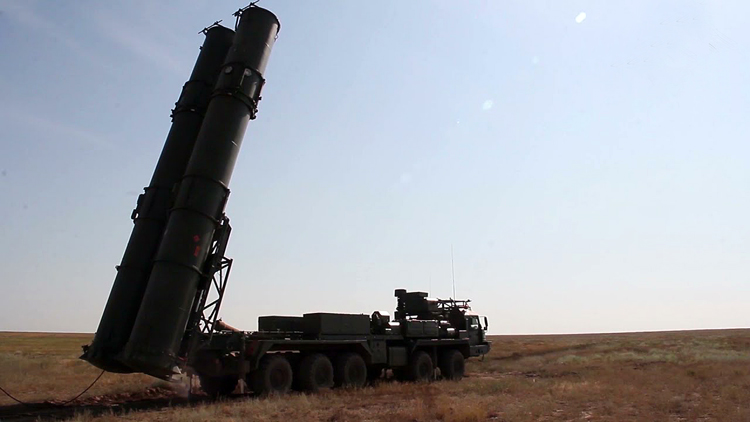
Indian media has quoted unconfirmed sources to say that the contract for 10 additional S-400 systems will be valued at $6.1 billion; a price increase of $0.67 billion since 2018.
Russia's S-500 Prometheus AD system has entered operational service, with the first regiment deployed in December 2025. It has a detection range of 800-km for airborne targets and interception range of 600-km, surpassing the S-400's 400 km limit. It can neutralise hypersonic missiles at Mach 7, ballistic threats, and even low-Earth orbit satellites; unrivalled compared to America's THAAD or Patriot AD systems. Each S-500 battery includes four specialised radars: the 91N6E(M) S-band for acquisition, 96L6-TsP C-band, 76T6 multimode, and 77T6 Yenisei for anti-ballistic engagements.
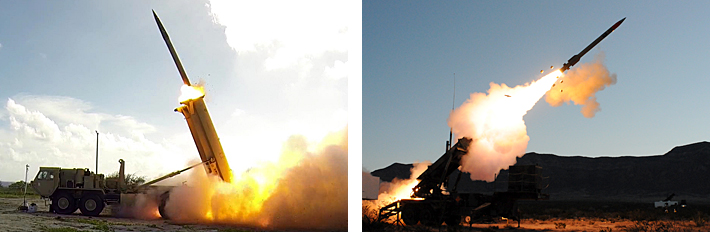
The S-500 integrates into Russia's layered network alongside S-400, S-350, and Pantsir units, enabling simultaneous tracking of multiple targets, including up to 10 ballistic or hypersonic ones at speeds of 7 km/s. AI-assisted elements aid target identification and interceptor selection, with a reaction time of 3-4 seconds. Russia claims the S-500 can counter fifth-generation stealth aircraft like the USAF F-22 Raptor and F-35 Lightning II.
Indian news reports also say that MoD is scheduled to begin formal discussions with Russia for procuring the S-500 long-range AD system, and that India is also considering the near-term procurement of 40 x Su-57 jet fighters to rapidly enhance combat capabilities of the Indian Air Force (IAF). The question here is the authenticity of these reports; since the trend in recent months, or rather years, has become of overloading the media with contradictory reports (by default or design) to keep readers guessing.
Russia's S-500 Prometheus AD system has entered operational service, with the first regiment deployed in December 2025
During Russian President Vladimir Putin's visit to India in December 2025 for the 23rd India-Russia Annual Summit, no India-Russia defence deal was announced – fearing sanctions by the Donald Trump administration. Then India proposed a $39–40 billion acquisition of 114 French Rafales under the MRFA programme despite escalating costs, phased deliveries, limited source code technology transfer detrimental to long-term strategic autonomy; compared to Russia offering full technology transfer of the Su-57E, as covered in these columns earlier (https://www.sps-aviation.com/experts-speak/?id=1051&h=Make-in-India-Rafale). The plan to procure 114 Rafale plus 40 x Su-57E appears doubtful.
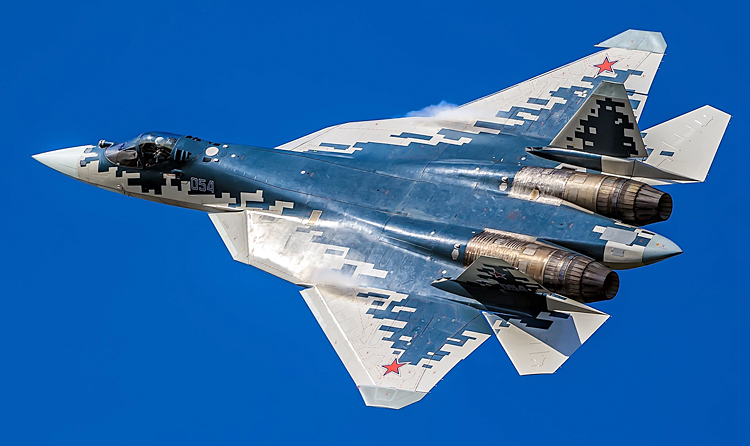
US Secretary of State Marco Rubio confirmed India stopped importing Russian oil in December 2025 after Trump threatened reintroducing 500 per cent tariffs. The US recently allowed a 30-day waiver to India for importing Russian oil, but it is at much higher price, with no discount, and to be paid in dollars. Trump has thanked India for the $300 billion investment by Reliance in America's first refinery in Texas but has immediately launched a fresh global tariff probe, which includes India. Under these circumstances, will India import 40 x Russian Su-57E?
Defence Research and Development Organisation (DRDO) has awarded a ₹80.28 crore contract for a high-precision optical system tailored for air defence applications
Coming to the additional 10 S-400 systems and discussions for the S-500, India received its first regiment of the S-400 contracted in October 2018 only in December 2021, and all have not been received to-date. While MoD is reportedly planning to procure 10 additional S-400 systems, when would the deal be signed and all systems received by when? Are we geared for a $6.1 billion deal with Russia, ignoring possible US sanctions? Why are we not going for the S-500, which gives a 699-km interception range, which Russia had already offered to India, including joint production?
Separately, the Defence Research and Development Organisation (DRDO) has awarded Paras Defence a ₹80.28 crore contract for a high-precision optical system tailored for air defence applications, according to news reports of March 9, 2026. The contract involves specialised development work on the optical system, critical for modern AD networks, to enable precise detection, tracking, and engagement of aerial threats. The execution timeline is set at 18 months from the date of the supply order, reflecting a structured approach to project delivery.
High-precision optical systems like the one under development are vital for air defence platforms such as the Akash missile system or emerging integrated AD networks. They incorporate advanced lenses, sensors, and stabilisers to function in harsh environments, providing real-time targeting data to command centres.