
The insightful articles, inspiring narrations and analytical perspectives presented by the Editorial Team, establish an alluring connect with the reader. My compliments and best wishes to SP Guide Publications.

"Over the past 60 years, the growth of SP Guide Publications has mirrored the rising stature of Indian Navy. Its well-researched and informative magazines on Defence and Aerospace sector have served to shape an educated opinion of our military personnel, policy makers and the public alike. I wish SP's Publication team continued success, fair winds and following seas in all future endeavour!"

Since, its inception in 1964, SP Guide Publications has consistently demonstrated commitment to high-quality journalism in the aerospace and defence sectors, earning a well-deserved reputation as Asia's largest media house in this domain. I wish SP Guide Publications continued success in its pursuit of excellence.
China is rapidly advancing a wide spectrum of next-generation military and strategic technologies, signalling a decisive push to dominate future warfare domains
 |
The Author is Former Director General of Information Systems and A Special Forces Veteran, Indian Army |

In March 2025, Chinese scientists tested a new type of bomb that doesn't use nuclear reactions but still creates a massive explosion with extreme heat. The 2-kg bomb produced a fireball over 1,000 degrees Celsius, hot enough to melt aluminium alloys, that lasted more than two seconds. This fireball duration is about 15 times longer than the explosion from an equivalent amount of TNT. Developed by the China State Shipbuilding Corporation's (CSSC) 705 Research Institute, a key player in underwater weapon systems, the device uses a magnesium-based solid-state hydrogen storage material.
Chinese scientists tested a new type of bomb that doesn't use nuclear reactions but still creates a massive explosion with extreme heat
The hydrogen bomb can cause extended thermal damage because the white-hot fireball it produces lasts much longer than TNT's fleeting 0.12-second flash. A series of experiments showed the weapon's directed energy potential. The bomb's peak shockwave pressure was about 40 per cent that of TNT, but its heat projection covered a much larger area. Chinese researchers see potential military use for destroying high-value targets over a wide zone. This hydrogen bomb could represent a new kind of powerful explosive with heat-focused impact, differing from traditional nuclear weapons; avoiding radiation but still delivering intense destruction through fire and blast effects.
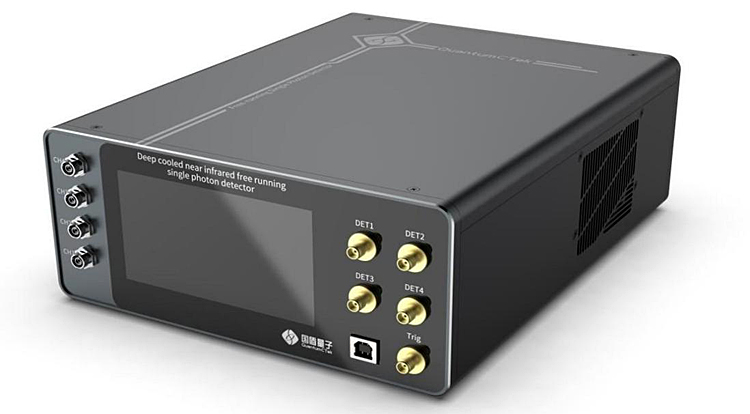
China is mass-producing the world's first ultra-sensitive quantum radar detector - 'Photon Catcher'. The device can detect individual photons, the smallest units of light, enabling spotting stealth aircraft that are normally invisible to conventional radar. The 'Photon Catcher' would give China a potential edge in monitoring advanced fighter jets. China's Science and Technology Daily reported on October 10, 2025 that 'Photon Catcher' is a breakthrough in quantum radar technology. American stealth jets like the F-22 rely on special coatings and airframe designs to absorb or deflect radar waves but Quantum radar operates differently. When stealth aircraft interact with photons emitted by the radar, the photons' original quantum properties change. By analysing the reflected photons' positions and states, quantum radar can effectively detect deception. The quantum radar could quickly detect IAF jets in future conflict.
China is mass-producing the world's first ultra-sensitive quantum radar detector - 'Photon Catcher'. The 'Photon Catcher' would give China a potential edge in monitoring advanced fighter jets.
China has also unveiled a revolutionary planetary defence radar prototype capable of tracking over 1,000 incoming missiles and space objects simultaneously. Using phased-array radar technology and AI-driven prediction systems, this machine can detect threats from thousands of km away, including ICBMs and even near-Earth asteroids. The system built to simulate Earth's future 'space shield', works with deep-space sensors to monitor high-speed objects moving at tens of thousands of km/h.
Chinese scientists revealed an unprecedented space-based power system prototype that achieves both high power and precision. Their device delivers 2.6 megawatts (MW) of pulsed power while maintaining pulse synchronisation accuracy of just 0.63 microseconds in ground tests. To synchronise 36 separate power modules all firing at once, the team used a central FPGA-based controller, a type of programmable chip excellent for real-time tasks, ensuring all units fire within 630 nanoseconds of each other. The result is a total output of 2.59MW in clean, square-wave pulses – ideal for driving particle accelerators, lasers and other advanced space-based systems. In addition to particle-beam weapons, this has non-military applications like lidar and laser communications and next-generation ion thrusters, revolutionising satellite manoeuvring and microwave remote sensing.
China has also unveiled a revolutionary planetary defence radar prototype capable of tracking over 1,000 incoming missiles and space objects simultaneously.
Concurrently, China has unveiled a next-generation tank equipped with AI-assisted targeting systems that can identify, track, and strike enemies beyond the line of sight; using advanced sensors, radar data, and satellite coordination, the system builds a real-time 3D battlefield map, allowing the tank to lock onto hidden or distant threats. The onboard AI processes data faster than a human crew could react, firing with near-perfect precision. Military analysts say this technology could redefine armoured warfare, turning tanks into autonomous combat platforms capable of fighting in digitally fused battle networks. This isn't just an upgrade; it's a shift toward the AI battlefield, where machines perceive more than the human eye ever could.
According to news reports of October 15, 2025, China has unveiled the design of a game-changing military aircraft that could outmatch the world's biggest airlift aircraft. The concept, at a pre-prototype stage, introduces a blended wing body (BWB) configuration and promises performance figures that could surpass both the US Air Force C-5 Galaxy, as well as the Russian AN-124; both designed to haul tanks, missiles, and personnel over vast distances. The aircraft is designed to carry up to 120 metric tons of cargo over a distance of 6,500 km without refuelling. Technical details released suggest an aircraft cruising at Mach 0.85, with a maximum take-off weight approaching 470 tonnes. The aircraft could significantly elevate China's ability to move troops and heavy equipment across oceans, without relying on allied staging points or foreign bases.
During China's Victory Parade on September 3, 2025, China unveiled its Dongfeng-5C(DF-5C) next-generation ICBM capable of striking any point on the planet.
The aircraft will include V-tail stabilizers, wingtip extensions for lift enhancement, wing-mounted engines that reduce wake turbulence and improve thrust efficiency, and can take off from semi-prepared 2,600-meters long runways. A future BWB variant could serve as a long-range tanker for supporting China's developing H-20 stealth bomber or its sixth-generation fighters. Chinese researchers are optimising for three mission-critical elements: fuel efficiency, cargo capacity, and take-off flexibility.

During China's Victory Parade on September 3, 2025, China unveiled its Dongfeng-5C(DF-5C) next-generation ICBM capable of striking any point on the planet. The introduction of the DF-5C, with its hypersonic speed, extended range and multiple warheads indicates a more assertive posture. The DF-5C was unveiled at a time when the US is upgrading its Minuteman-III missiles and Russia has deployed its RS-28 Sarmat Satan-II ICBM. The DF-5C ICBM can travel over 20,000-km. Its Multiple Independently targetable Re-entry Vehicle (MIRV) payload allows it to deliver up to 10 nuclear warheads simultaneously; striking multiple targets across different continents. The system includes next-generation guidance, combining inertial navigation, celestial correction, and Beidou satellite positioning. These enhancements make the DF-5C more accurate and less vulnerable to interception by conventional missile defence systems. The missile's capabilities have raised concerns that China is now exploring a "counterforce" strategy; targeting enemy military and nuclear infrastructure, not just retaliation.
China has unveiled a hyper-realistic, humanoid robot 'Elf V1', with lifelike skin and blinking eyes which can read your emotions in real time, as reported on October 16, 2025.
Albania appointing an artificial intelligence (AI) system named 'Diella' as a virtual cabinet-level minister was covered in these columns earlier. But in terms of humanoid robots, But China has unveiled a hyper-realistic, humanoid robot 'Elf V1', with lifelike skin and blinking eyes which can read your emotions in real time, as reported on October 16, 2025. With bionic skin, 30 facial muscle actuators, and synchronized eye and lip movements, it doesn't just resemble a human, it performs like one. China's push into humanoid robotics is part of a larger strategic investment in AI. A report by the Brookings Institution says China aims to become the world leader in AI by 2030.