
The insightful articles, inspiring narrations and analytical perspectives presented by the Editorial Team, establish an alluring connect with the reader. My compliments and best wishes to SP Guide Publications.
"Over the past 60 years, the growth of SP Guide Publications has mirrored the rising stature of Indian Navy. Its well-researched and informative magazines on Defence and Aerospace sector have served to shape an educated opinion of our military personnel, policy makers and the public alike. I wish SP's Publication team continued success, fair winds and following seas in all future endeavour!"

Since, its inception in 1964, SP Guide Publications has consistently demonstrated commitment to high-quality journalism in the aerospace and defence sectors, earning a well-deserved reputation as Asia's largest media house in this domain. I wish SP Guide Publications continued success in its pursuit of excellence.
With doubts over its practical application, India's 'Cold Start' doctrine in now evolving towards 'Cold Strike' as deterrence doctrines remain ineffective unless decisively executed
 |
The Author is Former Director General of Information Systems and A Special Forces Veteran, Indian Army |
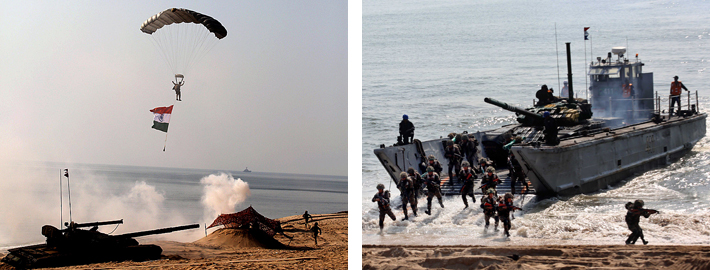
The 'Cold Start' doctrine was developed after India's Operation 'Parakram' in 2002 witnessed slow mobilisation of strike formations, whereas, the requirement was quick deployment of strike formations to achieve surprise and inflict damage before international pressure could mount. The new doctrine was a military strategy designed for rapid, limited conventional attacks into Pakistani territory after a major terrorist incident, aiming to use conventional superiority to achieve political goals without triggering Pakistan's nuclear weapons. The doctrine aimed to punish Pakistan and force it to stop supporting cross-border terrorism, with the captured territory used as a bargaining chip.
The 'Cold Start' doctrine was developed after India's Operation 'Parakram' in 2002 witnessed slow mobilisation of strike formations, whereas, the requirement was quick deployment of strike formations
Key aspects of the Cold Start doctrine included –
Significantly, Timothy J. Roemer, US Ambassador to India (2009-2011) has raised several questions about the actual application of India's Cold Start doctrine; India's willingness to pursue this option, including not to implementing the doctrine after the 2008 Mumbai terrorist attacks, all of which has now surfaced in a leaked cable. According to Roemer, India would likely encounter mixed results, the Cold Start is a mixture of myth and reality and that the value of the doctrine to the Indian government may lie more in the plan's existence than in any real-world application. Walter Ladwig, specialising in US foreign policy, opines that a host of factors, including the terrain, the favourable deployment of Pakistani forces, and a lack of strategic surprise in the most likely conflict scenarios, would mitigate whatever mobilisation advantages India may be gaining by its experimentation with Cold Start.
With the operationalisation of the new 'Rudra' Brigade, the Army reportedly plans to upgrade its Cold Start military doctrine to 'Cold Strike' Doctrine
Why India did not strike Pakistan after the 2008 Mumbai terrorist attacks remains a mystery. One viewpoint is that intelligence intercepts/analysis done during these attacks led Indian planners to believe this was a deliberate attempt by Lashkar-e-Taiba (LeT) to provoke an Indian military strike on Pakistan, in order to entice other Islamist Pakistani militant groups that were engaged in armed conflict with the Pakistani state to redirect their attacks away from the Pakistani state and unify against India. This assessment was later verified by interrogations and court testimony of David Headley (half Pakistani, half American terrorist) while in US custody. Was this intelligence assessment sane? For that matter, what led India's NSA to personally lead the so-called Pakistani investigation team to the IAF Base at Pathankot, which had been struck by Pakistani terrorists in January 2016?
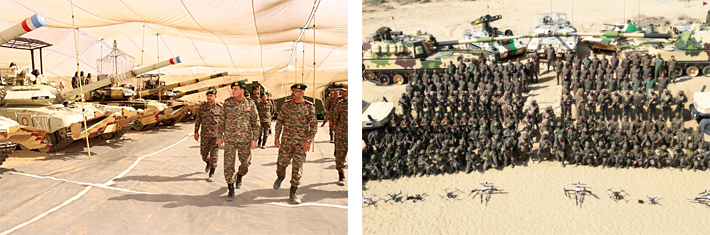
Over the years, India has been practicing the 'Cold Start' in various exercises. In November 2025, the Indian Armed Forces undertook the Tri Service Exercise 'Trishul'. The broader set of exercises involved Exercise 'Akhand Prahar' between the Indian Army and Air Force. During these exercises, the new 'Rudra' Brigade in the Konark Corps under Southern Command was operationally validated. With the operationalisation of these brigades, the Army reportedly plans to upgrade its Cold Start military doctrine to 'Cold Strike' Doctrine, as reported in the media.
Finally, any doctrine, whether Cold Start or Cold Strike can only deter adversaries when it is physically executed and its efficacy is acknowledged by the adversaries
Force projection and strike options are rehearsed by countries big and small, including China and Pakistan, individually, bilaterally and multilaterally. As for trans-border operations since 2014, India conducted Operation 'Hot Pursuit' deep inside Myanmar (2015), the 'URI surgical strike' in Pakistan (2016) and the stand-off Balakot airstrike (2019). These operations were in retaliation to the large number of casualties suffered by Indian security forces at the hands of Myanmar-based terrorists (in the first instance) and Pakistani terrorists in the latter two cases. In Operation 'Sindoor', our troops did not cross the border into POK/Pakistan. Heavy damage was inflicted on Pakistan, which it is yet to repair, but we also lost IAF jets on the first day for failing to target Pakistan's military assets.
It doesn't appear that Pakistan has learnt its lesson. 122 Pakistani terrorists are presently operating in J&K as per TV news of November 23, 2025. The Delhi and Nowgam blasts proved unambiguous Pakistani connection, but in the security meeting chaired by the Prime Minister, Pakistan was not named. We have said time and again that terror and talks can't go together. But we are talking to Bangladesh despite indications that massive amounts of RDX entered India through Bangladesh, follow up to Pakistani Army Chief Asim Munir having threatened earlier that India will be attacked from the East - through Bangladesh?
Finally, any doctrine, whether Cold Start or Cold Strike can only deter adversaries when it is physically executed and its efficacy is acknowledged by the adversaries. In absence of this, the doctrine remains a theory and nomenclatures don't impress a terrorist country like Pakistan. As of now, Pakistan doesn't seem to have been given the right lesson.