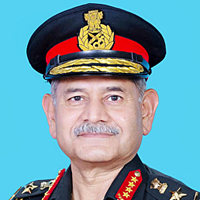
The insightful articles, inspiring narrations and analytical perspectives presented by the Editorial Team, establish an alluring connect with the reader. My compliments and best wishes to SP Guide Publications.
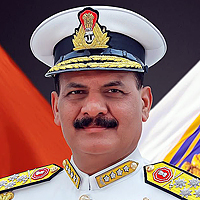
"Over the past 60 years, the growth of SP Guide Publications has mirrored the rising stature of Indian Navy. Its well-researched and informative magazines on Defence and Aerospace sector have served to shape an educated opinion of our military personnel, policy makers and the public alike. I wish SP's Publication team continued success, fair winds and following seas in all future endeavour!"

Since, its inception in 1964, SP Guide Publications has consistently demonstrated commitment to high-quality journalism in the aerospace and defence sectors, earning a well-deserved reputation as Asia's largest media house in this domain. I wish SP Guide Publications continued success in its pursuit of excellence.
The Indian Armed Forces, primarily through the Services Sports Control Board (SSCB) and institutions like the Army Sports Institute (ASI), have historically anchored India's multi-sport success, contributing to major CWG milestones since 1934.
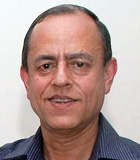 |
The Author is Former Director General of Information Systems and A Special Forces Veteran, Indian Army |
The name 'Commonwealth' is a misnomer considering the wealth the British looted during their rule, including $47 trillion from India. The Commonwealth, having 56 independent countries, needs to be renamed 'Common-Looted-Wealth'. As such, the abbreviation CWG denoting Commonwealth Games should be replaced with 'CLWG'.
India has been participating in the CWG from their very inception in 1934, where Rashid Anwar won India's first-ever CWG medal, clinching a Bronze in wrestling. Other major CWG milestones of India include: 1958 (Cardiff) – Indian Army's sprinter Milkha Singh won first Gold and Lila Ram won second Gold (wrestling). 1978 (Edmonton) - Ami Ghia and Kanwal Thakar Singh won first women Bronze (badminton); 2002 (Manchester)- Women's Team won Gold (hockey); 2010 (New Delhi) - India won 101 medals (39 Gold, 26 Silver, and 36 Bronze medals), finishing second overall; 2018 (Gold Coast) - Manika Batra first Indian woman to win an individual Gold (table tennis); 2022 (Birmingham) - Women's Fours team won Gold, while Sharath Kamal emerged most successful athlete 4 medals.
Despite the 2026 Glasgow CWG dropping nine major sports—including traditional military strongholds like shooting and wrestling—the Indian Armed Forces still spearheaded India's performance, helping secure fourth place on the medal table (39 total: 13 Gold, 17 Silver, 9 Bronze).
India's shooting star Jaspal Rana remains the most successful Indian athlete in CWG history, having won and incredible 15 medals: 9 Gold, 4 Silver and 2 Bronze medals.
Indian Armed Forces, primarily represented by the Services Sports Control Board (SSCB), have been a foundational pillar of India's sporting history, contributing to the Commonwealth Games (CWG) since India's debut in 1934. Through rigorous systematic training via the Army Sports Institute (ASI) and multiple nodal centres, Indian Military personnel have historically anchored India's multi-sport success, culminating in stellar historic milestones and record-breaking performances at the 2026 Glasgow Commonwealth Games.
In the CWG held in Gold Coast, Australia in 2018, where India finished third overall, winning 66 medals (26 Gold, 20 Silver, and 20 Bronze medals), the Indian Military won 13 individual medals; Indian Army 3 Gold, 3 Silver and 4 Bronze, and Indian Air Force 1 Silver and 2 Bronze medals.
In the CWG held in Birmingham in 2022, where India finished overall fourth, winning 61 medals (22 Gold, 18 Silver and 23 Bronze medals, the Indian Military won 13 individual medals - Indian Army 4 Gold, 1 Silver and 3 Bronze, Indian Navy 2 Gold medals, and Indian Air Force 2 Silver and 1 Bronze medal.
Comprising nearly 78.57 per cent of the national boxing squad, Indian Army athletes drove a historic 10-medal haul (7 Gold, 3 Silver), supported administratively by BFI Executive Director Colonel Arun Malik's restructuring of Indian boxing governance.
The 2026 Glasgow CWG was a highly streamlined scaled-down model; to reduce costs, nine major sports were axed from the programme. Crucially, this included Shooting and Wrestling - the two traditional strongholds of the Indian Armed Forces sports programmes. India finished fourth on the overall medal table, winning a total of 39 medals– 13 Gold, 17 Silver and 9 Bronze medals. Despite the removal of these core military sports, members of the Indian Armed Forces still left a massive mark, primarily dominating the Boxing ring and Para-Athletics.
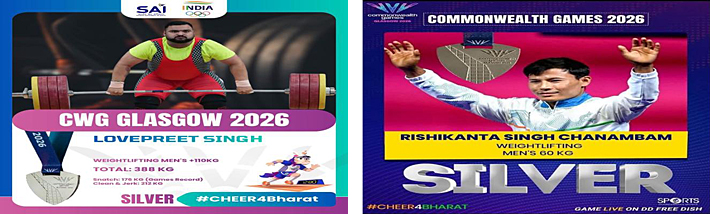
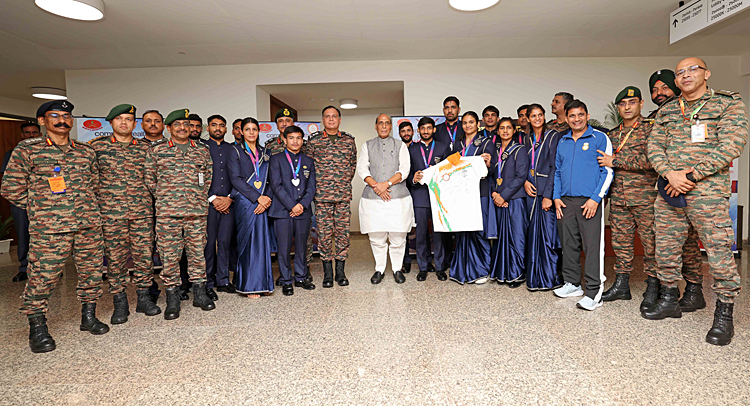
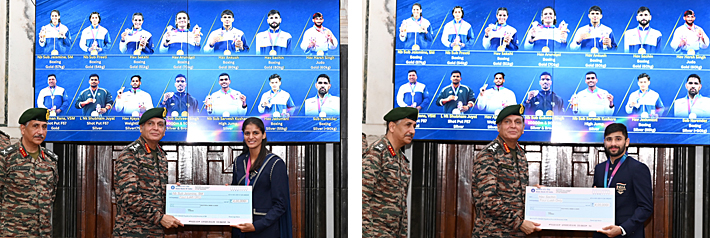
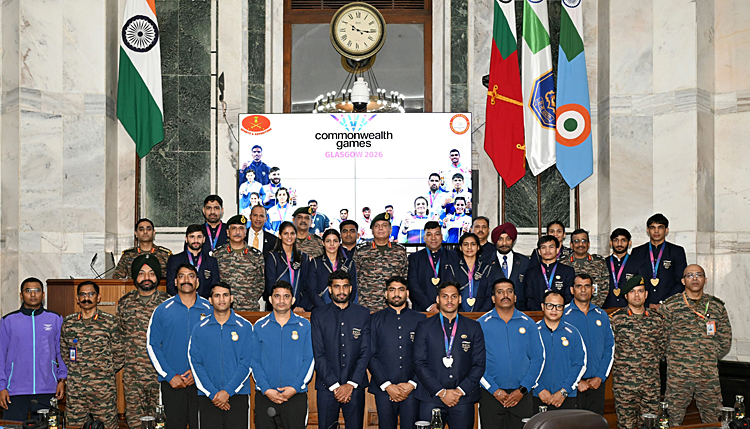
At Glasgow, Indian Armed Forces athletes spearheaded unprecedented podium sweeps, securing historic firsts across several disciplines. The military displayed absolute domination in boxing. The Indian Army formed nearly 78.57 per cent of the national boxing contingent, leading India to its best-ever boxing haul of 10 medals (7 Gold, 3 Silver). Women pugilists leading the charge included soldiers Sakshi Chaudhary, Arundhati Choudhary, Jaismine Lamboria, and Preeti Panwar achieving a flawless 100 per cent conversion rate, with all four clinching gold medals. The Army's long-distance runner Gulveer Singh became the first Indian ever to win a medal in the gruelling men's 10,000-meter event, tracking a brilliant final-lap sprint to take a historic Silver Medal (27:49.78). He followed it up with a Bronze in the 5,000m to become the first Indian to claim two distance running medals at a single edition. The Indian Army's para-athlete Soman Rana, a landmine blast survivor who suffered a below-knee amputation while deployed on the Line of Control (LoC) in 2006, won India's first-ever Gold medal in the Men's F57 Shot Put. Alongside training partner Shubham Juyal, he secured India's historic maiden one-two finish in the discipline.
Army athletes achieved landmark historic firsts: long-distance runner Gulveer Singh became the first Indian to win a 10,000m CWG medal (Silver) and two distance medals in a single edition, while LoC survivor Subedar Soman Rana won India's first-ever Gold in Men's F57 Shot Put.
Indian military medal winner included:
The credit for transforming India's boxing mainly goes to Colonel Arun Malik who has been serving for some four years as the Executive Director of the Boxing Federation of India (BFI). A Sword of Honour awardee before joining the Army (19 Guards), he commanded 12 Guards during his active military career and took premature retirement. He has completed four full Ironman races and six Half-Ironman) races; finishing the gruelling Ironman 70.3 Oman in 2019 with a time of 5 hours and 28 minutes.
As the Executive Director of the BFI, Malik has played a central role in restructuring India's boxing governance, transitioning the sport through international alignment, and managing high-stakes athlete policies. He spearheaded BFI's alignment with the new governing body, World Boxing, and in early 2025 was appointed by World Boxing to an elite six-member interim committee alongside BFI President Ajay Singh to stabilize administrative operations, manage bank accounts, and oversee domestic and international tournament selection.
In the 2026 CWG at Glasgow, Australian ranked first with 171 medals (70 Gold, 45 Silver and 56 Bronze medals), England ranked second with 110 medals (29 Gold, 45 Silver and 36 Bronze medals), Canada ranked third with 62 medals (19 Gold, 20 Silver and 23 Bronze medals), India ranked fourth with 39 medals (13 Gold, 17 Silver and 9 Bronze medals), while Scotland ranked fifth with 38 medals (13 Gold, 8 Silver and 17 Bronze medals). Scotland naturally had the advantage of being the host – same as India had in the 2010 CWG held at Delhi, winning 101 medals (39 Gold, 26 Silver, and 36 Bronze medals), of which the Indian Armed Forces won 25 medals (10 Gold and 15 Silver/Bronze medals).
To build on past achievements and target a 200-medal haul at the 2030 CWG in Ahmedabad, the Union Cabinet approved a ₹36,441 crore revamp of the 'Khelo India' scheme for 2026–2031.
At the same time, we need to acknowledge that India has won only 564 medals in CWG, while having a population over 1.4 billion (roughly 55% of the entire Commonwealth's combined 2.5 billion population) and is the third largest country in the Commonwealth by geographic size.
The Union Cabinet recently approved revamping 'Khelo India' scheme with a financial outlay of ₹36,441 crore from 2026–27 to 2030–31; including enhanced Assistance to National Sports Federations (ANSFs), creating new Emerging Khelo India Athletes (E-KIAs) category, launch of Khelo India Feeder Schools (KIFS) and Khelo India Utkrishta Vidyalayas (KIUV), unified digital platform, and establishment of National Coach Accreditation Board (NCAB).
Finally, execution of policies/schemes matter. Winning more medals is essential in line with India's stature, not just increasing participation. The 2030 CWG is to be held in Ahmedabad (India). It is not known whether the major sports excluded from CWG, including wrestling and shooting will be included in the 2030 CWG. But India must aim for a 200-medal haul; with India and the Indian Military continuing to strive for excellence.