
The insightful articles, inspiring narrations and analytical perspectives presented by the Editorial Team, establish an alluring connect with the reader. My compliments and best wishes to SP Guide Publications.
"Over the past 60 years, the growth of SP Guide Publications has mirrored the rising stature of Indian Navy. Its well-researched and informative magazines on Defence and Aerospace sector have served to shape an educated opinion of our military personnel, policy makers and the public alike. I wish SP's Publication team continued success, fair winds and following seas in all future endeavour!"

Since, its inception in 1964, SP Guide Publications has consistently demonstrated commitment to high-quality journalism in the aerospace and defence sectors, earning a well-deserved reputation as Asia's largest media house in this domain. I wish SP Guide Publications continued success in its pursuit of excellence.
India's continued dependence on foreign aero and marine engines highlights the urgent need for increased domestic R&D investment and need to develop self-reliant propulsion technologies
 |
The Author is Former Director General of Information Systems and A Special Forces Veteran, Indian Army |
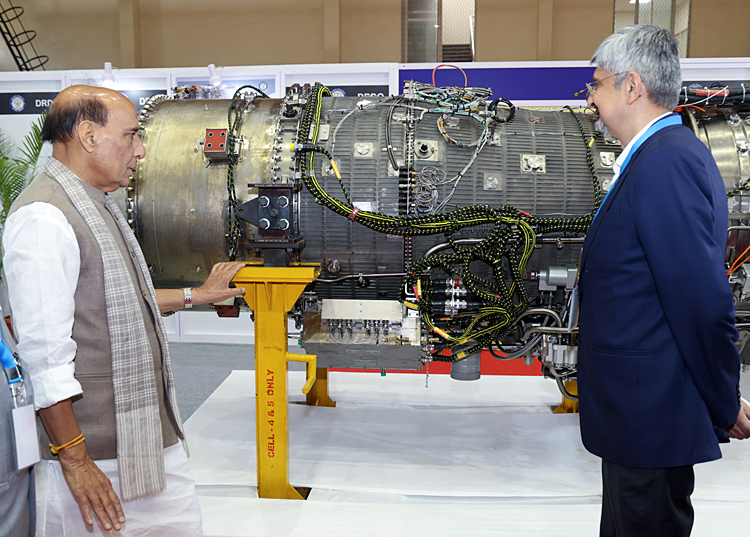
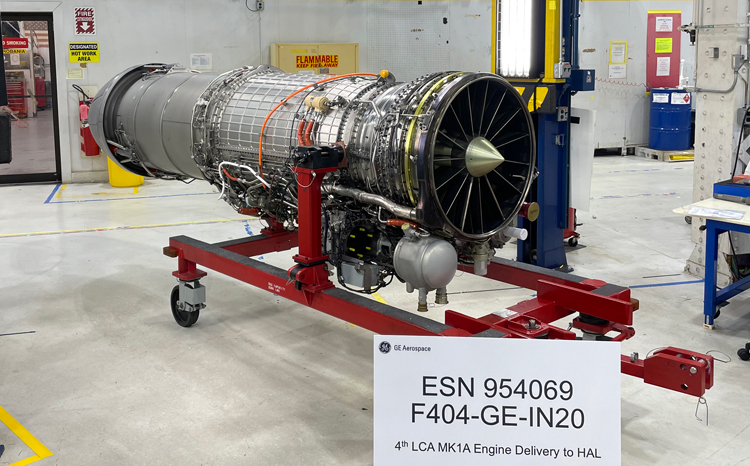
Hindustan Aeronautics Limited (HAL) has imposed contractual penalties on General Electric (GE) Aerospace for significant delays in supplying F404-IN20 engines for the Tejas Mk-1A fighter jet programme. The penalties have been invoked as part of the contract because only six of the 99 ordered engines have been delivered, resulting in a delay of over two years. HAL had ordered 99 F404-IN20 engines in 2021 for roughly $700 million to power the Tejas Mk1A jets, with deliveries scheduled to begin in 2024.
While 20 Tejas aircraft are ready, the lack of engines has stalled the delivery of jets to the Indian Air Force (IAF). GE has cited global supply chain bottlenecks and disruptions in its supply chain for the delays and has promised to ramp up production and deliver 20 more engines by the end of 2026. As a result, the induction of the first batch of Tejas Mk1A into the IAF is now expected in mid-2026 rather than the original 2024 target.
While 20 Tejas aircraft are ready, the lack of engines has stalled the delivery of jets to the Indian Air Force (IAF)
India's primary indigenous aircraft engine programme, the Kaveri (GTX-35VS), turbofan project developed by the DRDO's Gas Turbine Research Establishment (GTRE), has faced technical problems of power and thrust since the 1980s. Originally intended to power the LCA Tejas fighter, it failed to meet that target, However, it is now being developed to power unmanned combat aerial vehicles (UCAVs). As of now, the "dry" (non-afterburning) variant of the Kaveri engine, designed for stealth UCAVs, has received clearance for flight testing. Efforts are currently on to develop a high-thrust engine, with plans for a Kaveri 2.0.
At the same time, while India has made strides in domestic shipbuilding, weaponry, and system integration, its reliance on overseas suppliers for naval vessel propulsion remains a significant weak point. The country's shipyards have mastered the art of designing and constructing intricate warships locally, yet the absence of home-grown main propulsion units acts as a major operational hurdle. Resultantly, the Indian Navy has identified foreign marine engine dependency as a major hurdle for complete defence indigenisation.
While India has made strides in domestic shipbuilding, weaponry, and system integration, its reliance on overseas suppliers for naval vessel propulsion remains a significant weak point
The last decade has witnessed remarkable growth in India's maritime capabilities, highlighted by the local manufacturing of advanced submarines, frigates, destroyers, and even aircraft carriers. However, the core power plants, specifically marine diesel engines, gas turbines, and sophisticated integrated electric propulsion systems, are predominantly imported.
Indian Navy officials have been pointing out that relying on foreign Original Equipment Manufacturers (OEMs) for vital marine engines severely limits the nation's journey toward total self-sufficiency in the defence sectorin recent discussions with the Parliamentary Standing Committee on Defence (SCOD), according to one report. No doubt marine engines are highly incredibly complex and represent one of the most strictly regulated areas of military manufacturing, Therefore, these systems are bound by rigid export laws and a reluctance from foreign powers to share core technological know-how.
Relying on international vendors, like American and Ukrainian gas turbines, leaves the Indian Navy exposed to unpredictable supply chain disruptions
Relying on international vendors, like American and Ukrainian gas turbines, leaves the Indian Navy exposed to unpredictable supply chain disruptions and shifting geopolitical landscapes, highlighting the physical limits of current domestic production. Global conflicts, such as the ongoing war in Ukraine and the US-Israel war on Iran, can suddenly cut access to vital components, causing massive procurement delays. If crucial engines or their spare parts are unavailable during ship construction or routine refits, it directly degrades the fleet's timeline and overall combat readiness.
The Ministry of Defence (MoD) has initiated multiple targeted development efforts primarily channelled through the Make-1 Scheme and the Technology Development Fund (TDF), which are specifically engineered to fund and support ambitious, high-reward indigenous research and development (R&D) operations. This aligns with broader frameworks like the Indian Naval Indigenisation Plan (INIP) and the Swavlamban initiatives, which aim to transition India from a "buyer's navy" to a completely independent "builder's navy." The TDF mechanism is geared towards empowering smaller enterprises, private tech firms, and startups to pioneer specialised, niche maritime technologies that support the broader ecosystem. The DRDO and public sector units are pursuing indigenous alternatives, such as the Kaveri Marine Gas Turbine and high-power diesel engine frameworks, in collaboration with domestic industry.
India spends about 0.6-0.7 per cent of its GDP on R&D, compared to over 2.4 per cent by China and over 3.5 per cent by the US
Ironically, India spends about 0.6-0.7 per cent of its GDP on R&D, compared to over 2.4 per cent by China and over 3.5 per cent by the US. 2024-2025 data showed total R&D investment by India, China and the US was $17 billion. $496 billion and $886 billion respectively. This despite India being the 4th largest economy globally, and soon to become 3rd as mentioned by Prime Minister Narendra Modi. With roughly 26 per cent of global R&D output, Beijing enjoys an overwhelming edge in technological advancements and new age warfare.
A post on social media points out that the $8 billion deal for mounting Israeli radars on Tejas fighter jets was at the cost of what could have been done indigenously. Another post says, "Defence Minister Rajnath Singh wants to develop 5th & 6th gen aero-engines in 5-6 years. But he hasn't ordered a flying test bed in the last decade and stopped GTRE funding for the last 15 years. The difference between loud intent and loud mouth".
Securing domestic expertise in aero engines and marine propulsion is far more than an engineering milestone; it is an absolute strategic necessity. Mastering these technologies guarantees full lifecycle independence, ensuring uninterrupted access to necessary upgrades, routine maintenance, and critical spare parts on its own terms. Until true autonomy in engine production is achieved, India's most modern, indigenously constructed aircraft and warships will continue to be tethered to foreign dependencies.
Finally, India needs to redouble efforts for developing aero and marine engines, specifically to include the private sector, setting aside ₹-20-25 crore for developing each category of these engines.