
The insightful articles, inspiring narrations and analytical perspectives presented by the Editorial Team, establish an alluring connect with the reader. My compliments and best wishes to SP Guide Publications.

"Over the past 60 years, the growth of SP Guide Publications has mirrored the rising stature of Indian Navy. Its well-researched and informative magazines on Defence and Aerospace sector have served to shape an educated opinion of our military personnel, policy makers and the public alike. I wish SP's Publication team continued success, fair winds and following seas in all future endeavour!"

Since, its inception in 1964, SP Guide Publications has consistently demonstrated commitment to high-quality journalism in the aerospace and defence sectors, earning a well-deserved reputation as Asia's largest media house in this domain. I wish SP Guide Publications continued success in its pursuit of excellence.
As autonomous systems become central to modern warfare, a new generation of Indian start-ups is attempting to bridge critical capability gaps through advanced unmanned technologies
 |
The Author is Former Director General of Information Systems and A Special Forces Veteran, Indian Army |
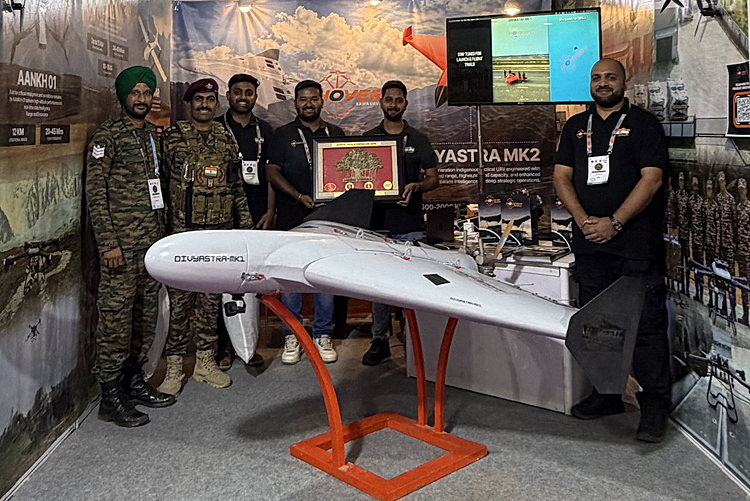
In the present era, where drones have emerged as a decisive weapon in modern conflicts—from Ukraine to West Asia—reshaping how armies think about warfare, the successful trial of Divyastra Mk-1 UAV on June 2, 2026, developed by the Lucknow-based defence startup HoverIt, has come as a major boost to India's indigenous defence technology and asymmetric warfare capabilities.
HoverIt demonstrated its tactical loitering munition (LM) platform, Divyastra Mk-1, which was witnessed by senior Indian Army officials in Jodhpur. The trial marks a milestone in India's push to build advanced unmanned combat systems without relying on foreign suppliers. According to HoverIt founder Saurav Singh Bhadauria, the demonstration marked an important milestone for the company's efforts to develop indigenous unmanned systems for the Indian Armed Forces.
Divyastra Mk-1 is an autonomous tactical unmanned aerial vehicle (UAV) designed for intelligence, surveillance and reconnaissance (ISR), decoy missions and precision strikes
Divyastra Mk-1 is an autonomous tactical unmanned aerial vehicle (UAV) designed for intelligence, surveillance and reconnaissance (ISR), decoy missions and precision strikes. The platform has an operational range of up to 500 kilometres and can remain airborne for up to five hours. It is capable of carrying mission-specific payloads and operating autonomously during missions. Bhadauria told the media that the ability to launch the drone from a mobile vehicle platform is particularly important in modern warfare, where mobility and survivability have become critical factors on the battlefield.
Earlier, on April 2, 2026, HoverIt conducted high-speed taxi trials of its Divyastra Mk-2 long-range loitering munition on the Ganga Expressway, signalling rapid progress in India's indigenous deep-strike UAV capabilities. These trials were conducted along the Ganga Expressway within the Uttar Pradesh Defence Industrial Corridor, underscoring the platform's transition from concept development towards flight-phase readiness. According to the company, the system achieved stable ground runs at speeds of approximately 145 km/h, validating airframe behaviour and control response under high-velocity conditions, an essential step before full flight trials.
High-speed taxi trials are a critical engineering milestone in fixed-wing unmanned aircraft development, enabling validation of:
In an industry environment where defence UAV programmes often take years to move from blueprint to prototype validation, the compressed development timeline of Divyastra Mk-2 reflects a growing shift among Indian private-sector drone manufacturers towards rapid prototyping and accelerated iteration cycles.
The Divyastra Mk-2 programme highlights a broader transformation underway in India's defence-drone sector
The Divyastra Mk-2 represents a major evolution from Divyastra Mk-1, HoverIt's earlier AI-enabled loitering munition platform. While the Mk-1 variant is has an operational range of around 500 km with swarm-enabled strike capability, the Mk-2 is being positioned as a deep-strike unmanned platform capable of engaging targets up to roughly 1,500–2,000 km away, significantly expanding its strategic reach beyond tactical battlefield roles. Open-source reporting also suggests the platform could support extended endurance missions in the eight to 12-hour class, enabling persistent surveillance-strike operations deep inside contested territory.
The Divyastra Mk-2, built within India's emerging defence startup ecosystem, is among an emerging category of long-range retractable strike UAV systems increasingly shaping modern warfare doctrine. HoverIt operates from the Lucknow node of the Uttar Pradesh Defence Industrial Corridor and functions under KAWA UAV Private Limited, focusing on mission-ready unmanned systems for defence and homeland-security applications. HoverIt's earlier systems, including Baaz payload drones and Raftaar fixed-wing VTOL platforms, have undergone tactical payload-delivery demonstrations and validation in high-altitude areas of Ladakh. The company is focusing on:
The Divyastra Mk-2 programme highlights a broader transformation underway in India's defence-drone sector. Traditionally dominated by long-cycle institutional programmes, the ecosystem is now witnessing startup-driven experimentation in long-range strike UAV architectures. Loitering munitions have emerged as one of the most disruptive classes of unmanned systems due to their:
India's increasing investment in indigenous loitering-munition platforms, including private-sector initiatives such as Divyastra, reflects the growing strategic importance of deep-strike UAV layers within modern force structures. According to a report in Reuters, India is set to purchase $2 billion worth of military drones (its biggest-ever procurement) from domestic industry in 2026, with deliveries scheduled over 18 to 24 months.
India is set to purchase $2 billion worth of military drones from domestic industry in 2026
TISA Aerospace (a subsidiary of Zen Technologies) recently unveiled its 'Anister' UAV, marking a significant step in India's indigenous loitering munition and surveillance drone capabilities. Anister is a next-generation system designed to deliver precision-strike capabilities with autonomous target tracking and engagement powered by AI-driven software. It can lock onto moving targets and execute strikes with high accuracy, while also aborting missions mid-flight, if required. It is equipped with surveillance and reconnaissance payloads, enabling real-time intelligence gathering, mapping and target acquisition. This dual capability makes it not only a weapon but also a force multiplier for commanders seeking situational awareness. The UAV is expected to be deployed for both tactical missions and strategic surveillance, supporting the Indian Army's growing demand for unmanned systems that can operate in contested environments.
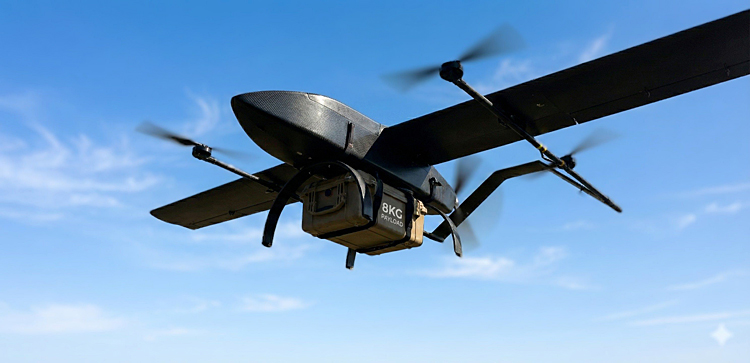
According to news reports dated June 4, 2026, Enercomp Solutions has introduced the HANS VTOL drone, capable of achieving a range of up to 250 km, making it suitable for extended missions that require endurance and reliability. Its payload capacity of 8 kg allows it to carry a variety of mission-critical equipment, from surveillance sensors to logistics supplies. Operating at altitudes of up to 5,000 metres above mean sea level, the drone is well suited for deployment in high-altitude regions where conventional aerial platforms often face limitations. Its cruise speed between 18 and 35 km/h, offers flexibility for both slow, detailed mapping operations and faster transit flights.
Anister is a next-generation system, designed to deliver precision strike capabilities with autonomous target tracking and engagement powered by AI-driven software
The drone's wingspan of 4.21 metres, combined with a carbon-composite body, provides structural strength while keeping weight optimised. The use of advanced composites not only enhances durability but also contributes to aerodynamic efficiency, ensuring stable flight even in challenging conditions. This makes it particularly effective for surveillance tasks, precision mapping of terrain, and the delivery of critical logistics in remote or contested areas. Its ability to combine agility with endurance ensures that it can support both civilian and defence applications.
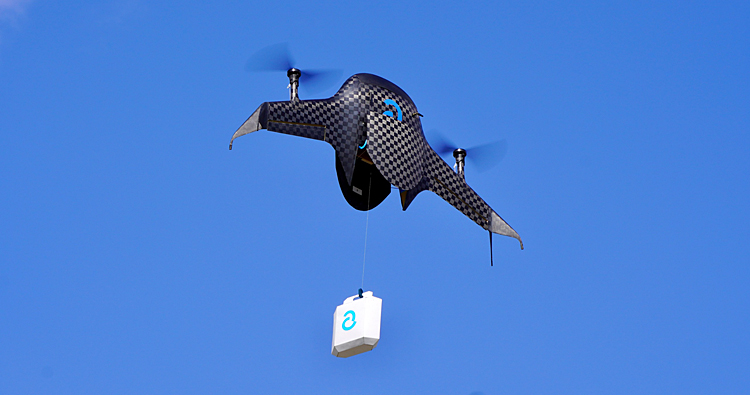
Concurrently, Bengaluru-based startup Airbound has unveiled a lightweight 2.5 kg hybrid drone, named 'TRT', which combines vertical take-off and landing (VTOL) capability with aeroplane-like forward flight. Designed for practical logistics in challenging environments, this compact platform can carry a 1 kg payload over a range of 40 km at a cruise speed of 60 km/h, making it ideal for last-mile delivery, defence applications and healthcare supply chains across India's diverse terrain.
The TRT has an advanced blended wing body architecture and proprietary carbon fibre composite construction
The drone can launch and land vertically almost anywhere, including remote areas without road connectivity, hilly regions and disaster zones. The TRT can service multiple sectors, including:
The TRT has an advanced blended-wing-body (BWB) architecture and proprietary carbon-fibre composite construction. This design achieves up to four times the aerodynamic efficiency of conventional drones, resulting in a remarkable drag ratio of 12. The lightweight yet extremely strong carbon-fibre airframe reduces energy consumption while enhancing structural durability and flight endurance. With a wingspan of 1.4 metres, the TRT remains compact and highly manoeuvrable.