

The insightful articles, inspiring narrations and analytical perspectives presented by the Editorial Team, establish an alluring connect with the reader. My compliments and best wishes to SP Guide Publications.

"Over the past 60 years, the growth of SP Guide Publications has mirrored the rising stature of Indian Navy. Its well-researched and informative magazines on Defence and Aerospace sector have served to shape an educated opinion of our military personnel, policy makers and the public alike. I wish SP's Publication team continued success, fair winds and following seas in all future endeavour!"

Since, its inception in 1964, SP Guide Publications has consistently demonstrated commitment to high-quality journalism in the aerospace and defence sectors, earning a well-deserved reputation as Asia's largest media house in this domain. I wish SP Guide Publications continued success in its pursuit of excellence.
The global UAV sector is rapidly shifting from passive reconnaissance to active combat roles, highlighted by indigenous air-to-air electronic jammers and low-cost, long-range gasoline strike drones, alongside international breakthroughs in extreme high-speed electric interceptor technologies.
 |
The Author is Former Director General of Information Systems and A Special Forces Veteran, Indian Army |
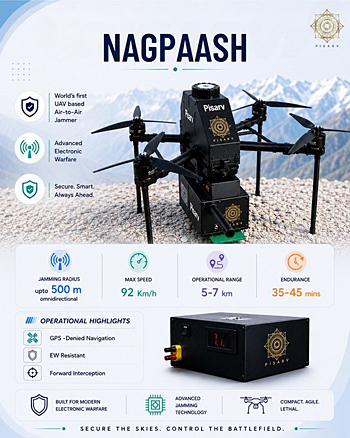
The 'Nagpaash' drone developed by the Indore-based Pisarv Technologies in Madhya Pradesh, has been recognised as the world's first UAV-based air-to-air electronic warfare jammer, according to news report of July 29, 2026. Pisarv Technologies is a new-age deep-tech company committed to building intelligent systems that protect, educate, and empower. The company has a strong foundation in aerospace, autonomous systems, and educational technology.
Nagpaash can achieve a top speed of 92 km/h, enabling it to manoeuvre quickly in tactical scenarios. Its operational range extends between five to seven km, providing sufficient coverage for frontline missions. With a flight endurance of 35-45 minutes, the UAV can sustain electronic warfare operations long enough to disrupt enemy activity during critical phases of battle. These specifications make it a compact yet highly effective system for short-duration, high-intensity engagements.
Pisarv Technologies developed 'Nagpaash,' recognised as the world's first UAV-based air-to-air electronic warfare jammer, featuring a top speed of 92 km/h, 35–45 minutes endurance, and an omni directional jamming radius of up to 500 meters.
The UAV has been engineered to operate effectively in GPS-denied environments, a critical feature given the increasing use of satellite navigation disruption in modern warfare. Its ability to navigate and function without reliance on GPS ensures resilience against electronic countermeasures and enhances survivability in hostile conditions. Unlike traditional ground-based jammers, Nagpaash can project its electronic attack directly into contested airspace, providing a mobile and flexible shield against adversary systems; which makes it particularly suitable for forward airspace interception missions, where reliability and autonomy are paramount.
Nagpaash is equipped with an omnidirectional jamming radius of up to 500 metres, allowing it to interfere with hostile signals across a wide area. This capability ensures that enemy drones, aircraft, and communication systems operating within its sphere are effectively neutralised. The system has been designed specifically for modern tactical battlefields, where the ability to disrupt adversary sensors and communications from the air is becoming increasingly vital. By integrating electronic warfare capabilities onto a UAV platform, Nagpaash represents a significant leap in India's indigenous defence technology development.
Designed specifically for tactical battlefields and forward airspace interception, Nagpaash operates effectively in GPS-denied environments without relying on satellite navigation, projecting mobile electronic attacks directly into contested airspace.
Introduction of Nagpaash marks a milestone in the evolution of UAV-based warfare. It demonstrates how unmanned systems can be transformed from passive reconnaissance platforms into active electronic attack assets. It not only strengthens India's tactical battlefield capabilities but also positions the country at the forefront of UAV-based electronic warfare globally.
In another innovative advancement, the Bhopal-based Rodella Aerospace has showcased its XG-2T, a petrol-powered kamikaze drone designed for long-range precision strike missions. With a 750 km range, five hours endurance, and a 20 kg warhead, it represents a cost-effective indigenous solution for one-way attack operations. The XG-2T drone carries a 20 kg warhead in its nosecone, making it suitable for precision strike missions against high-value targets. Its airframe, with a wingspan of two metres and an all-up weight (AUW) of 40 kg, is optimised for long-range terminal attack missions.
Rodella Aerospace showcased the XG-2T, a petrol-powered kamikaze drone costing ~₹20 lakh that carries a 20 kg warhead, offers a 750 km range with 5 hours endurance at 180 km/h, and aligns with the IAF's initiatives for cost-effective long-range strike systems
The XG-2T drone cruises at a speed of 180 km/h and can sustain flight for up to five hours, giving it an operational range of 750 km. This endurance profile allows it to penetrate deep into contested airspace and deliver its payload with accuracy. The cost of each unit is estimated at around ₹20 lakh, making it a relatively affordable option compared to imported systems.
The Indian Air Force (IAF) has recently launched initiatives to collaborate with domestic companies to design and produce kamikaze systems, ensuring self-reliance in defence production. Rodella Aerospace has positioned the XG-2T as part of India's growing ecosystem of indigenous unmanned aerial systems; aligned with the IAF's broader programmes to integrate long-range kamikaze drones into its arsenal, strengthening preparedness for drone-centric warfare.
The gasoline-engine XG-2T provides deep-strike strategic reach that complements short-range, electric tactical platforms (like Rodella's Firebird-E), enabling flexible deployment across both conventional and asymmetric warfare scenarios.
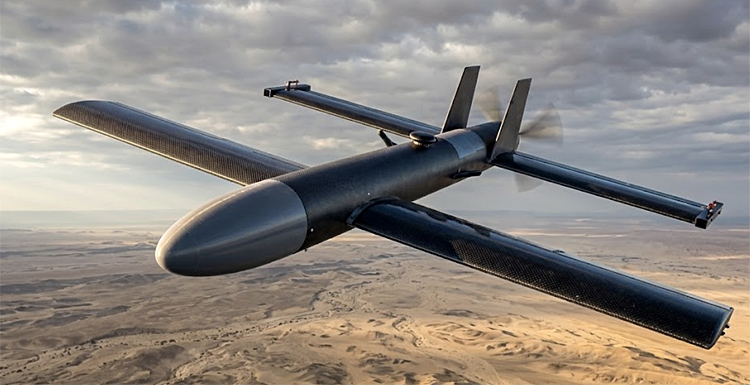
The XG-2T complements Rodella's portfolio of UAVs, which includes surveillance and tactical strike platforms such as the Firebird-E. While the Firebird-E is electrically powered and designed for shorter-range tactical missions, the XG-2T's petrol engine provides greater endurance and range, making it suitable for strategic deep-strike operations. The design reflects balancing cost-effectiveness and operational capability; relatively low production cost allowing deployment in larger numbers, while its endurance and payload capacity make it a credible threat in modern warfare scenarios. The drone's specifications suggest it could be deployed in both conventional and asymmetric warfare contexts, offering flexibility to commanders in the field. The system is expected to be integrated into India's evolving doctrine of unmanned combat operations, where kamikaze drones are increasingly seen as decisive assets.
In global UAV developments, German firm Quantum Systems' 'Apex Recordhunter' prototype achieved 699 km/h in level flight, setting a benchmark for battery-powered drones and demonstrating propulsion tech meant for future high-speed interceptor drones.
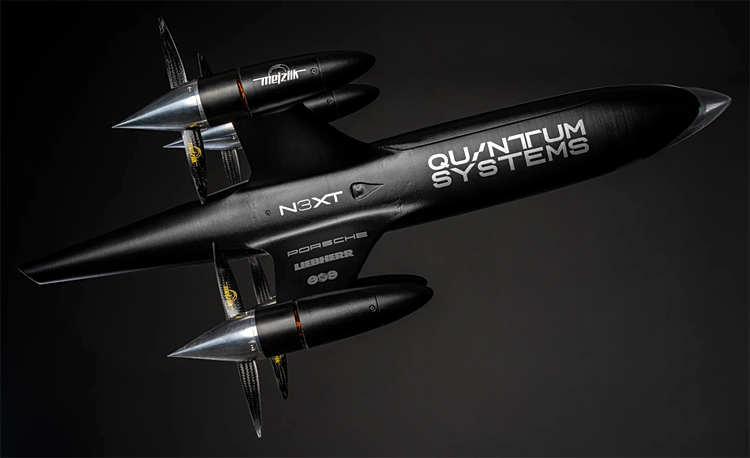
In news from abroad, a four-rotor electric drone (prototype named 'Apex Recordhunter') built by N3XT, the experimental arm of German company Quantum Systems, has reportedly reached 699 km/h in level flight, making it the fastest battery-powered drone ever recorded. The company claims the flight took place during an internal test on June 26, 2026 and that formal certification from Guinness World Records is still weeks away. The Apex Recordhunter has beaten the previous official record of roughly 657.59 km/h for an electric aircraft.
On a battlefield speed is vital; where seconds can decide who lives, it could be the difference between stopping an incoming attack drone and letting it reach its target. Quantum Systems plans to channel this technology straight into a new line of interceptor drones. According to the company, Apex Recordhunter itself is not a weapon. It's a technology demonstrator built by the same engineering team developing Quantum Systems' interceptor programme, and the two platforms share underlying know-how rather than hardware. The Apex project also shows just how far battery electric propulsion can be pushed when the goal isn't carrying passengers but squeezing every bit of performance out of aerodynamics and materials.