

The insightful articles, inspiring narrations and analytical perspectives presented by the Editorial Team, establish an alluring connect with the reader. My compliments and best wishes to SP Guide Publications.

"Over the past 60 years, the growth of SP Guide Publications has mirrored the rising stature of Indian Navy. Its well-researched and informative magazines on Defence and Aerospace sector have served to shape an educated opinion of our military personnel, policy makers and the public alike. I wish SP's Publication team continued success, fair winds and following seas in all future endeavour!"

Since, its inception in 1964, SP Guide Publications has consistently demonstrated commitment to high-quality journalism in the aerospace and defence sectors, earning a well-deserved reputation as Asia's largest media house in this domain. I wish SP Guide Publications continued success in its pursuit of excellence.
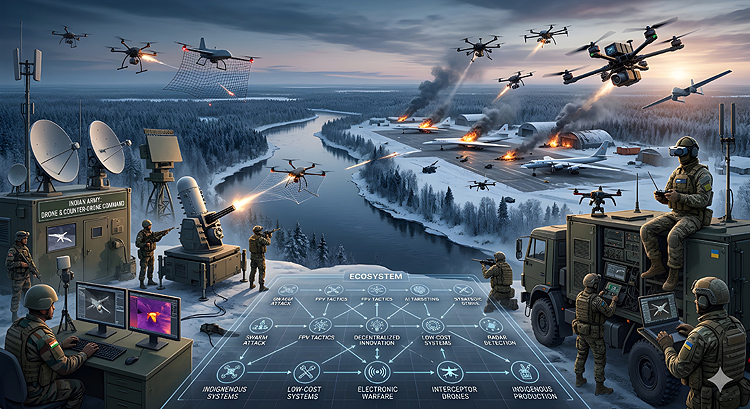
There is a need for the military as a whole to absorb all the lessons and evolve a drone eco system for the future, as well as a drone-cum-counter drone strategy that suits the battle area
 |
The Author is Former Director General of Information Systems and A Special Forces Veteran, Indian Army |
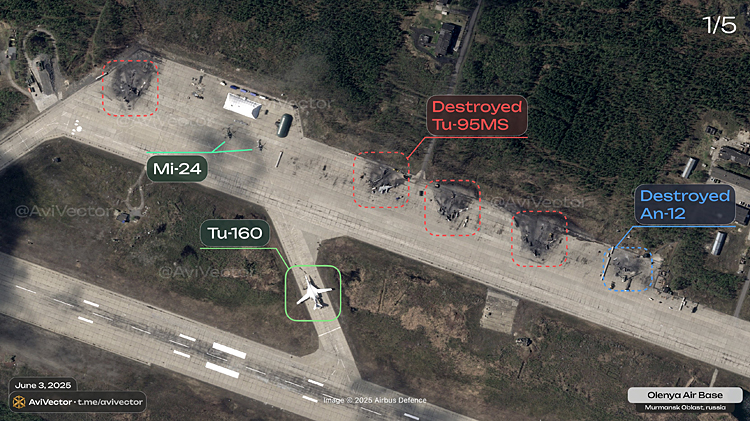
On June 1, 2025, Ukraine executed Operation 'Spider's Web', an audacious coordinated drone attack using hidden, remotely launched drones that damaged some 40 Russian aircraft at multiple airbases, including Olenya and Belaya, significantly impacting Russian strategic aviation. According to a report in The Moscow Times on June 12, 2025, Russia relocated dozens of its strategic bombers to more remote airbases across the country in the wake of this month's sweeping Ukrainian drone assault on Moscow's military aircraft.
The report quoted Ukrainian President Volodymyr Zelensky saying this was their longest-range operation ever that targeted multiple airbases deep inside Russia, including in the Murmansk, Irkutsk, Ryazan and Ivanovo regions. Satellite imagery analysed by the OSINT research group AviVector shows that all Tu-160 bombers previously stationed at the Belaya airbase in Irkutsk and the Olenya airbase in Murmansk had vacated their positions by early June. Two of those bombers were redeployed to Anadyr in the Chukotka region, three to Yelizovo in the Kamchatka region and another three to the Borisoglebskoye airbase in the Republic of Tatarstan. Tu-22M3 and Tu-95MS aircraft were also relocated from Murmansk to bases in Tatarstan and the Amur and Saratov regions, as well as to Mozdok in the republic of North Ossetia — a facility that had not been actively used by the Russian military in recent years.
Airbases, with stores of fuel, munitions and parked aircraft, have plenty of high-value targets. And they are currently wide open to small drones
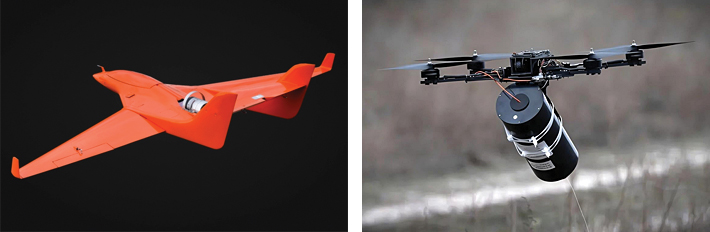
Operation 'Spider's Web'showed how vulnerable airbases are to attacks by small drones. The Security Services of Ukraine (SBU) smuggled FPV drones into Russia in concealed compartments in trucks driven by unsuspecting Russian drivers to locations outside five Russian airbases. First-person view (FPV), also known as remote-person view (RPV), or video piloting, is a method used to control a remote-controlled vehicle from the driver or pilot's viewpoint. Most commonly it is used to pilot a radio-controlled aircraft or other type of unmanned aerial vehicle (UAV) such as a military drone. The operator gets a first-person perspective from an onboard camera that feeds video to FPV goggles or a monitor. Drone warfare is continuing in the Ukraine war from both sides.
However, a new chapter in drone operations has emerged in the ongoing US-Israel war on Iran. A recent viral video shows an FPV drone attack on the US Victory Airbase outside Baghdad; in which, the drone flies around for two minutes to survey the base before slamming into a building. The attack in the video did minimal damage, but the operator could fly around unopposed with no sign of defensive fire or other interference. If the next one finds an occupied hangar, a parked aircraft or a stack of munitions, the result will likely be very different. The IRGC drone attack served as a wakeup call in the Gulf region for protecting airbases against small drones. FPV drones have long-range and can search for targets and carry out precise strikes. Airbases, with stores of fuel, munitions and parked aircraft, have plenty of high-value targets. And they are currently wide open to small drones.
But while large drones can be stopped by a layered defence of radar, air patrols, missiles and short-range systems, FPV drones are much harder to spot especially if they are flying at extremely low level
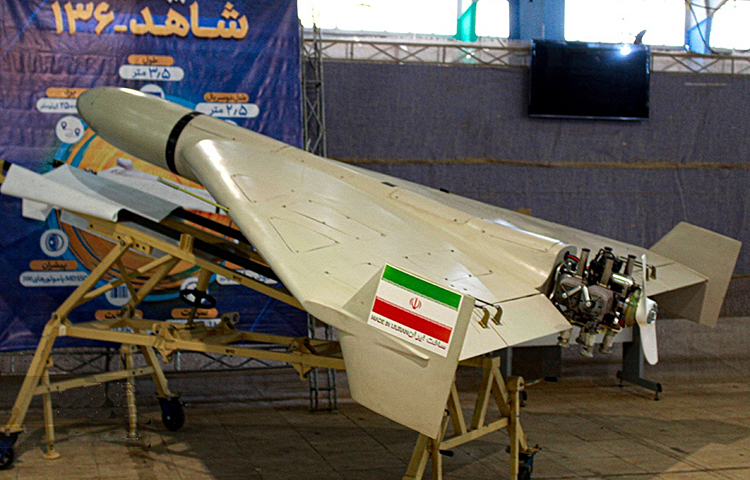
Iran has been hitting targets with its 2,000-km range 'Shahed' drones. But while large drones can be stopped by a layered defence of radar, air patrols, missiles and short-range systems, FPV drones are much harder to spot especially if they are flying at extremely low level. Most radar cannot easily tell a small drone from a bird. Acoustic sensors may help, but in the noisy environs of an airbase the buzz of a drone may be swamped by jet engines. Also, while radio-controlled drones may be picked up by their transmission, fiber drones are radio silent. Fiber FPV attacks will require specialist radar and cameras or thermal imagers with AI specifically trained to pick up the signatures of quadcopters and sift them out from background clutter. Defensive measures, whether interceptor drones, computer-controlled machine guns or other systems, will stop drones attacking in small numbers. Even security forces on the ground with shotguns might do some good. But mass attacks from different directions will continue to remain challenging.
Drone strikes and counter- strikes in the middle east are eye openers. According to the CSIS, 71 per cent of strikes by Iran in the first week were by drones, the UAE itself faced 1,422 drone attacks and 246 missiles. Precision swarm drone attacks are now possible by many small nations. Where a 'Shahed' drone costs $35,000, a Patriot missile interceptor costs $4 million. This has led to a new military architecture that optimises cheap autonomous systems, AI-assisted targeting, commercial satellite imagery, resilient communications, integrated sensors, and cyber tools all operating together in a compressed time, to surprise the enemy and deny any chance of recovery.
While radio-controlled drones may be picked up by their transmission, fiber drones are radio silent. Fiber FPV attacks will require specialist radar and cameras or thermal imagers with AI specifically trained to pick up the signatures
Pakistan is also learning this lesson with low-cost drone attacks by the Taliban hitting deep inside Pakistan, raising new fears about escalation and vulnerability. Such drone attacks are reaching deeper into Pakistan, hitting sensitive areas and raising alarm. Officials call them rudimentary, but analysts warn their impact could far exceed their sophistication. What do these low-cost drones reveal about Pakistan's vulnerabilities, and what comes next as the country's tensions with Afghanistan continue to grow!
It was covered in these columns on February 13, 2026, during a press conference ahead of Army Day 2026, the Army Chief General Upendra Dwivedi signalled a paradigm shift in military aviation and indigenous manufacturing, saying that the Army plans large-scale production-cum-deployments of long-range combat drones across all Military Commands. He outlined an ambitious "decentralised innovation" model; each of the Army's operational commands has been empowered to manufacture or induct approximately 5,000 unmanned aerial systems (UAS) - creating a vast, distributed arsenal tailored specifically to local threat perceptions and geographical realities.
Army Chief General Upendra Dwivedi signalled a paradigm shift in military aviation and indigenous manufacturing, saying that the Army plans large-scale production-cum-deployments of long-range combat drones across all Military Commands
Clarifying the nature of these platforms, the Army Chief emphasised that the focus is strictly on military-grade combat systems. The new fleet includes long-range tactical strike drones and loitering munitions capable of operating deep within contested airspace. According to recent reports, the Army has successfully test-fired indigenous drones with strike ranges exceeding 100-km. And, the induction of Berkut-BM drones underscores the Indian Army's evolving focus on fast, expendable platforms capable of neutralising high-value targets deep within enemy territory.
However, looking at Ukraine and the US-Israel war on Iran, plus and developments in the Middle East, there is a need for the military as a whole to absorb all the lessons and evolve a drone eco system for the future, as well as a drone-cum-counter drone strategy that suits the battle area of up to a divisional sector or in offensive; taking into account: how drones are affecting tactical operations; what kind of drones and how these should be used in defence, attack and for deep offensives; the scale of drones, including reserves, that need to be maintained at all times and infrastructure required to produce these indigenously.
Currently, both the Army and the Indian Air Force (IAF) are going in for long range drones, in addition to the artillery developing weapons up to 300 km-range or above. The IAF considers long-range strike platforms should be assigned and operated by them. There is an obvious need for coordinating acquisition of these platforms by all the three services, in order to avoid duplication. The urgency for evolving a pan-military drone ecosystem and a drone-cum-counter drone strategy is need of the hour.