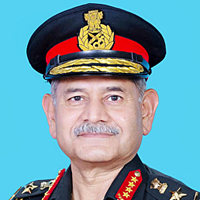
The insightful articles, inspiring narrations and analytical perspectives presented by the Editorial Team, establish an alluring connect with the reader. My compliments and best wishes to SP Guide Publications.
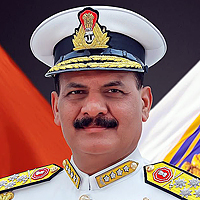
"Over the past 60 years, the growth of SP Guide Publications has mirrored the rising stature of Indian Navy. Its well-researched and informative magazines on Defence and Aerospace sector have served to shape an educated opinion of our military personnel, policy makers and the public alike. I wish SP's Publication team continued success, fair winds and following seas in all future endeavour!"

Since, its inception in 1964, SP Guide Publications has consistently demonstrated commitment to high-quality journalism in the aerospace and defence sectors, earning a well-deserved reputation as Asia's largest media house in this domain. I wish SP Guide Publications continued success in its pursuit of excellence.
The government is integrating private sector players into space research. Public funds will strategically support this expansion, broaden the horizons of Indian space endeavours and foster innovation through public-private synergy.
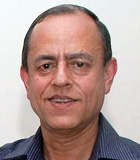 |
The Author is Former Director General of Information Systems and A Special Forces Veteran, Indian Army |
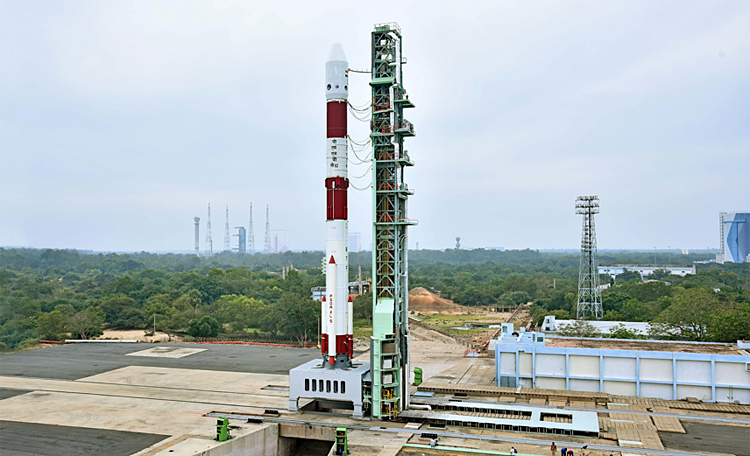
The January 12, 2026 launch by the Indian Space Research Organization (ISRO) with its Polar Satellite Launch Vehicle — PSLV C62 mission was unsuccessful. The primary load of the mission was the advanced hyper spectral earth observation satellite EOS-N1 to boost India's surveillance powers from space. PSLV-C62 was meant to be a comeback flight after the setback of PSLV-C61 in May 2025, when the PSLV's third stage malfunction led to the loss of the rocket and the EOS-09 radar imaging satellite meant to enhance India's day and night, all-weather space-based surveillance. The PSLV-C61 mission was the rocket's third failure in 63 flights. ISRO's Failure Analysis Committee (FAC) report of the May 2025 PSLV-C61 failure and the FAC report pertaining to the failure of the NVS-02 strategic satellite in January 2025 were not made public — was the government hiding something by not making these FAC reports public?
The Bhartiya Antariksha Station (BAS) is expected to be launched by 2028
There has been speculation about possible sabotage in the PSLV launches — that could be external (with China closely monitoring India's space launches and the US undermining India's growth?) and internal. The suspicion grew with NSA Ajit Doval detailed to look into the failures. Then there was the case of Nishant Agarwal, a BrahMos Aerospace employee, arrested in 2018 for passing sensitive missile information to Pakistan's intelligence agency (ISI), sentenced to life imprisonment in 2024, although acquitted recently after a prolonged legal battle.
For that matter, hindrances in space launches are not new. NASA had delayed its Artemis II crewed moon mission for a second time, pushing the planned March 2026 launch to early April 2026 following a technical issue with the Space Launch System (SLS) rocket's helium system. The rocket returned to the launch pad for final tests after repairs, marking the second time it has moved from the assembly building to Pad 39B.
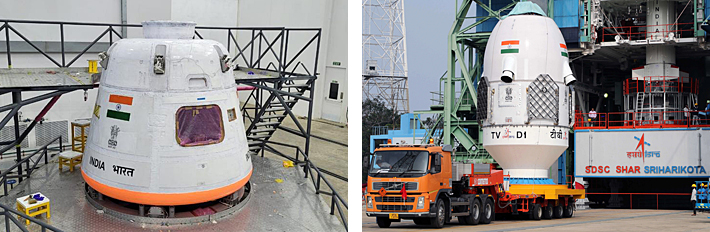
As reported in these columns earlier, ISRO's 2026 missions include: PSLV TDS; HLVM3 Gaganyaan-1 (G1) Uncrewed Orbital Test Flight; Gaganyaan TV-D2 Test Vehicle Abort Mission-2; GSLV IDRSS1 (CMS-04); HLVM3 Gaganyaan-2 (G-2) Uncrewed Orbital Test Flight-2; HLVM3 Gaganyaan-3 (G3) Uncrewed Orbital Test Flight. ISRO's HLVM3 Gaganyaan-4 (H1) "Crewed Test Flight" is scheduled in 2027. The Bhartiya Antariksha Station (BAS) is expected to be launched by 2028.
India is set to allocate ₹1,500 crore for its ambitious first Venus mission, named Shukrayaan-1
Now according to news reports of March 7, 2026, India is set to allocate ₹1,500 crore for its ambitious first Venus mission, named Shukrayaan-1, aimed at probing the atmosphere of Shukra Graha (Venus) and its historical influence on Earth over millennia. Nilesh Desai, Director of ISRO, shared these details during an interaction with a media delegation from Jammu and Kashmir (J&K) on March 6 at Ahmedabad. Earlier, some Members of Parliament raised concerns over the substantial outlay, citing Venus's hostile environment dominated by gases such as helium and carbon dioxide. ISRO has said that understanding Venus's impact on Earth and studying the planet is essential. At Ahmedabad, Desai highlighted Venus's unique characteristics: it rotates far more slowly than Earth, with one day there equivalent to 243 Earth days. Its atmosphere features thick clouds of carbon dioxide and sulphuric acid, posing significant challenges for study. Desai also noted that the space research budget, previously just 1.5 per cent of India's total national expenditure, has risen to 2.5 per cent, reflecting heightened recognition of its strategic value. He compared this to leading space faring nations like the US, China, and Japan, which devote larger shares of their budgets to such endeavours. He also urged elevating space allocation to 5-7 per cent, or even 10 per cent, to remain competitive.
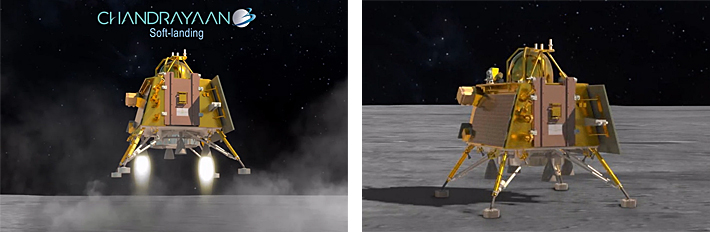
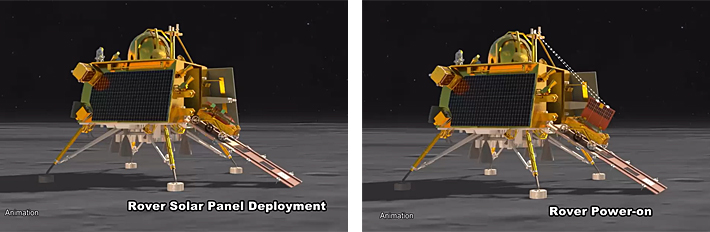
ISRO's collaborations extend to international partners, notably NASA on select initiatives, alongside engagements with other countries, amplifying India's role in global space research. Desai also discussed the forthcoming Mars mission, emphasising that landing on the Red Planet is simpler than on the Moon due to Mars's relatively flat terrain, in contrast to the Moon's vast craters. He recounted challenges from Chandrayaan-2 and Chandrayaan-3, particularly the Vikram lander's touchdown at the lunar south pole amid temperatures plummeting to nearly -200°C, which temporarily disabled several instruments. Engineers exerted considerable effort to restore functionality. The Mars venture, an unmanned endeavour targeting the solar system's second-smallest planet—known for its iron oxide-rich surface—will dispatch an orbiter, lander, and rover. The journey from Earth will span at least ten months, with scientists already advancing preparations.
ISRO's collaborations extend to international partners, notably NASA on select initiatives, alongside engagements with other countries, amplifying India's role in global space research
The government is emulating the US model by integrating private sector players into space research. New space regulations have been established, and a dedicated Space Regulatory Authority is in formation. Public funds will strategically support this expansion, broaden the horizons of Indian space endeavours and foster innovation through public-private synergy.
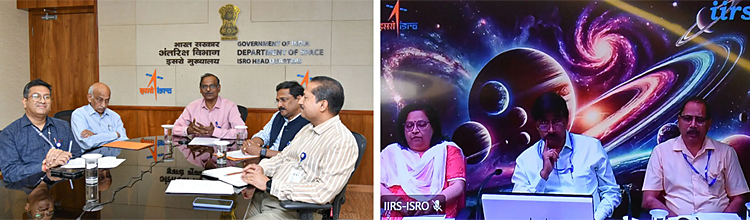
In another news report of March 12, 2026, ISRO Chairman V. Narayanan announced that Chandrayaan-4 will aim to collect lunar samples and return them to Earth, marking a new milestone in India's exploration of the Moon. Following this, Chandrayaan-5 will feature a heavier lander and a mission life extended to around 100 days, compared to the 14-day lifespan of Chandrayaan-3. The rover too will be substantially larger, weighing 350-kg compared to the 25-kg rover used previously. Narayanan highlighted that Chandrayaan-3's success in 2023, which made India the first nation to achieve a soft landing near the Moon's south pole, has paved the way for these ambitious missions. That mission yielded discoveries including the identification of eight minerals, seismic activity measurements, and insights into the Moon's thermal profile and electron clouds. These achievements have strengthened India's position in global lunar research.
New space regulations have been established, and a dedicated Space Regulatory Authority is in formation
Narayanan also noted India's progress in space technology, citing advancements in satellite optics and payload development. He pointed out that India has already completed 10 scientific missions, including AstroSat, which continues to function successfully after a decade in orbit. He emphasised that India now has the capability to design, build, and launch its own vehicles and satellites, a remarkable transformation from its modest beginnings. India's START 2026 programme aims to inspire young minds to pursue careers in science and technology, ensuring the next generation contributes to the nation's progress. India's space programme is not only about exploration but also about ensuring food security, water security, communication, and safety for its citizens.
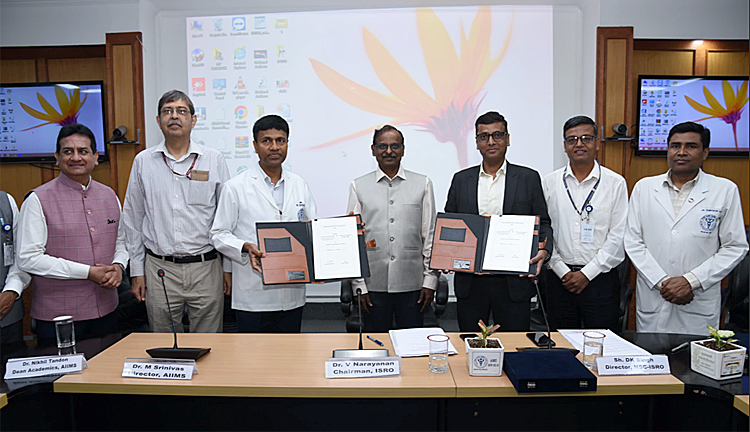
Concurrently, All India Institute of Medical Sciences (AIIMS) and ISRO signed a Memorandum of Understanding (MoU) on March 9, 2026, to propel research in space medicine, with direct implications for the Gaganyaan programme and future manned missions; uniting medical expertise with space technology, addressing the physiological challenges of microgravity. This collaboration establishes a robust framework for both ground-based and space-based investigations into space medicine. Key focus areas include: human physiology; cardiovascular and autonomic regulation; musculoskeletal health under microgravity conditions; microbiome and immunology; genomics and biomarkers; behavioural health. These domains are critical for safeguarding astronaut well-being during extended space exposure.