
The insightful articles, inspiring narrations and analytical perspectives presented by the Editorial Team, establish an alluring connect with the reader. My compliments and best wishes to SP Guide Publications.

"Over the past 60 years, the growth of SP Guide Publications has mirrored the rising stature of Indian Navy. Its well-researched and informative magazines on Defence and Aerospace sector have served to shape an educated opinion of our military personnel, policy makers and the public alike. I wish SP's Publication team continued success, fair winds and following seas in all future endeavour!"

Since, its inception in 1964, SP Guide Publications has consistently demonstrated commitment to high-quality journalism in the aerospace and defence sectors, earning a well-deserved reputation as Asia's largest media house in this domain. I wish SP Guide Publications continued success in its pursuit of excellence.
ISRO successfully launched EOS-05, India's first geosynchronous imaging satellite providing continuous real-time monitoring for disaster management, agriculture, and national security
 |
The Author is Former Director General of Information Systems and A Special Forces Veteran, Indian Army |
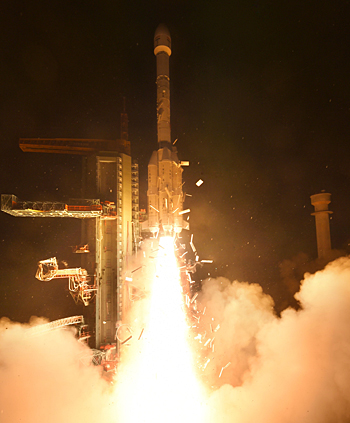
On September 4, 2026, ISRO achieved a historic milestone with the successful launch of EOS-05, India's first ever imaging satellite in geosynchronous orbit. The mission was carried out from Sriharikota in Andhra Pradesh in the early hours of September 4, using the GSLV-F17 rocket. The satellite, weighing over 2,300 kg, was placed into a precise sub-geosynchronous transfer orbit just 18 minutes after lift-off, marking ISRO's maiden success of the year. ISRO's launch of India's first imaging satellite will help keep a permanent eye on its border from 36,000 km away.
The launch followed a smooth 27-hour countdown beginning at 11:30 PM on September 2. At exactly 2:55 AM, the 51.7-metre-tall, three-stage GSLV rocket, with its cryogenic upper stage, lifted off with a mass of 420.5 tonnes. Despite rain and the odd hour, large crowds gathered at the Satish Dhawan Space Centre to witness the event, many carrying umbrellas to cheer the mission.
The expected apogee of EOS-05, India's first ever imaging satellite in geosynchronous orbit, was 28,934 km, but the cryogenic third stage delivered an apogee of 31,026 km, exceeding projections by 2,092 km
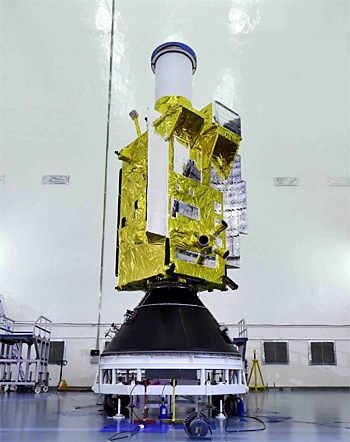
This achievement is significant because most Earth observation satellites operate from low Earth orbit. EOS-05, however, will hover at an altitude of nearly 36,000 km, matching Earth's rotational speed. This positioning allows the satellite to provide continuous real-time imagery of the same region, a capability that is crucial for agriculture, disaster management, and national security. In fact, ISRO's GSLV-F17 rocket has outperformed expectations, placing EOS-05 into a higher-than-planned orbit. The GSLV-F17 mission was designed to place EOS-05 into a Sub-Geosynchronous Transfer Orbit. The expected apogee was 28,934 km, but the cryogenic third stage delivered an apogee of 31,026 km, exceeding projections by 2,092 km. This achievement is significant because EOS-05, weighing 2,367 kg, is heavier than the 2,250 kg maximum payload GSLV can deliver to a standard Geostationary Transfer Orbit.
This improved performance means the satellite will conserve fuel during orbit-raising, likely extending its mission life beyond the planned seven years. Senior scientists described the satellite as "the eye in the sky," highlighting its strategic importance. The mission was a morale booster for ISRO, which had faced setbacks in recent years.
EOS-05, weighing 2,367 kg, is heavier than the 2,250 kg maximum payload GSLV can deliver to a standard Geostationary Transfer Orbit
ISRO Chief V. Narayanan expressed his delight, announcing that the GSLV-F17 vehicle had successfully and precisely injected the advanced EOS-05 satellite into the required orbit. He noted that this was the 107th launch from Sriharikota and the 19th mission of the GSLV series. He recalled that the first GSLV launch carried a payload of 1,536 kg, and since then, ISRO has steadily improved the rocket's performance by optimising structural mass and enhancing propulsion systems.
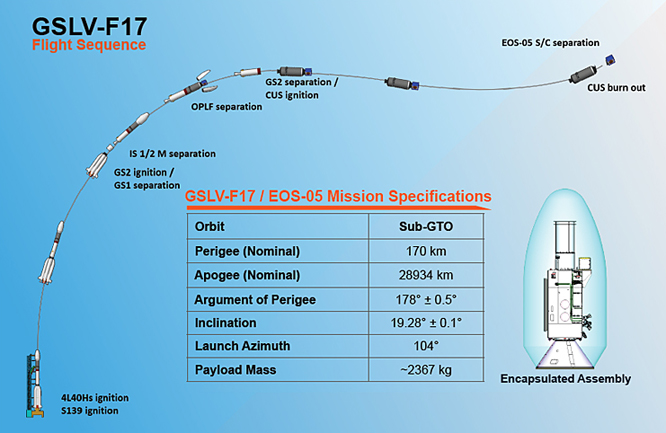
Once operational, EOS-05 will become India's first dedicated imaging satellite from the geo-orbit, providing strategic data for national activities. Satellite telemetry confirmed that all systems were functioning perfectly, with solar panels deployed and the satellite's health reported as stable. Orbit-raising manoeuvres will soon elevate the satellite to its final geosynchronous position, ensuring uninterrupted imaging capabilities.
Mission Director Thomas Kurien emphasised that EOS-05 is uniquely configured for near real-time imaging and is the heaviest satellite ever launched by GSLV into a GTO or sub-GTO orbit. Project Director Imteyaz Ahamad described it as a complex satellite with multi-band operating capabilities, making it one of a kind in terms of configuration and content.
This positioning allows the satellite to provide continuous real-time imagery of the same region, a capability that is crucial for agriculture, disaster management, and national security
The EOS-05 mission is seen as a replacement for the unsuccessful GSLV-F10/EOS-03 mission of 2021, which was aborted due to a cryogenic stage anomaly. The success of EOS-05 marks a redemption for ISRO, restoring confidence in its launch program. It also comes after a gap of nearly eight months, following the failure of PSLV-C62 in January 2026, which was unable to place 16 satellites into orbit due to a third-stage anomaly.
According to Press Trust of India, the mission also carried a spiritual dimension, as ISRO Chairman V. Narayanan had visited the Tirumala Tirupati temple days earlier to pray for its success. The culmination of teamwork between ISRO and its industrial partners has now delivered a satellite that will serve India's strategic and civilian needs for years to come.
EOS-05 is India's first imaging satellite designed to operate from geosynchronous orbit. Ideally, such satellites are launched into an elliptical 170 × 35,786 km Geostationary Transfer Orbit. From there, they use onboard propulsion to raise the perigee and circularise into a Geostationary Orbit at 35,786 km altitude. However, due to the payload mass exceeding GSLV's GTO capacity, ISRO opted for a burn-to-depletion strategy, exhausting all cryogenic propellant to send the satellite as far as possible. The higher apogee achieved means EOS-05 will now require less of its own propellant to reach geosynchronous orbit. This conservation of fuel is critical because the remaining propellant will be available for station-keeping and attitude control once the satellite is operational.
By saving fuel during orbit-raising, EOS-05 is expected to extend its mission life beyond the planned seven years
Station-Keeping ensures the satellite remains fixed relative to Earth's rotation, while attitude control maintains its orientation for imaging and communication. By saving fuel during orbit-raising, EOS-05 is expected to extend its mission life beyond the planned seven years. This extended operational period will enhance India's ability to conduct continuous Earth observation, disaster monitoring, cyclone tracking, flood assessment, forest fire detection, agricultural planning, and environmental studies. It will also provide persistent monitoring over strategically important regions.
EOS-05 is the heaviest satellite ever launched by GSLV into a Sub-GTO orbit, demonstrating the improved performance of India's indigenous cryogenic stage. The rocket's lift-off mass was 420.5 tonnes, and this was its 19th flight. The success boosts confidence in India's ability to place heavier payloads into geosynchronous orbit, a capability crucial for advanced communication, meteorology, and strategic surveillance. EOS-05's successful injection into a higher orbit also highlights ISRO's engineering refinements. The cryogenic stage has evolved significantly since its early flights, now capable of delivering payloads beyond its nominal design limits. This achievement strengthens India's position in space technology and enhances its strategic autonomy in Earth observation.