

The insightful articles, inspiring narrations and analytical perspectives presented by the Editorial Team, establish an alluring connect with the reader. My compliments and best wishes to SP Guide Publications.

"Over the past 60 years, the growth of SP Guide Publications has mirrored the rising stature of Indian Navy. Its well-researched and informative magazines on Defence and Aerospace sector have served to shape an educated opinion of our military personnel, policy makers and the public alike. I wish SP's Publication team continued success, fair winds and following seas in all future endeavour!"

Since, its inception in 1964, SP Guide Publications has consistently demonstrated commitment to high-quality journalism in the aerospace and defence sectors, earning a well-deserved reputation as Asia's largest media house in this domain. I wish SP Guide Publications continued success in its pursuit of excellence.
India is advancing indigenous nuclear fusion through superconducting tokamak research, private-sector innovation and a proposed fusion-fission hybrid leveraging thorium reserves, potentially positioning India as a significant future player in fusion energy
 |
The Author is Former Director General of Information Systems and A Special Forces Veteran, Indian Army |
India's journey for an indigenous 'artificial sun' (read nuclear fusion technology) is accelerating from academic research to an aggressive roadmap for domestic clean energy. Beyond China, France, and India, only a selective group of technologically sophisticated nations possess active superconducting Tokamaks or advanced fusion ignition devices, including the US, South Korea, Japan in partnership with EU, the UK, and Russia. China's primary artificial sun, the Experimental Advanced Superconducting Tokamak (EAST), achieved its first operational plasma way back in 2006. Another major, larger device, the HL-2M (and its successor HL-3) Tokamak was officially turned on in December 2020.
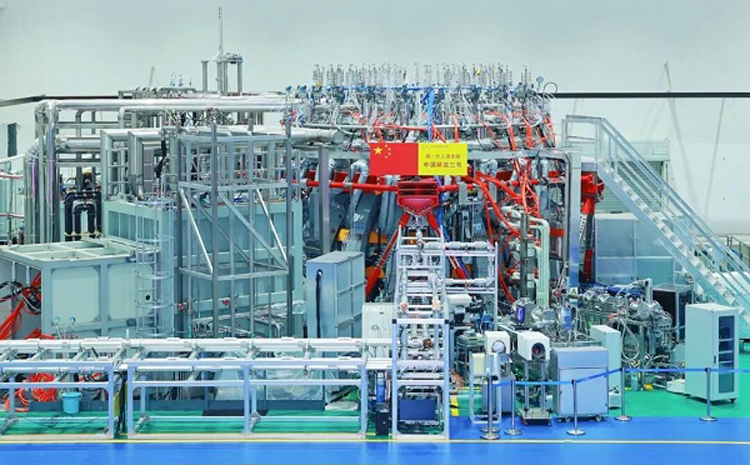
China is aggressively expanding its fusion portfolio: in final stages of building the Burning Plasma Experimental Superconducting Tokamak (BEST) in Hefei, scheduled for assembly completion by 2027; plans first experimental fusion electricity by 2030; finalised designs for China Fusion Engineering Test Reactor (CFETR) outputting up to 2 gigawatts thermal power by 2035; established China Fusion Energy Inc. to fast-track commercial deployment of multiple fusion systems.
India reached a massive technological breakthrough by successfully installing an advanced 82.6 GHz, 400-kilowatt Gyrotron system
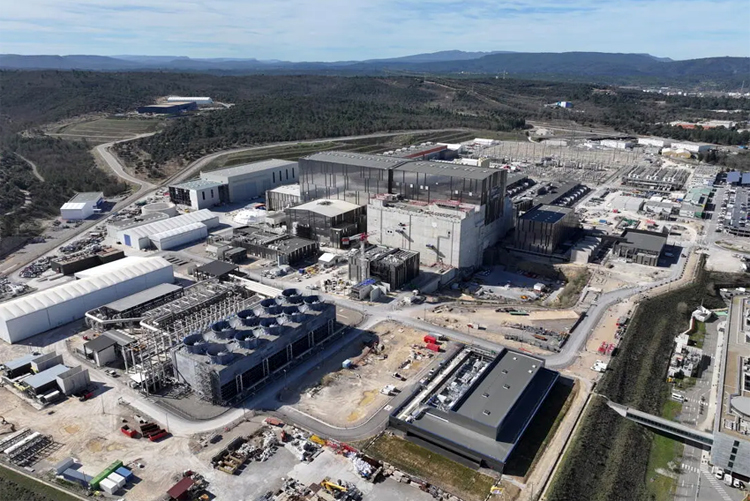
The International Thermonuclear Experimental Reactor (ITER), actively under construction in Cadarache, southern France, is a mega-consortium of 35 nations (including China, the US, the EU, India, Russia, Japan, and South Korea), designed to act as the world's largest magnetic confinement plasma physics experiment (Tokamak reactor) to prove the scientific and technological feasibility of fusion power as a commercial energy source. China actively participates in ITER, funding about 9 per cent of it and delivering critical components like the reactor's massive magnet feeder system.
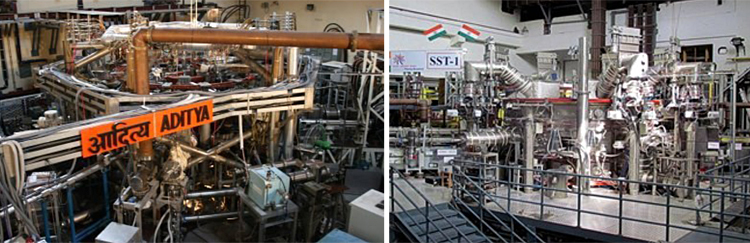
India's ambitions for an artificial sun have surged dramatically with major technical milestones. India's fusion journey began in 1989 with the operationalisation of the 'ADITYA' Tokamak. Over the decades, India has established its flagship machine, the Steady State Superconducting Tokamak-1 (SST-1), at the Institute for Plasma Research (IPR) in Gandhinagar, Gujarat.
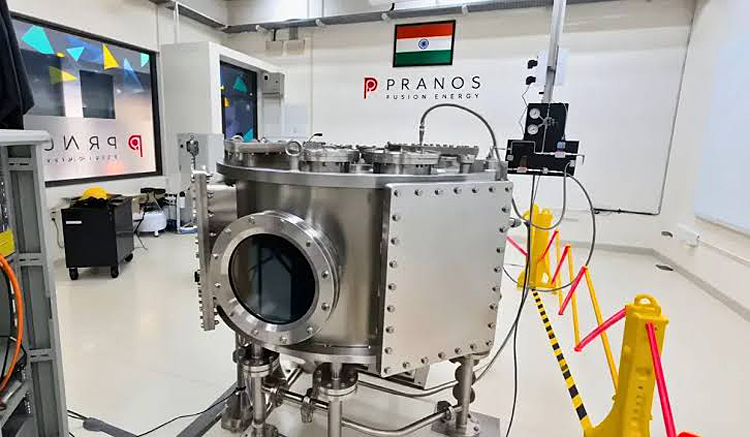
SST-1 is a medium-sized superconducting tokamak structured to confine gas and replicate stellar physics, generating strong magnetic fields to encapsulate and suspend superheated plasma. India reached a massive technological breakthrough by successfully installing an advanced 82.6 GHz, 400-kilowatt Gyrotron system. This critical component beams intense microwave energy into the reactor to superheat and keep the plasma stable at star-level temperatures. Alongside state projects, a Bengaluru-based deep-tech startup 'Pranaos Fusion' developed 'Pragya', a privately constructed compact tokamak acting as a commercial prototype testbed.
In September 2026, they unveiled 'Pragya', India's first privately developed compact tokamak
India is accelerating the timeline to achieve commercial fusion through two completely distinct, highly strategic vectors: a hyper-nimble private sector software and hardware push and a sovereign fusion-fission hybrid model designed to unlock the country's massive thorium reserves. Historically, India's fusion development has been a state-monopolised enterprise. However, recent policy updates under the SHANTI Act explicitly removed the state monopoly, legalising and creating a deliberate runway for private aerospace and deep-tech firms to design and deploy nuclear reactors.
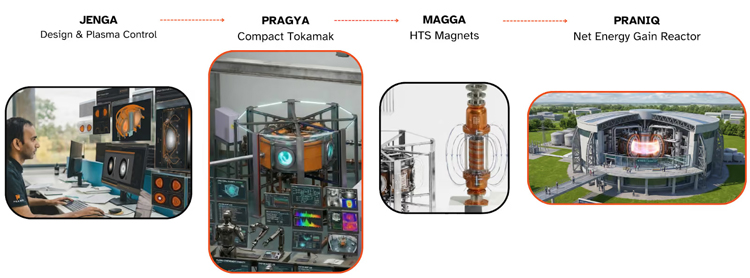
The torchbearer of this private push is Pranos Fusion, a deep-tech startup based in Bengaluru. In September 2026, they unveiled 'Pragya', India's first privately developed compact tokamak. Unlike the massive, doughnut-shaped conventional tokamaks used by ITER or China's EAST, Pragya is built as a low-aspect-ratio 'spherical' tokamak (shaped more like a cored apple). This design inherently handles higher plasma pressure relative to its magnetic field strength, allowing for a much more compact, cost-efficient, and rapid build cycle.
They created 'Jenga', a specialised digital twin software platform that runs predictive AI models on plasma control, and Magga, a proprietary High-Temperature Superconducting (HTS) magnet programme slated for full operation by 2027
Instead of aiming directly for power generation out of the gate, Pranos is using Pragya as a hyper-frequent testbed. It is engineered to fire 10 to 12 plasma pulses every single day (roughly 3,000 runs a year) to gather vast operational data on plasma behaviour, sensor responses, and high-vacuum dynamics. Pranos isn't just trying to beat global superpowers on raw reactor scaling; they are building the critical gaps in the global ecosystem. They created 'Jenga', a specialised digital twin software platform that runs predictive AI models on plasma control, and Magga, a proprietary High-Temperature Superconducting (HTS) magnet programme slated for full operation by 2027. While state-led demonstration reactors take decades, Pranos aims to use the data gleaned from PRAGYA to deploy PraniQ by 2030 - a next-generation reactor built specifically to hit net energy gain.
In pure fission, a reactor must maintain a highly dangerous critical mass of fuel to keep a chain reaction self-sustaining. In India's hybrid concept, the fusion reactor acts strictly as an external neutron gun firing neutrons into a surrounding blanket of non-fissile Thorium-232. The moment the fusion reactor is turned off, the entire process safely halts instantly; there is no physical mechanism for a runaway meltdown. When the thorium blanket is struck by the high-energy neutrons coming off the fusion core, the thorium atoms transmute into Uranium-233. This Uranium-233 can then be extracted and used to power India's vast network of commercial Advanced Heavy Water Fission.
India's hybrid approach doesn't require the fusion core to be 100 per cent perfect or continuous; even intermittent pulses from a fusion reactor are enough to generate the neutrons needed to breed thorium, radically
Pure fusion requires a reactor to hold onto plasma seamlessly for days to maintain grid power; a physics nightmare that global scientists are still trying to solve. India's hybrid approach doesn't require the fusion core to be 100 per cent perfect or continuous; even intermittent pulses from a fusion reactor are enough to generate the neutrons needed to breed thorium, radically. The core contrast in vectors is as under:
Finally, with its vast reserves of Thorium and hybrid approach towards nuclear fusion technology, India is set to be a leading power in establishing artificial suns.