
The insightful articles, inspiring narrations and analytical perspectives presented by the Editorial Team, establish an alluring connect with the reader. My compliments and best wishes to SP Guide Publications.
"Over the past 60 years, the growth of SP Guide Publications has mirrored the rising stature of Indian Navy. Its well-researched and informative magazines on Defence and Aerospace sector have served to shape an educated opinion of our military personnel, policy makers and the public alike. I wish SP's Publication team continued success, fair winds and following seas in all future endeavour!"

Since, its inception in 1964, SP Guide Publications has consistently demonstrated commitment to high-quality journalism in the aerospace and defence sectors, earning a well-deserved reputation as Asia's largest media house in this domain. I wish SP Guide Publications continued success in its pursuit of excellence.
Iran's unrest arise not only from internal governance failures but from prolonged blockades, sanctions and geopolitical rivalry, while escalating US-Iran tensions and regional proxy dynamics risk igniting a wider Middle East conflict
 |
The Author is former Chief of Staff of a frontline Corps in the North East and a former helicopter pilot. He earlier headed the China & neighbourhood desk at the Defence Intelligence Agency. He retired in July 2020 and held the appointment of Addl DG Information Systems at Army HQ. |
I have always been interested in the Middle East, specifically since 2001 when I went to Lebanon to work with the United Nations as the Chief Humanitarian Officer of the UNIFIL. A combustible mix of Sunni, Shia and Maronite Christians, Lebanon is the only nation in the Middle East with a Christian head of state with a Sunni Prime Minister and a Shia Speaker of the Parliament and thus provides a valuable window to understand the complexities of the region. Travelling the countryside for various reconstruction works such as building schools, hospitals, resourcing community libraries and such other assistance like providing generators and help in demining, provided opportunity to interact with Mayors and Governors drawn from all the three faiths and see communities at close quarters.
The US led western narrative would have us believe that an incompetent Hamas regime in Gaza is solely responsible for this despair as much as an oppressive theocratic Iranian regime is solely responsible for the tragic economic mismanagement in Iran
Lebanon was the place where I got my first close view of Iran. Hezbollah, patronised by Iran, is the dominant force in South Lebanon where UNIFIL was deployed. Hezbollah had claimed, somewhat rightly, that Israel withdrew from South Lebanon after occupying it since 1978 because of the unrelenting pressure of attrition from Hezbollah. This was one Iranian venture that was spectacularly successful and thus a bragging point to sell its revolutionary "Axis of Resistance" tentacles. It embraced Hamas, a Sunni resistance group of Palestine which, under now eliminated Ismail Haniyeh, eventually captured power in Gaza in 2007. Despite the relentless bombing of Gaza for over two years now since the October 7, 2023 Hamas raids, Hamas remains dangerous though depleted. Over 72,000 have been killed in the 28 months since October 2023, and estimate thousands more remain uncounted beneath destroyed buildings.
What caused widespread unemployment, poverty, and food and water insecurity among the people of Gaza despite it being a Mediterranean coastal strip with huge tourism and trade potential? This question is relevant to understand the complexities of what has caused the widespread economic hardship in oil-rich Iran to force its population spill into the streets in anger since the July 28, 2025 in a coordinated series of strikes across multiple sectors which highlighted the depth of this despair. Truck drivers protested the systemic corruption and cronyism that defines the economy, specifically targeting the monopolies and discriminatory distribution of freight by regime-affiliated steel companies. In Tehran, bakers held a rally, declaring it was impossible to continue working under the crushing weight of soaring flour prices and other essential materials. In Southern Iran, oil and gas industry workers, both permanent and contractual, protested low wages and precarious, temporary contracts.
The US led western narrative would have us believe that an incompetent Hamas regime in Gaza is solely responsible for this despair as much as an oppressive theocratic Iranian regime is solely responsible for the tragic economic mismanagement in Iran. But the truth maybe somewhat more complex.
In Gaza, as much as in the West Bank, the complete blockade and chokehold by Israel on whatever is left of Palestine, has made it near impossible for the authorities to do any meaningful economic activities except feed controlled labour for Israeli households and shops and factories. Economic blockade of Cuba since the revolution in 1959 has had similar impact despite it being an idyllic Caribbean tourist paradise. Economic blockade and sanctions on Venezuela, with the largest know oil reserves in the world, has had similar impact on its economy and population as has been the case with Iran since the Revolution in 1979.
In Gaza, as much as in the West Bank, the complete blockade and chokehold by Israel on whatever is left of Palestine, has made it near impossible for the authorities to do any meaningful economic activities
It must beget the question why a Mullah-led popular revolution could take shape at all in the seventies if its economy was well managed under US controlled ruler Reza Shah Pahlavi. It's not about freedom of women which appear to be one of the primary drivers of the current bout of protests because under the Shah, with an American wife, Tehran in the seventies was one of the most liberal and stylish societies. It's also not about restoring democracy because it was the US which had thrown out a democratically elected Prime Minister Mosaddegh in 1953 because he had nationalised its oil sector. Post the coup, Iran retained nominal sovereignty over its oil facilities, but, under an agreement reached in 1954, it split revenues 50–50 with an international consortium that controlled production and marketing. The same model is being sought to be replicated in Venezuela now, with the US having abducted President Maduro on January 3, 2026.
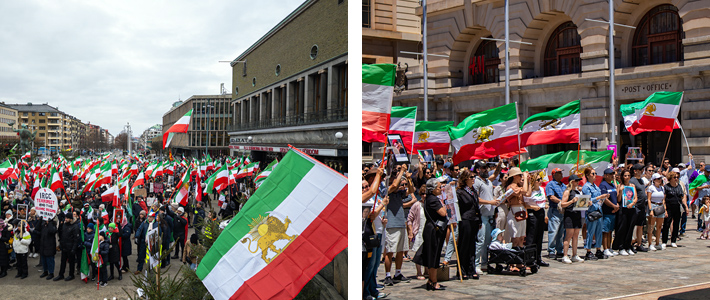
Of course, the theocracy has been accused of exercising an overbearing control over life choices of women and young girls in Iran. In the widespread protests that had rocked Iran in January 8-9, 2026, more than 36,500 Iranians were killed by security forces during the crackdown, making it the deadliest two-day protest massacre in history. As Iranians organised mourning ceremonies on the 40th day of the deaths of thousands of protesters across the nation, a pamphlet was distributed in the city of Qom, the bastion of Iranian clergy. It accused the clergy of having lost contact with "real community" and "Instead of living in small cells of the howzah (theological school), they live in luxurious abodes and enjoy the best possibilities that worldly life can offer."
The pamphlet revealed that the luxury villas and pent-houses where some clergy live in are theoretically owned by "foundations," "charities" and "research centres" funded by the state. Thus, instead of taking an interest in matters that touch the foundations of society, they focus on "the appearances" such as why the government allows some women to play fast and loose with "hijab" or why banks play tricks to circumvent the ban on charging interest.
Commemorations for the dead after 40 days have been at the heart of Iran's mourning culture for generations, one of the final rituals of farewell before returning to the rhythms of daily life. Such ceremonies have played a pivotal role in the country's modern history: They were a staging ground for the protests that eventually overthrew Iran's Shah in 1979. Before the 1979 revolution, the clergy was largely independent of state funds. Khomeini sought a goldilocks solution by trying to unite the turban and the military cap.
Iran has spent billions of dollars to arm, train and fund groups like Hamas, Hezbollah, Palestinian Islamic Jihad (PIJ) and Houthis in Yemen as proxies and fulcrum in its foreign and regional geopolitical policy goals
Suppression of women's freedom and lifestyle choices are not new to the Islamic world. A newly introduced penal code in Taliban-ruled Afghanistan signed by the group's supreme leader, Hibatullah Akhundzada, reportedly equates women with "slaves" and permits husbands and so-called "slave masters" to physically punish them, provided no bones are broken, or "open wounds" are inflicted, formalising sweeping restrictions under the regime. The ISIS imposes its own medieval code wherever it gets a toehold. So Iran's clergy is not unique or isolated in this space to attract special attention though during recent demonstrations, protesters in several cities chanted slogans such as "Clerics must go and get lost" and "Until clerics are in shrouds, the homeland will not be free."
New displays of defiance do not necessarily mean that momentum toward a new wave of nationwide protests is building. What everyone is waiting for is whether the other shoe will drop, whether a US strike will happen or not.
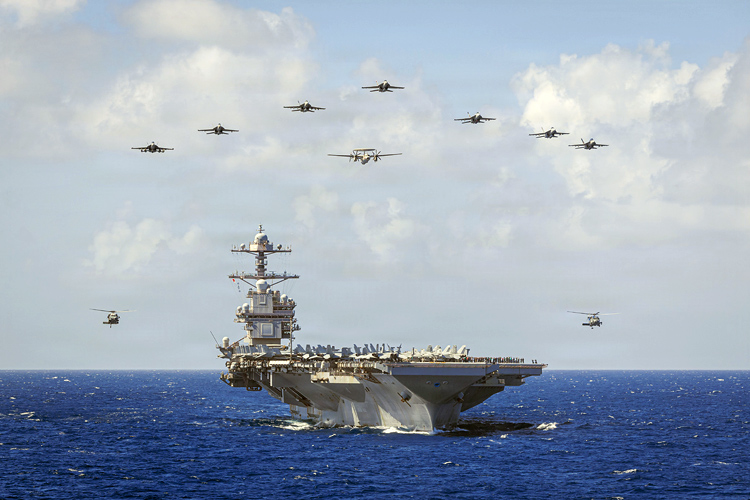
The severity of Iran's crackdown is also partly a reaction to threats beyond its borders. President Trump has massed warships in Persian Gulf waters, a show of force amid tenuous US-Iran talks over reining in Iran's nuclear and military capabilities though US President Trump had vacuously claimed that Iran's nuclear capabilities had been 'decimated' in the June 22, 2025 lightning strikes on its nuclear facilities. If they were decimated why worry or bother now?
A full-fledged all-out offensive seems unlikely as it can definitely spin-off into another forever war like the US 20-years engagement in Afghanistan
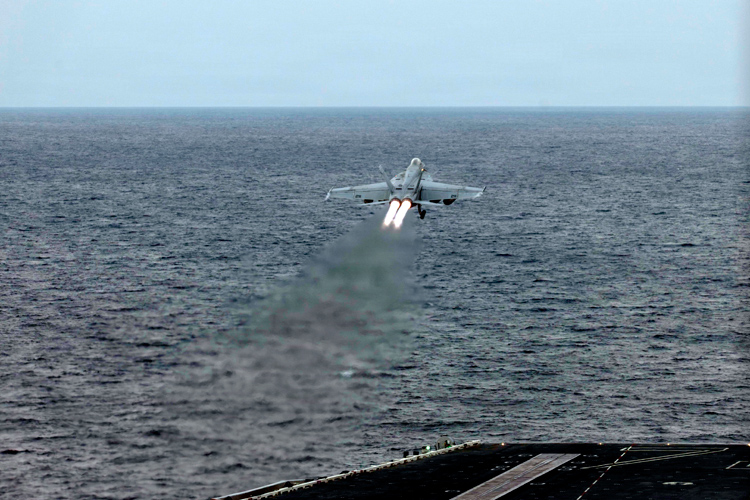
Iran has spent billions of dollars to arm, train and fund groups like Hamas, Hezbollah, Palestinian Islamic Jihad (PIJ) and Houthis in Yemen as proxies and fulcrum in its foreign and regional geopolitical policy goals. A primary target is close US ally Israel. A nuclear bomb in Iran's arsenal makes it an existential threat to Israel. Hence the assembly of the 'armada' in the region with USS Abraham Lincoln aircraft carrier floating in the Persian Bay along with its three destroyers, another aircraft carrier USS Gerald Ford heading towards the Strait of Gibraltar and US bases in the region spanning from Egypt, Turkey and Jordan to Oman, Qatar and Saudi Arabia.
A full-fledged all-out offensive seems unlikely as it can definitely spin-off into another forever war like its 20-years engagement in Afghanistan from where it had to disengage and withdraw in an embarrassing manner in August 2021. Another lightning strike at selective assets is a more probable option with reasonable combat power arrayed to manage a fall-out should Iran expand the theatre to include US allies in the region.
Whichever way the current stand-off plays out, the risk of another regional war looms!