
The insightful articles, inspiring narrations and analytical perspectives presented by the Editorial Team, establish an alluring connect with the reader. My compliments and best wishes to SP Guide Publications.

"Over the past 60 years, the growth of SP Guide Publications has mirrored the rising stature of Indian Navy. Its well-researched and informative magazines on Defence and Aerospace sector have served to shape an educated opinion of our military personnel, policy makers and the public alike. I wish SP's Publication team continued success, fair winds and following seas in all future endeavour!"

Since, its inception in 1964, SP Guide Publications has consistently demonstrated commitment to high-quality journalism in the aerospace and defence sectors, earning a well-deserved reputation as Asia's largest media house in this domain. I wish SP Guide Publications continued success in its pursuit of excellence.
Jet-powered drones are emerging as high-speed, long-range strike and swarm platforms, offering India greater lethality, survivability and indigenous unmanned warfare capabilities.
 |
The Author is Former Director General of Information Systems and A Special Forces Veteran, Indian Army |
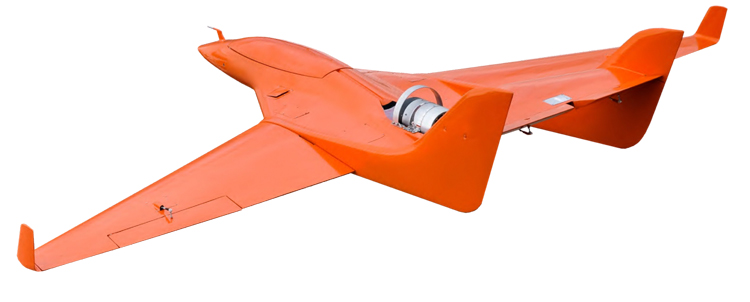
During World War I, the US and Britain developed the first pilotless vehicles Jet-powered drones known as the "Lightning Bug' and "Ryan Firebee' were employed as remote warfare aircraft in 1960. Drones were widely employed to monitor the environment and climate by 1993. Jet-powered drones powered by turbojets are increasingly used in defence sectors for decoy operations, testing of radar systems, long-range surveillance, and now for attack/kamikaze missions.
Jet-powered drones offer higher speeds and payload capacity than propeller-driven systems, making them suitable for decoy, surveillance, precision-strike and kamikaze missions.
Leveraging advantages such as high speed and large payload capacity, jet-powered drones are particularly suited for executing critical missions like seizing air superiority and conducting precise strikes against ground or naval targets in high-threat, high-intensity warfare environments. Jet engines aren't limited by propeller speeds, allowing for faster travel. They can produce much higher power outputs compared to traditional engines. However, jet engines consume more fuel, especially at lower speeds.
In the Russia-Ukraine war, in which Ukraine is only a proxy of NATO, Russia has recently introduced a faster generation of jet-powered attack drones, forcing Ukraine to rethink its air defence strategy. After fresh missile and drone strikes, Kyiv has appealed to nearly 40 partner nations for urgent Patriot interceptor missiles. How do these new drones work? Why are they harder to intercept? And could they change the balance of the air war? This discussion/report explains the latest escalation in Russia's aerial campaign.
VEDA Aeronautics is preparing to bid for the Indian Army's jet-based kamikaze drone procurement programme, building on its Sureshastra Mk-1 swarm-drone capability.
According to news reports of July 5, 2026, Delhi-based VEDA Aeronautics is preparing to bid for the Indian Army's newly approved jet-based kamikaze drone procurement programme, a critical component of the ₹52,000 crore defence modernisation package cleared by the Defence Acquisition Council (DAC). The defence start-up has already established credibility through its delivery of the "Sureshastra MK-1' jet-powered swarm drones to the Indian Air Force (IAF). These drones, developed under the Mehar Baba Swarm Drone programme, are designed for long-range precision strikes and swarm coordination, capable of overwhelming hostile air defence air-defence systems. The company's proven expertise in jet-powered loitering munitions makes its bid for the Army's procurement programme a natural progression; positioning VEDA as a leading contender in India's push for indigenous, high-speed loitering munitions designed for precision strike and swarm warfare.
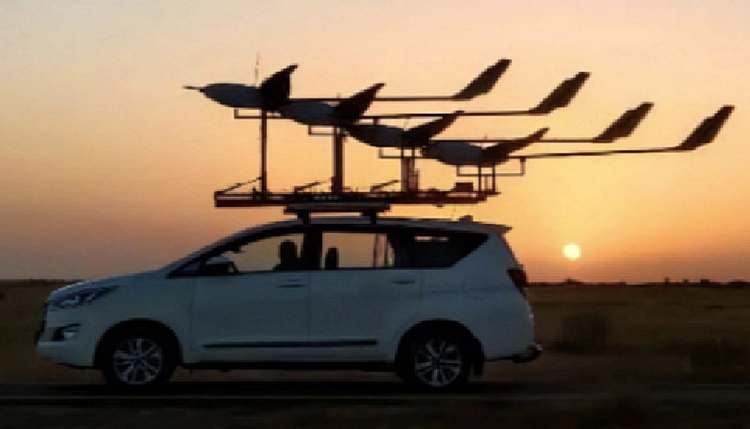
VEDA's Sureshastra Mk1 platform is particularly relevant to this programme. Measuring 3.5 metres in length with a wingspan of 3 metres, it carries a 30–40 kg high-explosive warhead and cruises at speeds of 350–400 km/h. With a strike range exceeding 500 kilometres, it is capable of engaging high-value targets such as enemy airfields, radar installations, and command centres. Its low-observable V-tail design reduces radar visibility, while its ability to operate in GPS-denied environments ensures resilience against electronic warfare. A defining feature of the Sureshastra MK-1 is its swarm capability; more than 20 drones can coordinate simultaneously, exchanging targeting data in real time and executing synchronised attacks. This swarm intelligence allows saturation of enemy defences, a capability highly sought by the Indian Army as it prepares for future battlefields dominated by unmanned systems. VEDA is also working on canister-launched variants tailored for Army platforms such as BMP infantry fighting vehicles, expanding operational flexibility.
The Sureshastra Mk-1 reportedly carries a 30–40 kg warhead, cruises at 350–400 km/h, has a strike range exceeding 500 km and can coordinate more than 20 drones simultaneously.
At the same time, the Indian Army has already received 106 jet-powered kamikaze drones, including 100 operational "Peacekeeper (Agniveg)' drones and six training drones designed for long-range precision strikes against high-value enemy targets deep inside hostile territory, according to news reports of June 11, 2026. Developed by indigenous firm SMPP, these systems are capable of operating in heavily jammed and spoofed electronic warfare environments. The drones successfully underwent user trials, where they reportedly achieved high accuracy with a circular error probable (CEP) of less than five metres, according to the company. The system also demonstrated an operational range of around 180 km. These systems are capable of operating in heavily jammed and spoofed electronic warfare environments.
The jet-powered drones can fly at speeds of up to 450 km/h and are designed to strike targets such as command centres, radar installations, logistics hubs, and other strategic military assets, it said. They are a cost-effective option to bridge the gap between traditional artillery and long-range missile systems.
The Indian Army has reportedly received 106 jet-powered kamikaze drones, including 100 operational Peacekeeper (Agniveg) drones and six training systems, strengthening its long-range precision-strike capability.
The overall jet-powered kamikaze drone procurement programme reflects India's urgent requirement to strengthen its deterrence posture amid evolving regional threats. Jet-based kamikaze drones offer the Army enhanced lethality, survivability, and cost-effectiveness. By sourcing these systems domestically, India reduces reliance on foreign imports and reinforces its Aatmanirbhar Bharat initiative, ensuring strategic autonomy in critical defence technologies.