
The insightful articles, inspiring narrations and analytical perspectives presented by the Editorial Team, establish an alluring connect with the reader. My compliments and best wishes to SP Guide Publications.

"Over the past 60 years, the growth of SP Guide Publications has mirrored the rising stature of Indian Navy. Its well-researched and informative magazines on Defence and Aerospace sector have served to shape an educated opinion of our military personnel, policy makers and the public alike. I wish SP's Publication team continued success, fair winds and following seas in all future endeavour!"

Since, its inception in 1964, SP Guide Publications has consistently demonstrated commitment to high-quality journalism in the aerospace and defence sectors, earning a well-deserved reputation as Asia's largest media house in this domain. I wish SP Guide Publications continued success in its pursuit of excellence.
India's drive towards defence self-reliance is gathering momentum, with a series of indigenous programmes spanning unmanned systems, counter-drone technologies, artillery and long-range missiles
 |
The Author is Former Director General of Information Systems and A Special Forces Veteran, Indian Army |
India is aggressively fast-tracking defence indigenisation to reduce import dependency and secure supply chains amid evolving geopolitical dynamics. Domestic defence production more than doubled over a five-year period, reaching a record high of ₹1.78 lakh crore in FY 2025–26. The SRIJAN Defence Portal, launched by the Ministry of Defence (MoD), reportedly allows the Government to list previously imported defence items that Indian companies can reverse-engineer and manufacture locally.
In one of the largest indigenous UAV procurements, the MoD cleared the procurement of 87 Medium-Altitude Long-Endurance (MALE) drones costing over ₹30,000 crore last year under the Indigenously Designed, Developed and Manufactured (IDDM) category of the Defence Acquisition Procedure. Ten Indian defence firms had submitted bids in response, according to news reports dated June 17, 2026.
The programme is expected to be a cornerstone of India's unmanned warfare roadmap, with projections suggesting future demand could rise to 350 units
These 87 drones will be equipped with advanced surveillance and combat features, including real-time intelligence, surveillance and reconnaissance (ISR) capabilities, synthetic aperture radar, electro-optical payloads, secure communication links and satellite communication systems. The drones will act as force multipliers, providing persistent surveillance and strike options that enhance deterrence and operational readiness.
Plans are also in place to integrate indigenous missile systems, enabling precision-strike missions against high-value targets. This integration is expected to significantly enhance India's tri-service capabilities across land and maritime domains. The programme is expected to be a cornerstone of India's unmanned warfare roadmap, with projections suggesting future demand could rise to 350 units. The project also positions India as a potential exporter of MALE-class drones to friendly nations in Asia, Africa and Latin America.
The IAF intends to retain ownership of intellectual property rights, ensuring flexibility for future modifications, upgrades, and scaling up of production
Concurrently, the Indian Air Force (IAF) has embarked on a programme to co-develop long-range kamikaze drones with Indian industry. The initiative, centred at Sulur in Tamil Nadu, will create a fully indigenous ecosystem for the design, production and sustainment of one-way attack drones. The IAF currently operates the Israeli-origin Harop drones.
On June 12, 2026, the IAF issued a limited tender enquiry to select Indian firms, stipulating that the drones must be indigenously designed, developed and manufactured under the Indigenously Designed, Developed and Manufactured (IDDM) category. The IAF's No. 5 Base Repair Depot (5 BRD) at Sulur, Coimbatore, has been designated as the nodal agency for the programme. The IAF intends to retain ownership of intellectual property rights, ensuring flexibility for future modifications, upgrades and scaling up of production, allowing 5 BRD to establish a long-term capability for sustaining future generations of attack drones.
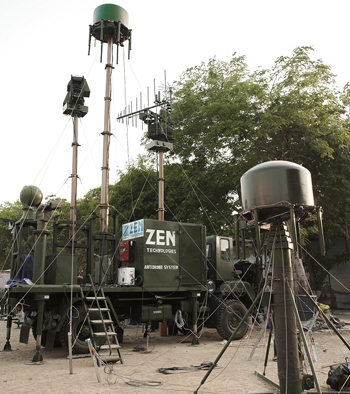
Zen Technologies has recently unveiled its new directed energy weapon (DEW), named 'Zen Bijli'
The IAF has specified that the drone must be fixed-wing, capable of operating at altitudes up to 16,000 ft, and functional in both day and night conditions. It must carry a payload of at least 30 kg, with modular and swappable options to accommodate munitions, airborne data-relay systems or sensors depending on mission requirements. The weapon system will be jointly developed by the IAF and industry partners, with preference given to local suppliers, explicitly mandating that the drone must be free of any Chinese-origin technology, components or materials. Joint development will cover the airframe and other critical systems and subsystems. Additionally, the IAF has sought a complete maintenance ecosystem. The drone is expected to be launched from a static platform.
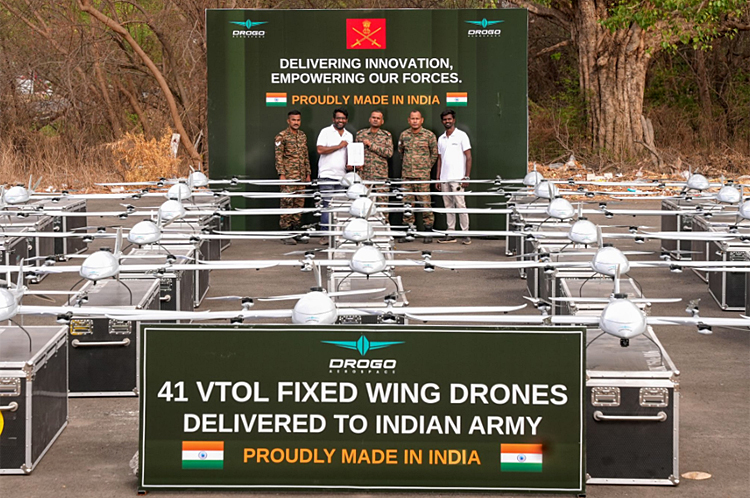
Hyderabad-based Drogo Aerospace Pvt Ltd delivered the first batch of 41 JK 250e drones to the Indian Army in June 2026 under a contract worth ₹2 crore. The balance 176 drones are to be delivered by August 2026, bringing the total order to 217 units. These drones are capable of flying for up to three hours on a single charge, making them suitable for extended surveillance and reconnaissance missions. The induction of the JK 250e drones represents a step forward in strengthening the Army's aerial surveillance and reconnaissance capabilities.
Gurugram-based defence technology start-up Armory has secured three contracts worth ₹100 crore for its AI-powered counter-drone system SURGE, which uses the proprietary Samaritan OS to detect drones via radio frequency within a 5 km radius and execute jamming or spoofing up to 3 km. SURGE incorporates radar, electronic warfare and machine-learning capabilities.
The trial demonstrated flawless performance, hitting a target at a distance of 1,000 km
Zen Technologies has recently unveiled its new directed-energy weapon (DEW), named 'Zen Bijli', at the North Tech Symposium 2026 held at Prayagraj in June 2026, along with several other defence products, including the Zen HyperStrike long-range strike system, AI-powered anti-drone solutions, smart air-burst ammunition, and an unmanned ground vehicle. Zen Technologies has not disclosed critical details of Zen Bijli, such as laser power output, target-engagement envelope, fire-control architecture, mobility configuration, power requirements or intended military applications. However, all this denotes the wave of defence indigenisation sweeping across India.
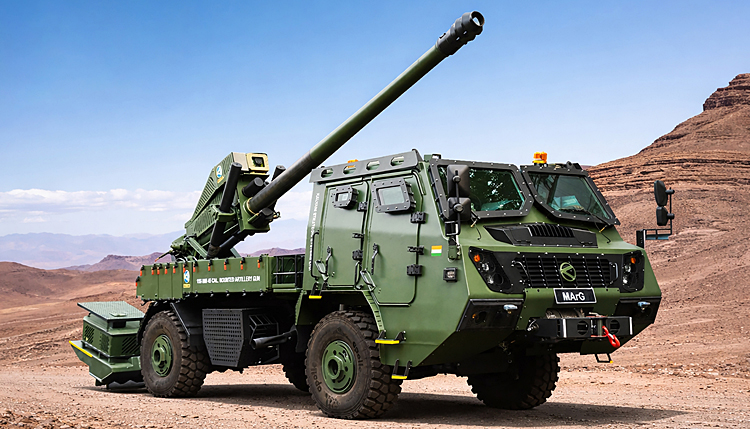
Bharat Forge's defence arm, Kalyani Strategic Systems Limited (KSSL), made headlines at Eurosatory 2026 in Paris by unveiling its MArG series of 155mm mounted artillery guns, the world's first of their kind on a 4×4 high-mobility vehicle, according to reports. KSSL presented its Mounted Artillery Guns (MArG) series as a family of three calibre configurations. The MArG-39 calibre emphasises mobility and tactical flexibility, the MArG-45 calibre balances medium-range firepower, and the MArG-52 calibre delivers extended-range capability.
The LRLACM is designed to be launched from multiple platforms, enhancing operational flexibility for the Indian Armed Forces
The 155mm/39-calibre variant, weighing 18 tonnes, capable of carrying 18 rounds, and deployable in less than two minutes, even at night, can negotiate gradients of up to 30 degrees, making it a versatile "go-anywhere" gun. This breakthrough positions India as a serious contender in the global defence export market, showcasing unmatched mobility, rapid deployment, and NATO-standard firepower.
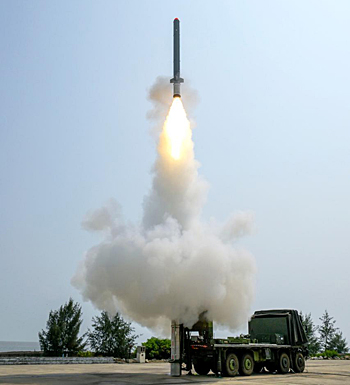
Finally, India achieved a major milestone with the successful test firing of the Long-Range Land Attack Cruise Missile (LRLACM) from the Integrated Test Range at Chandipur, Odisha, on June 15, 2026. The trial demonstrated flawless performance, hitting a target at a distance of 1,000 km, with all previous issues resolved.
With a speed of up to Mach 0.8, the capability to fly at terrain-skimming altitudes, the ability to carry a 500 kg warhead, and a stand-off strike capability at ranges exceeding 1,000 km, the LRLACM is designed to be launched from multiple platforms, enhancing operational flexibility for the Indian Armed Forces. The missile will undergo two more developmental trials, followed by two user trials over the next two years before formal induction into service.