

The insightful articles, inspiring narrations and analytical perspectives presented by the Editorial Team, establish an alluring connect with the reader. My compliments and best wishes to SP Guide Publications.
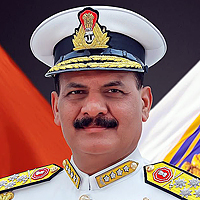
"Over the past 60 years, the growth of SP Guide Publications has mirrored the rising stature of Indian Navy. Its well-researched and informative magazines on Defence and Aerospace sector have served to shape an educated opinion of our military personnel, policy makers and the public alike. I wish SP's Publication team continued success, fair winds and following seas in all future endeavour!"

Since, its inception in 1964, SP Guide Publications has consistently demonstrated commitment to high-quality journalism in the aerospace and defence sectors, earning a well-deserved reputation as Asia's largest media house in this domain. I wish SP Guide Publications continued success in its pursuit of excellence.
India is advancing a $3.5 billion acquisition of six additional P-8I Poseidon aircraft to strengthen maritime surveillance and anti-submarine warfare capabilities, while balancing defence modernisation and strategic autonomy goals
 |
The Author is Former Director General of Information Systems and A Special Forces Veteran, Indian Army |
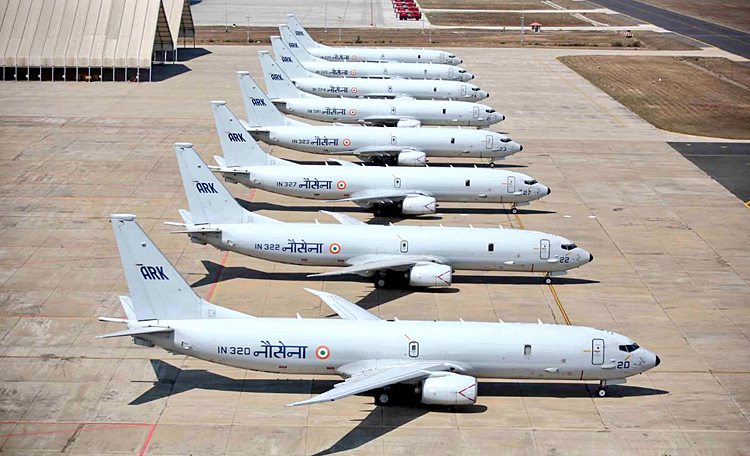
According to news reports, India is moving forward with the acquisition of six additional P-8I Poseidon maritime reconnaissance aircraft from the US despite the sharp rise in costs. 17 years ago in 2009, India was the first international buyer of the P-8I Poseidon aircraft. The deal, valued at over $3.5 billion, will be processed through the Foreign Military Sales (FMS) route.
The deal, valued at over $3.5 billion, will be processed through the Foreign Military Sales (FMS) route
Negotiations had been ongoing for more than a year, with India initially resisting the purchase due to the steep increase in price per aircraft, now estimated between $500–600 million. By comparison, the first batch of eight P-8Is, acquired in 2009, cost $2.1 billion in total. Boeing has attributed the surge in costs to global supply-chain disruptions, which have affected production and delivery timelines.
Newspaper reports quote unnamed sources saying that the Cabinet Committee on Security (CCS), chaired by Prime Minister Narendra Modi, is expected to finalise the note for approval by next month. The deal will contribute to the $500 billion target for bilateral trade target agreed earlier between US President Donald Trump and Prime Minister Modi.
The P-8I Poseidon is a long-range, multi-mission maritime patrol aircraft operated by the Indian Navy, acting as a crucial "eye in the sky" for surveillance, anti-submarine warfare (ASW), and anti-surface warfare (ASuW)
The Indian Navy, having acquired the first batch of P-8Is in 2009, currently operates a fleet of these aircraft to counter underwater threats in the Indo-Pacific region. The P-8I Poseidon is a long-range, multi-mission maritime patrol aircraft operated by the Indian Navy, acting as a crucial "eye in the sky" for surveillance, anti-submarine warfare (ASW), and anti-surface warfare (ASuW). Key features include the AN/APY-10 radar, 360-degree situational awareness, and the capacity to carry Harpoon anti-ship missiles and Mk-54 torpedoes.
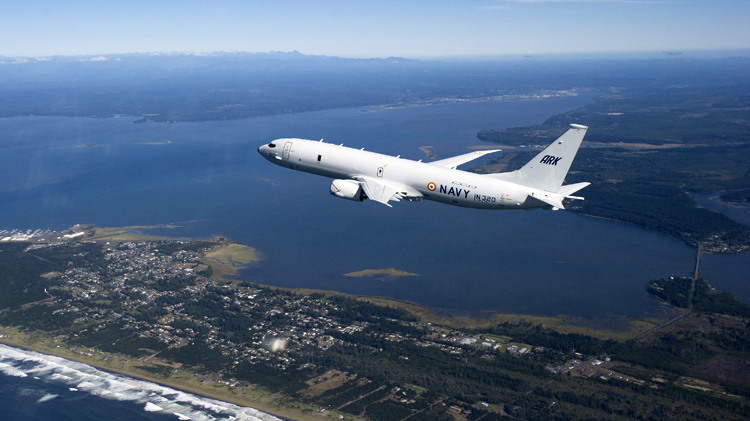
Key Characteristics of Indian Navy's P-8I Poseidon aircraft include: Variant - the P-8I is a custom variant of the Boeing P-8A Poseidon, specifically designed for India as a replacement for the ageing Tu-142M fleet; Operational Role - it conducts anti-submarine warfare (ASW), anti-surface warfare (AsuW), intelligence, surveillance, and reconnaissance (ISR) missions over the Indian Ocean; Radar - equipped with the multi-mode AN/APY-10 radar for tracking surface and sub-surface targets; Sub-surface Detection - features a Magnetic Anomaly Detector (MAD) and capability to deploy/monitor a wide range of sonobuoys; Electro-Optical/Infrared (EO/IR) - high-resolution sensors for day/night surveillance; Weaponry - capable of carrying AGM-84L Harpoon Block II anti-ship missiles and Mark 54 lightweight torpedoes for neutralising threats; Speed - maximum speed of 789–907 km/h; Range/Endurance - over 2,222 km range with four hours on station; Altitude - maximum operating altitude of 12,496 m; Operational Hub - based at Arakkonam, Tamil Nadu, with the 312A Naval Air Squadron; Interoperability - equipped with specialised equipment from Bharat Electronics Limited (BEL) and secured communication systems for interoperability.
Officials have stressed that there is no equivalent aircraft globally that can deliver such a wide range of capabilities simultaneously, making the acquisition strategically indispensable
The "I" in P-8I denotes India-specific modifications tailored to the Navy's requirements. Officials have stressed that there is no equivalent aircraft globally that can deliver such a wide range of capabilities simultaneously, making the acquisition strategically indispensable.
As seen from the above, the P-8I Poseidon is a highly capable platform, designed for anti-submarine warfare, maritime reconnaissance, and surveillance. It can track and engage both surface ships and submarines, while also performing intelligence, surveillance, and reconnaissance missions. The aircraft has already proven its versatility, with the Indian Navy deploying them not only for maritime patrols but also during the Himalayan stand-off with China five years ago, when they were used in Ladakh for surveillance.
The new batch will further enhance the Navy's operational reach and surveillance capacity across the Indian Ocean Region (IOR)
India currently operates a fleet of twelve P-8Is, with the first eight inducted in 2009 and four more added in 2016. These aircraft have performed well in service, strengthening India's maritime domain awareness and anti-submarine warfare capabilities. The new batch will further enhance the Navy's operational reach and surveillance capacity across the Indian Ocean Region (IOR).
Concurrent to the planned acquisition of six additional P-8I Poseidon maritime reconnaissance aircraft from the US, India is pursuing flexibility in indigenous weapons integration for the planned acquisition of 114 Rafale fighter jets. The Indian Air Force (IAF) is keen to ensure that the Rafale deal allows for a broader range of weapon systems, thereby supporting operational independence and reducing reliance on a single supplier. This approach also ties into India's wider push for indigenous manufacturing and self-reliance in defence procurement, ensuring that future acquisitions contribute to domestic capability-building. However, Dassault has intimated that the source code of Rafale's software will not be shared with India, which means that integration of indigenous sensors, radars and weapons will continue to be controlled by France, which is not good.