

The insightful articles, inspiring narrations and analytical perspectives presented by the Editorial Team, establish an alluring connect with the reader. My compliments and best wishes to SP Guide Publications.

"Over the past 60 years, the growth of SP Guide Publications has mirrored the rising stature of Indian Navy. Its well-researched and informative magazines on Defence and Aerospace sector have served to shape an educated opinion of our military personnel, policy makers and the public alike. I wish SP's Publication team continued success, fair winds and following seas in all future endeavour!"

Since, its inception in 1964, SP Guide Publications has consistently demonstrated commitment to high-quality journalism in the aerospace and defence sectors, earning a well-deserved reputation as Asia's largest media house in this domain. I wish SP Guide Publications continued success in its pursuit of excellence.
Development of new indigenous technologies align with India's broader military modernisation efforts, where unmanned systems and Air Defence systems are being inducted across the Armed Forces
 |
The Author is Former Director General of Information Systems and A Special Forces Veteran, Indian Army |

NOIDA-based EndureAir Systems, an indigenous unmanned aviation technology company founded in 2018, which was incubated at IIT Kanpur to develop, manufacture, and supply advanced aerial robotics and heavy-payload drones for the Indian Armed Forces, has unveiled a new long-range kamikaze drone, according to news reports of May 9, 2026. This marks another step in India's expanding unmanned strike capabilities. In March 2026, the company signed a cooperation agreement with Ananth Technologies to jointly develop indigenous loitering munitions under the Indigenously Designed, Developed and Manufactured (IDDM) category.
This new kamikaze drone is expected to fit seamlessly into India's broader push toward deep-strike unmanned warfare, swarm-based offensive operations, AI-enabled autonomous targeting, and cost-effective alternatives to expensive cruise missiles
Although detailed specifications have not yet been formally disclosed, possible characteristics of the platform suggest a range extending to hundreds of kilometres, enabling strikes well beyond the tactical battlefield. Its intended roles include anti-radar missions to suppress enemy air defences, anti-vehicle attacks against armoured formations, strikes on logistics nodes, and battlefield interdiction to disrupt adversary supply chains. Such versatility would allow the drone to operate across multiple mission profiles, enhancing operational flexibility for commanders.
Guidance is likely to be based on GPS/INS navigation, with electro-optical and infrared terminal guidance systems ensuring precision in the final attack phase. This dual-layered guidance architecture would allow the drone to function effectively even in contested environments, where electronic warfare and jamming are prevalent. Launch methods are expected to include catapult or rail-based systems, ensuring rapid deployment from mobile platforms without the need for complex infrastructure. The warhead is anticipated to be a high explosive fragmentation type, optimised for maximum lethality against both soft and hardened targets.
By positioning this drone as a cheaper alternative to cruise missiles, India is seeking to expand its strike options without incurring prohibitive costs
This new kamikaze drone is expected to fit seamlessly into India's broader push toward deep-strike unmanned warfare, swarm-based offensive operations, AI-enabled autonomous targeting, and cost-effective alternatives to expensive cruise missiles. It underscores India's growing emphasis on swarm tactics, where multiple drones can be deployed simultaneously to overwhelm enemy defences. Integration of AI-enabled autonomous targeting further enhances its potential, allowing the system to adapt dynamically to battlefield conditions and select targets with minimal human intervention.
The cooperation between EndureAir Systems and Ananth Technologies highlights the importance of industrial partnerships in accelerating indigenous defence development. By positioning this drone as a cheaper alternative to cruise missiles, India is seeking to expand its strike options without incurring prohibitive costs. Cruise missiles, while highly effective, are expensive and limited in number. A long-range Kamikaze drone offers a more affordable solution for sustained operations, enabling India to hold adversary infrastructure and rear-echelon assets at risk over extended campaigns.
It underscores India's growing emphasis on swarm tactics, where multiple drones can be deployed simultaneously to overwhelm enemy defences
This development also aligns with India's broader military modernisation efforts, where unmanned systems are being inducted across the Army, Navy, and Air Force. From tactical ISR drones to long-range strike UAVs, the armed forces are building a layered capability that enhances deterrence, resilience, and adaptability in future conflicts.
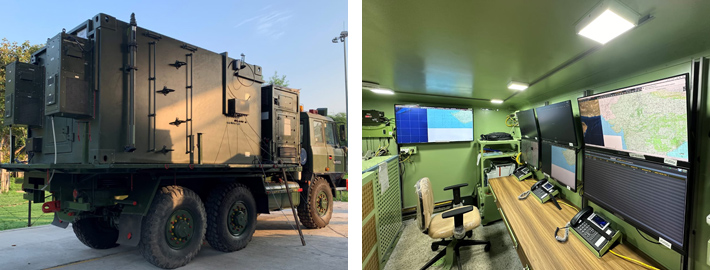
According to news reports of May 8, 2026, the Indian Army plans are underway to integrate the Akashteer air defence command and control system onto tracked armoured vehicles, a move that will allow them to keep pace with armoured formations during manoeuvres and enhanced cross country mobility. This decision has been taken following the success of the Akashteer system during Operation 'Sindoor' in 2025. This marks a shift from the current truck mounted configuration, which provides limited protection on the move, and terrain adaptability compared to armoured platforms.
Akashteer is seamlessly connected with the Indian Air Force's Integrated Air Command and Control System and the Navy's Trigun air defence network, forming part of India's broader C4ISR framework
The Ministry of Defence (MoD) has issued a request for proposal (RFP) for the procurement of 83 indigenously manufactured Carrier Air Defence Tracked (CADET) systems. These tracked platforms will be fitted with Akashteer equipment to provide real time air defence control and reporting for self propelled gun and missile units in mechanised formations. The RFP highlights the Army Air Defence's requirement for a common tracked platform capable of carrying current and future equipment in support of mechanised units.
The CADET will be integrated with the new generation Integrated Battlefield Management System and Identification of Friend or Foe systems, ensuring a unified operational picture across formations. The Army Air Defence (AAD) is tasked with protecting field formations in tactical battle areas and providing point defence to static establishments. It currently operates a mix of tracked and wheeled self propelled platforms alongside fixed weapon systems. Limitations in cross country movement and survivability of the truck mounted Akashteer units have prompted the shift to tracked carriers.
This tri service integration enhances situational awareness and enables precise, coordinated offensive and defensive actions
Akashteer is a fully automated network of radars and sensors forming the backbone of AAD. Akashteer is seamlessly connected with the Indian Air Force's Integrated Air Command and Control System and the Navy's Trigun air defence network, forming part of India's broader C4ISR framework. This tri service integration enhances situational awareness and enables precise, coordinated offensive and defensive actions.
The CADET platform has been conceptualised as a high powered tracked chassis with sufficient internal space to accommodate a crew of at least five, their personal weapons, and technical components. It will also feature external attachment points for mounting diverse equipment and structures. The equipment planned for integration on CADET includes Akashteer components, drone detection and interdiction systems, drone kill systems, and vehicle mounted counter swarm drone systems.