
The insightful articles, inspiring narrations and analytical perspectives presented by the Editorial Team, establish an alluring connect with the reader. My compliments and best wishes to SP Guide Publications.

"Over the past 60 years, the growth of SP Guide Publications has mirrored the rising stature of Indian Navy. Its well-researched and informative magazines on Defence and Aerospace sector have served to shape an educated opinion of our military personnel, policy makers and the public alike. I wish SP's Publication team continued success, fair winds and following seas in all future endeavour!"

Since, its inception in 1964, SP Guide Publications has consistently demonstrated commitment to high-quality journalism in the aerospace and defence sectors, earning a well-deserved reputation as Asia's largest media house in this domain. I wish SP Guide Publications continued success in its pursuit of excellence.
There are key developments in India's air power modernisation with the successful testing of the indigenous TARA glide weapon and the acquisition of long-range R-37M missiles to enhance combat capabilities
 |
The Author is Former Director General of Information Systems and A Special Forces Veteran, Indian Army |
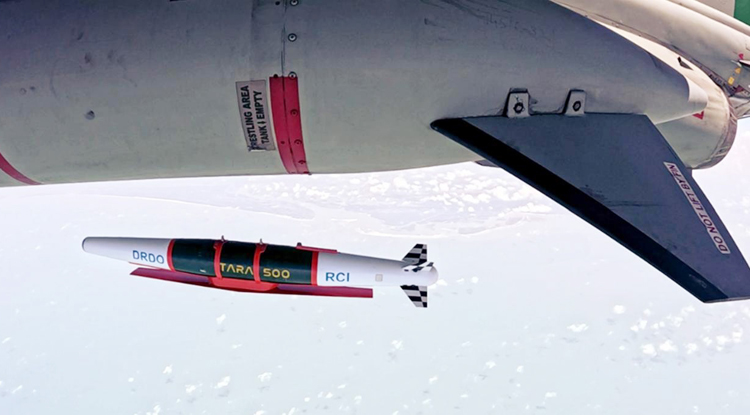
On May 7, 2026, the Defence Research and Development Organisation (DRDO) and the Indian Air Force (IAF) successfully carried out the maiden flight-trial of India's first indigenous glide weapon system; the Tactical Advanced Range Augmentation (TARA) designed to convert unguided warheads into precision guided munitions (PGMs). The trial was conducted off the coast of Odisha, marking a significant milestone in India's defence technology development. The system demonstrated the ability to extend the range of a bomb to between 150 and 180 km when released from an altitude of 5-km, with a circular error probability (CEP) of three metres. The system deploys wings and tail units after release, using inertial navigation, GPS-assisted guidance, and electro-optical seekers to achieve accuracy levels of under five metres, with some trials recording even tighter precision.
The successful demonstration of TARA represents a major advancement in India's ability to enhance the lethality and accuracy of low-cost weapons
TARA has been designed and developed by DRDO's Research Centre Imarat (RCI), Hyderabad, in collaboration with other DRDO laboratories. The project has been undertaken with the support of development-cum-production partners and Indian industries, which have already commenced production activities, ensuring rapid induction into service. It is a modular kit that can be attached to conventional bombs of 250 kg, 450 kg and 500 kg weight classes, transforming them into guided munitions. It employs an onboard Inertial Navigation System (INS), GPS navigation, and electro-optical guidance to achieve precision targeting.
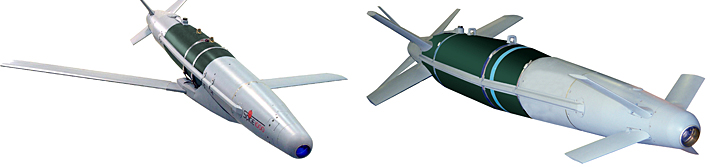
Somewhat like the Israeli SPICE system, which is already in service with the IAF, TARA is being integrated with multiple frontline fighter aircraft including the Jaguar, Mirage 2000, Sukhoi Su-30 MKI and LCA Tejas. This integration will provide the IAF with enhanced strike capabilities against ground-based targets, while reducing dependence on imported systems. The successful demonstration of TARA represents a major advancement in India's ability to enhance the lethality and accuracy of low-cost weapons.
The strategic importance of TARA lies in IAF's requirement of high-volume precision strikes for suppression of enemy air defences, runway attacks, bunker destruction, and deep strike capability
The strategic importance of TARA lies in IAF's requirement of high-volume precision strikes for suppression of enemy air defences, runway attacks, bunker destruction, and deep strike capability. TARA could become one of the mass use precision weapons for such missions, while more expensive systems like BrahMos and SCALP are reserved for high-value targets. TARA represents a milestone in India's defence modernisation; enhancing IAF's lethality, survivability, and operational flexibility, while reducing costs and dependence on foreign systems.
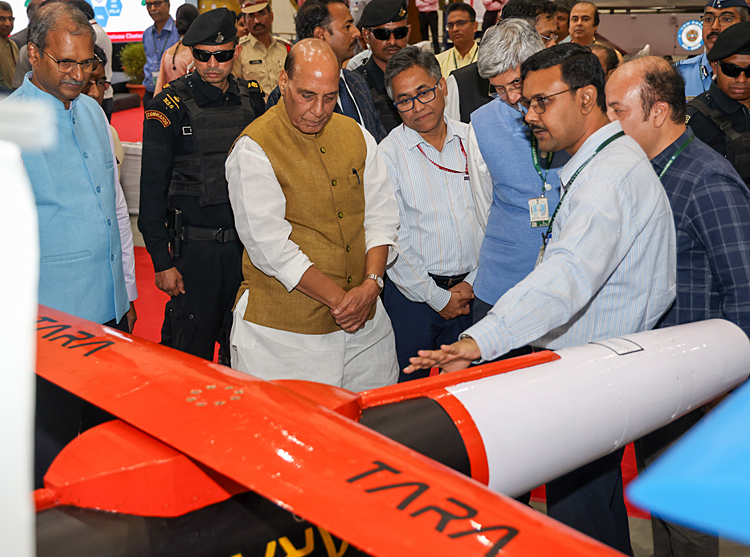
Defence Minister Rajnath Singh congratulated DRDO, the IAF and industry partners for the successful trial, describing it as a significant step forward in advancing India's indigenous defence capabilities. Secretary of the Department of Defence Research and Development and Chairman of DRDO, Samir V. Kamat, also extended his congratulations to the teams involved, highlighting the achievement as a testament to India's growing self-reliance in defence technology.
Both China and Pakistan possess glide weapon systems that convert conventional bombs into standoff precision weapons for striking targets without entering hostile airspace. China uses the LS-6 series of glide systems and has long possessed indigenous precision-guided glide munitions. Pakistan operates the H-2 and H-4 glide bombs, which were developed with Chinese assistance, having standoff ranges of 60 to 120+ km. Similar to TARA, these systems use aerodynamic fins and GPS/INS/laser guidance to transform standard bombs into precision weapons.
The Ministry of Defence (MoD) has signed a contract with Russia for importing 300 x Russian R-37M long range air-to-air missiles, valued at over $1.2 billion
According to news reports of May 3, 2026, the Ministry of Defence (MoD) has signed a contract with Russia for importing 300 x Russian R-37M long range air-to-air missiles, valued at over $1.2 billion. This is the longest-range air-to-air missile ever exported by Russia to any country.
The R-37M is a large-sized missile developed for the MiG-31BM interceptor, the heaviest aircraft in service globally built for air-to-air combat. The Su-30 MKI also being a heavyweight aircraft, these missiles can be integrated with them without excessively compromising the flight performance of these aircraft. The R-37M is reportedly rivalled only by the Chinese PL-17 missile and America's AIM-174 missile in range.
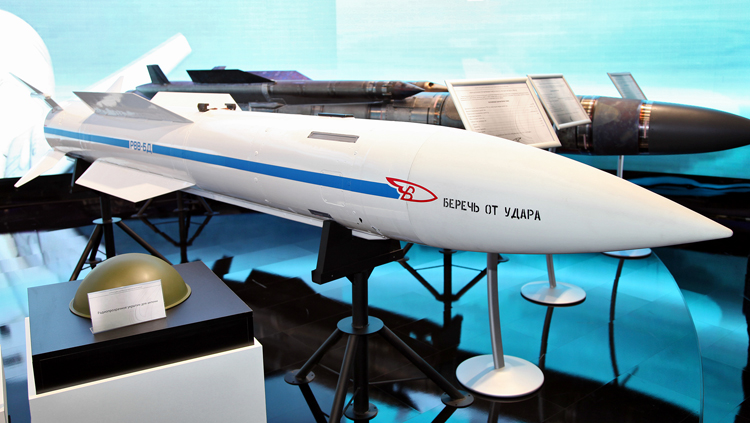
These R-37M missiles are expected to revolutionise the performances of the Su-30 MKI '4+ generation' fighters, that form the backbone of the Indian Air Force's combat fleet. These missiles will close to triple the engagement ranges of Indian Su-30 MKI fighters, at a time when broader plans to modernise the aircraft are being considered.
These R-37M missiles are expected to revolutionise the performances of the Su-30 MKI '4+ generation' fighters, that form the backbone of the Indian Air Force's combat fleet
The R-37M's combination of a 350 to 400 km engagement range, large 61 kg warhead, and especially high Mach 6 speed, allows it to significantly increase the combat potential of the Su-30 MKI. There is speculation in the media that the decision to procure the R-37M missiles was influenced by the use of 40N6 400 km range surface-to-air missiles (SAMs) from S-400 systems to disrupt Pakistani support operations during engagements in Operation 'Sindoor' last year, highlighting the value of being able to shoot down aircraft deep inside hostile territory, and destroying a high value electronic warfare aircraft or AEW&C system over extreme distances.
Concurrently, the MoD plans to comprehensively upgrade the IAF's Su-30 MKI fighter fleet, as well as importing more S-400 air defence missile systems; an agreement to procure ten battalions of S-400 long range air defence systems having been approved by the MoD in late March 2026.