
The insightful articles, inspiring narrations and analytical perspectives presented by the Editorial Team, establish an alluring connect with the reader. My compliments and best wishes to SP Guide Publications.

"Over the past 60 years, the growth of SP Guide Publications has mirrored the rising stature of Indian Navy. Its well-researched and informative magazines on Defence and Aerospace sector have served to shape an educated opinion of our military personnel, policy makers and the public alike. I wish SP's Publication team continued success, fair winds and following seas in all future endeavour!"

Since, its inception in 1964, SP Guide Publications has consistently demonstrated commitment to high-quality journalism in the aerospace and defence sectors, earning a well-deserved reputation as Asia's largest media house in this domain. I wish SP Guide Publications continued success in its pursuit of excellence.
Faced by the prospect of mass drone strikes, countries are looking for ability to field cheap, scalable interception by drones that cost a fraction of the multi-million-dollar Interceptor missiles
 |
The Author is Former Director General of Information Systems and A Special Forces Veteran, Indian Army |
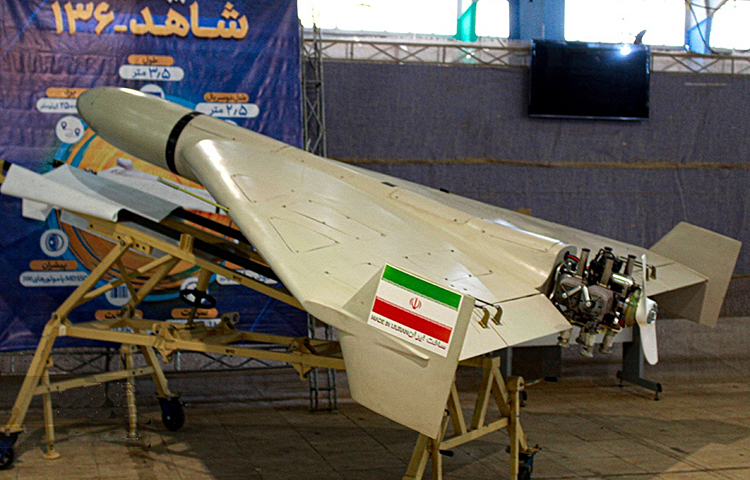
Iran's resilience in the face of US President Donald Trump's assertion that the US has obliterated Iran's nuclear programme and effectively targeted its missile facilities, has stunned the world. US is considering relocating its air defence systems from South Korea and Japan to the Middle East. But American AD systems in Saudi Arabia continue to be targeted and four have reportedly been destroyed by Iran's ballistic missiles. But these apart Iranian drones, having ranges up to 2,000 km, have created havoc in countries hosting US bases and those aligned with Washington.
Three Gulf states have approached the Ukrainian drone manufacturer 'TAF Industries' with requests to purchase interceptor drones.
Now the UAE has reportedly asked for 5,000 interceptors, Qatar for 2,000 and the reason every Gulf state is calling Ukraine for interceptors is the same – the American Patriot air defence system cannot protect them – as Ukraine has discovered while playing proxy for the US-NATO war on Russia. Three Gulf states have approached the Ukrainian drone manufacturer 'TAF Industries' with requests to purchase interceptor drones. These inquiries signal a shift in how countries under drone attack view air defence. It is an extended export market for Ukraine's battle-tested drone industry. Ukraine's interceptor drone industry came out of necessity; faced by the onslaught of mass 'Shahed' drone strikes - the same Iranian-designed platform Iran is now firing at Gulf states amid the US-Israeli war against Iran. Ukraine's ability to field cheap, scalable interception against Shahed-type drones — which cost tens of thousands of dollars each but draw multi-million-dollar Patriot missiles in response, is what Gulf buyers are now wanting to acquire.
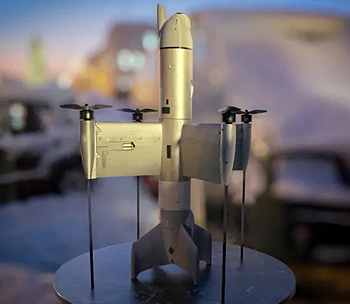
Ukraine has been scaling up its drone interceptor output to over 1,500 units per day domestically, with manufacturers producing roughly double of what Ukraine's own military requires. According to Oleksandr Yakovenko, founder of TAF Industries, the UAE has requested 5,000 interceptor drones, Qatar requested 2,000, and Kuwait also expressed interest in acquiring the systems, saying “They want to understand how to implement our drones into the whole defence system." Yakovenko further said, "Now every country understands that they have to have interceptor systems because it's not enough to have something like a Patriot anti-air system."
Founded only four years back in 2022, TAF Industries currently produces over 80,000 drones per month - more than 30 products. Its two main interceptor systems are: autonomous Octopus-100 having a combat radius of 30 km, speed exceeding 300 km/h, flight ceiling of 4,500m and carrying a 1.2 kg payload; manually controlled Kolibri-i10 having 15-km combat radius, speeds exceeding 200 km/h, ceiling of 3,000m, and carrying a 0.5 kg warhead.
For the Gulf States the problem in acquiring Ukrainian interceptor drones quickly is not the production rate, but the fact that it would take several months to train the pilots for operating them.
For the Gulf States the problem in acquiring Ukrainian interceptor drones quickly is not the production rate, but the fact that it would take several months to train the pilots for operating them. According to Yakovenko, fast deployment faces one key obstacle – people, in that, training pilots remains the main problem for countries eager to get interceptors into service quickly; operating the drones competently takes several months — a timeline that complicates any rapid roll-out for Gulf States. This is an acknowledgement that layered integration, not procurement alone, is what makes interceptors effective.
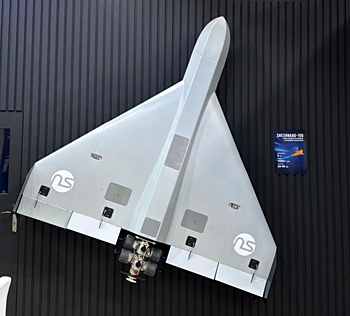
India has a fast-developing autonomous drone industry, which is developing, testing, and starting to field indigenous autonomous long-range loitering munitions designed like Iran's Shahed-136. As of March 2026, the primary platform identified for this role is the Sheshnaag-150 with a range of over 1,000-km, but not 2,000-km like Iran's Shahed. Designed by Bengaluru-based NewSpace Research and Technologies (NRT), the Sheshnag-150 was first flown in February 2025 and accelerated since then. It uses AI for swarm coordination and has GPS-denied navigation, allowing it to function in heavily jammed electronic warfare environments. It carries a 25-40 kg warhead and can loiter for over 5 hours.
India has a fast-developing autonomous drone industry, which is developing, testing, and starting to field indigenous autonomous long-range loitering munitions.
Drones will continue to play a major role in future conflicts. It was brought out in these columns earlier that China placed an order for one million combat drones on its indigenous industry, for delivery in 2026.
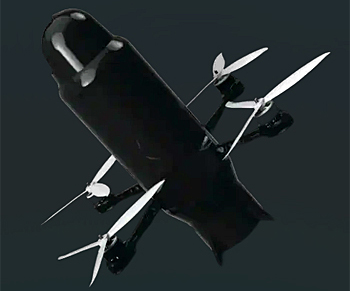
Reports in March 2026 have said that India's private firm Flying Wedge Defence & Aerospace has successfully tested India's first autonomous swarm drone interceptor, dubbed 'FWD YAMA', to outmatch drone swarms in aerial defence and suppression of enemy air defence missions. This is indeed a ground breaking advancement in India's defence landscape. This innovative platform addresses the escalating menace of low-cost drones, which have proven disruptive in recent global conflicts. By delivering precision aerial interception at a fraction of the expense of traditional missile systems, FWD YAMA promises to revolutionise threat neutralisation.
By delivering precision aerial interception at a fraction of the expense of traditional missile systems, FWD YAMA promises to revolutionise threat neutralisation.
According to Flying Wedge, the FWD YAMA interceptor operates at up to 100 times lower cost than conventional alternatives, with a projected per-unit price hovering around $10,000; with the cost varying based on configuration and mission requirements, making it economically viable for large-scale deployments. At its core, FWD YAMA harnesses artificial intelligence (AI), swarm coordination algorithms, and precision-kill mechanisms to tackle a spectrum of aerial threats. These range from diminutive micro-drones to more substantial unmanned aerial systems (UAS), ensuring versatile application in modern battlefields. Its software suite facilitates seamless integration across diverse aerial defence platforms, encompassing unmanned systems and precision-guided munitions. Autonomous navigation, targeting, and engagement form the bedrock of FWD YAMA's architecture. Once radar or surveillance systems provide initial cueing, the interceptor takes over independently, detecting, classifying, prioritising, tracking, and neutralising threats without any human input. Advanced sensor fusion drives its effectiveness. Radar-based cueing merges with multi-sensor data, electro-optical tracking, and vision-based terminal guidance to enable pinpoint interceptions, even amidst chaotic swarm scenarios.
FWD YAMA forms a cornerstone of Flying Wedge's expansive ecosystem. As drone warfare proliferates, such systems signal India's proactive pivot towards affordable, intelligent air defence solutions. Flying Wedge's milestone not only counters the immediate threats but also lays the groundwork for next-generation aerial dominance. The requirement now is mass production, quick induction and integration into India's defence network.