

The insightful articles, inspiring narrations and analytical perspectives presented by the Editorial Team, establish an alluring connect with the reader. My compliments and best wishes to SP Guide Publications.

"Over the past 60 years, the growth of SP Guide Publications has mirrored the rising stature of Indian Navy. Its well-researched and informative magazines on Defence and Aerospace sector have served to shape an educated opinion of our military personnel, policy makers and the public alike. I wish SP's Publication team continued success, fair winds and following seas in all future endeavour!"

Since, its inception in 1964, SP Guide Publications has consistently demonstrated commitment to high-quality journalism in the aerospace and defence sectors, earning a well-deserved reputation as Asia's largest media house in this domain. I wish SP Guide Publications continued success in its pursuit of excellence.
India faces a rapidly evolving threat landscape driven by advanced munitions and proliferating UAS. The MQ-9B AEW&C system from GA-ASI offers a cost-effective, scalable solution to enhance air and maritime domain awareness, strengthen surveillance capabilities, and support defence modernisation while complementing existing high-value assets and improving operational flexibility.

India and responsible nations around the globe face an enormous national security challenge: What does a resilient force structure look like in an era where both state and non-state actors can wield sophisticated munitions and uncrewed aerial systems (UAS) at scale?
While it surely calls for the adoption of new defence systems and ways of fighting, it starts with understanding the possibilities resident within systems already in inventory and which have existing training and maintenance support.
India's strategic partnership with General Atomics Aeronautical Systems, Inc. (GA-ASI) presents one such opportunity. GA-ASI is developing and testing an Airborne Early Warning & Control (AEW&C) system for its MQ-9B SkyGuardian®. This capability is aimed squarely at combatting threats that have upended battlefields from the Middle East to Eastern Europe: proliferated low- and high-tech aerial weapons and surveillance systems.
As India continues to modernise its armed forces to address evolving threats, the MQ-9B, equipped with Airborne Early Warning (AEW) capabilities offers a transformative solution to bolster national security.
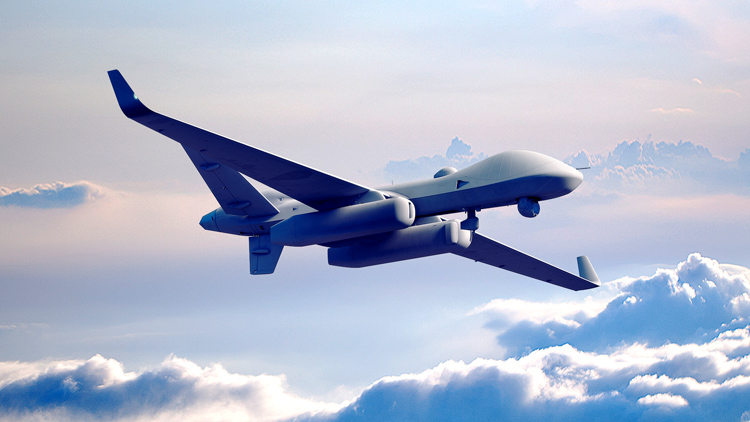
For decades, AEW, as practiced by India and other advanced nations, has been the domain of large commercial-sized jets packed with aircrew personnel as well as electronics that are expensive to acquire and even more expensive to operate.
While the MQ-9B AEW&C mission package doesn't wholly replace those traditional, exquisite systems, it does greatly extend the reach of those platforms and allows uncrewed systems to be dispatched to areas where it is simply too dangerous to send a capital asset and risk irreplaceable human lives.
GA-ASI and Saab's groundbreaking AEW&C mission package for the MQ-9B provides a cost-effective, scalable, and deployable option to counter both traditional and emerging aerial threats.
For India, a nation facing complex security challenges, this capability is a timely and strategic addition to its defence arsenal.
India's defence concerns are multifaceted, ranging from territorial disputes with peer-state adversaries to combating non-state actors utilising UAS and loitering munitions.
The proliferation of unmanned systems and advanced missile technologies has introduced a new layer of complexity to air domain awareness. Peer adversaries are expanding their UAS and missile arsenals, while non-state actors deploy increasingly sophisticated UAS for both surveillance and offensive operations.
These developments demand a robust, adaptable solution capable of detecting and responding to threats across the spectrum.
The MQ-9B AEW&C mission package answers this call. The system detects, tracks, and responds to high-altitude aircraft, stealthy cruise missiles, and low-flying UAS. The platform is particularly relevant for India, where maintaining vigilance across vast borders and maritime zones is critical to national security.
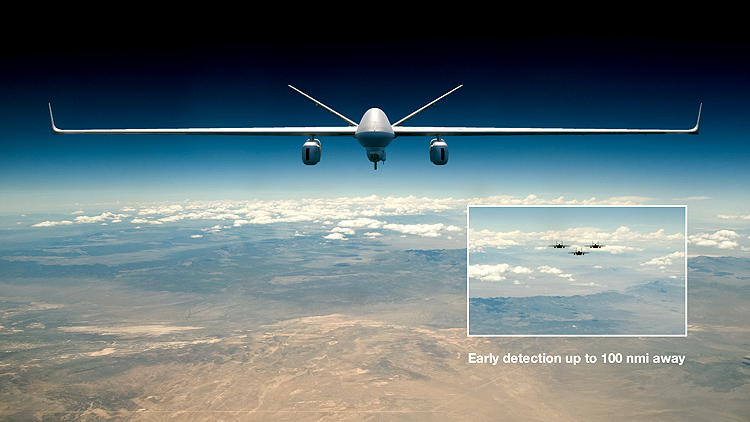
India's recent acquisition of 31 MQ-9B UAS underscores its commitment to leveraging cutting-edge unmanned systems for tri-service operations.
Adding MQ-9B aircraft with AEW capabilities would further enhance India's ability to monitor and defend its airspace, maritime corridors, and critical infrastructure.
The MQ-9B AEW&C variant is NATO STANAG 4671-compliant, ensuring interoperability with allied airspace and command frameworks. This feature aligns with India's growing emphasis on international defence partnerships and joint operations.
Whether deployed for crisis response, border security, or strategic deterrence, MQ-9B AEW&C delivers unmatched flexibility and reliability.
India's maritime security concerns are equally pressing, given its strategic position in the Indian Ocean Region (IOR).
The MQ-9B AEW&C variant's look-down radar capability over sea and land makes it a valuable asset for monitoring key sea lanes, detecting potential threats, and ensuring the safety of vital trade routes.
The MQ-9B has already proven its versatility in maritime operations, as evidenced by its SeaGuardian® configuration. The MQ-9B with AEW&C capabilities would provide India with a powerful tool to counter aerial and surface threats in the IOR. This capability is particularly relevant as peer adversaries expand their naval presence and deploy advanced missile systems in the region.
By integrating the MQ-9B AEW&C mission package into its armed forces, India gains a versatile and scalable capability to detect, track, and respond to emerging aerial threats across land and sea.
This versatile system will enhance air domain awareness, protect critical infrastructure, and secure shipping channels, providing persistent surveillance coverage where traditional platforms would be too risky or costly to deploy.
With its cost-effective and modular design, MQ-9B AEW&C is positioned to become a cornerstone of India's defence modernisation efforts, representing another strategic step toward safeguarding the subcontinent's national sovereignty and maintaining regional stability.