

The insightful articles, inspiring narrations and analytical perspectives presented by the Editorial Team, establish an alluring connect with the reader. My compliments and best wishes to SP Guide Publications.

"Over the past 60 years, the growth of SP Guide Publications has mirrored the rising stature of Indian Navy. Its well-researched and informative magazines on Defence and Aerospace sector have served to shape an educated opinion of our military personnel, policy makers and the public alike. I wish SP's Publication team continued success, fair winds and following seas in all future endeavour!"

Since, its inception in 1964, SP Guide Publications has consistently demonstrated commitment to high-quality journalism in the aerospace and defence sectors, earning a well-deserved reputation as Asia's largest media house in this domain. I wish SP Guide Publications continued success in its pursuit of excellence.
Artificial intelligence is rapidly moving from research labs into the core of modern military strategy, poised to transform how wars are fought. India's AI Summit is progressing but what can AI do in the military?

Artificial intelligence is rapidly moving from research labs into the core of modern military strategy, poised to transform how wars are fought, how forces are structured, and how decisions are made on the battlefield.
AI becomes a keyword when leaders from across the globe underscored the need for equitable, collaborative, and responsible development of artificial intelligence (AI) at the India AI Impact Summit in February in India, as key issues shaping the future of AI. But what can it do in the military?
AI's impact will be felt most strongly in two interconnected areas: scalable autonomy and human–machine teaming, and the modernisation of intelligence and military infrastructure
Defence analysts say AI's impact will be felt most strongly in two interconnected areas: scalable autonomy and human–machine teaming, and the modernisation of intelligence and military infrastructure. Together, these shifts promise to accelerate decision-making, enhance precision, and increase resilience in increasingly complex and contested environments.

Across air, land, and sea domains, militaries are investing heavily in autonomous and semi-autonomous systems. Powered by advances in machine learning, reinforcement learning, and edge computing, these systems are capable of operating with reduced human intervention while remaining under supervisory control.
Drone swarms, uncrewed ground vehicles, and autonomous maritime platforms are expected to work collaboratively, sharing data and adapting to threats even in communications-denied environments.
Drone swarms, uncrewed ground vehicles, and autonomous maritime platforms are expected to work collaboratively, sharing data and adapting to threats even in communications-denied environments
Manpreet Singh, a ML/AI expert, and AVP Genpact looks at the cutting-edge applications in the US, points out some key factors here, "The strategic implication is profound, rather than relying on a small number of high-value, manned platforms, future forces may deploy distributed networks of scalable, attritable systems. Such networks increase survivability and operational reach, complicating adversaries' targeting strategies."
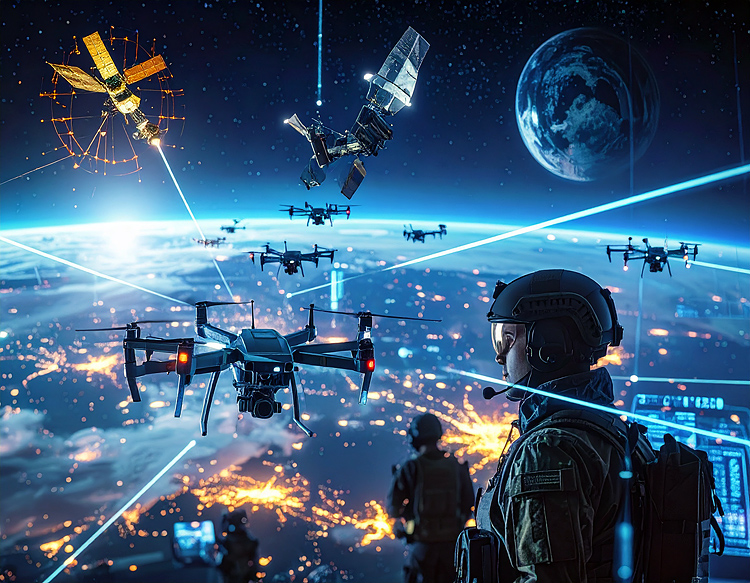
AI is not eliminating the human role in warfare—but it is changing it. Emerging "human–machine teaming" concepts envision intelligent systems that anticipate operator intent, generate response options, and dynamically adapt to shifting battlefield conditions. Rather than manually executing every action, personnel increasingly shift into supervisory command roles.
This evolution reduces cognitive burden while accelerating the so-called "decision loop"—the cycle of observing, orienting, deciding, and acting. It it's important to highlight that in high-tempo conflicts, even marginal gains in speed and accuracy can yield decisive advantage. That is what AI can be seen best in all-military applications.
Artificial intelligence is also reshaping intelligence, surveillance, and reconnaissance (ISR)
Artificial intelligence is also reshaping intelligence, surveillance, and reconnaissance (ISR). New multimodal AI models can fuse satellite imagery, drone footage, radar data, radio-frequency signals, cyber inputs, and text-based intelligence into unified situational awareness. By compressing analysis timelines, AI enables what experts describe as "sensor-to-decision" transformation—turning raw data into actionable insight in near real time.
In parallel, generative AI tools are beginning to support command-and-control functions. "These systems can simulate courses of action, assess risks, and present structured planning options at machine speed. Commanders retain authority, but the tempo of planning and execution accelerates significantly," Manpreet adds to the ML aspect.
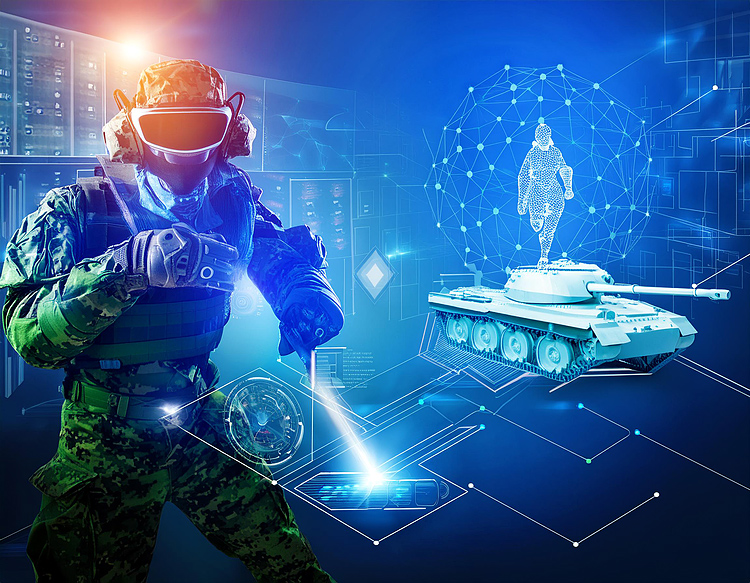
AI's influence extends beyond the front lines. In cyber and electronic warfare, machine learning systems are enabling automated threat detection, adaptive countermeasures, and real-time anomaly identification. Rather than static defences, future cyber architectures are expected to learn and evolve continuously. However, the most practical and visible AI demonstration is about predicative maintenance.
Artificial intelligence is no longer a supporting tool in defence strategy. It is fast becoming the digital backbone of military power today.
Manpreet explains the AI-based tools that predictive maintenance and AI-driven logistics systems are transforming military sustainment. By forecasting equipment failures and optimising supply chains, armed forces can shift from reactive repair to predictive readiness—ensuring higher operational availability and reduced long-term costs. In fact, digital twin simulations—virtual replicas of platforms and infrastructure—allow planners to test scenarios and anticipate disruptions before they occur.
As militaries adopt AI at scale, safeguarding these systems has become a priority. Adversarial threats—including data poisoning, spoofing, and electronic deception—pose significant risks.
To address these vulnerabilities, defence organisations are investing in secure deployment frameworks, zero-trust architectures, model robustness testing, and audit mechanisms. The goal is to ensure resilience: systems must degrade gracefully under attack rather than fail catastrophically. At the same time, responsible AI governance is emerging as a critical component of modernisation. Ethical safeguards, performance validation, and lifecycle oversight are increasingly viewed as essential to maintaining public trust and strategic stability.
Taken together, these developments point to a structural transformation in how military power is generated and applied. Future warfare is likely to feature distributed, AI-enabled autonomous systems with human commanders operating in supervisory roles. What is important is the real-time, fused intelligence ecosystems and predictive logistics and self-healing cyber defences.
In this emerging landscape, advantage will belong not merely to nations with the largest arsenals, but to those capable of securely integrating intelligent systems at scale. Artificial intelligence is no longer a supporting tool in defence strategy. It is fast becoming the digital backbone of military power today. And future AI will be radically different.
Manish Kumar Jha is a Consulting & Contributing Editor for SP's Aviation, SP's Land Forces and SP's Naval Forces and a security expert. He writes on national security, military technology, strategic affairs & policies.