
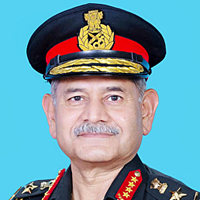
The insightful articles, inspiring narrations and analytical perspectives presented by the Editorial Team, establish an alluring connect with the reader. My compliments and best wishes to SP Guide Publications.
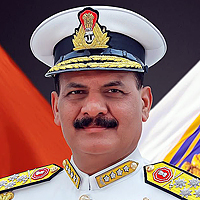
"Over the past 60 years, the growth of SP Guide Publications has mirrored the rising stature of Indian Navy. Its well-researched and informative magazines on Defence and Aerospace sector have served to shape an educated opinion of our military personnel, policy makers and the public alike. I wish SP's Publication team continued success, fair winds and following seas in all future endeavour!"

Since, its inception in 1964, SP Guide Publications has consistently demonstrated commitment to high-quality journalism in the aerospace and defence sectors, earning a well-deserved reputation as Asia's largest media house in this domain. I wish SP Guide Publications continued success in its pursuit of excellence.
Rajesh Kumar Singh's appointment comes at a crucial juncture for India's defence sector. With rising security challenges and growing emphasis on indigenous military capability, the government is looking to transform DRDO into a more agile and outcome-oriented institution.
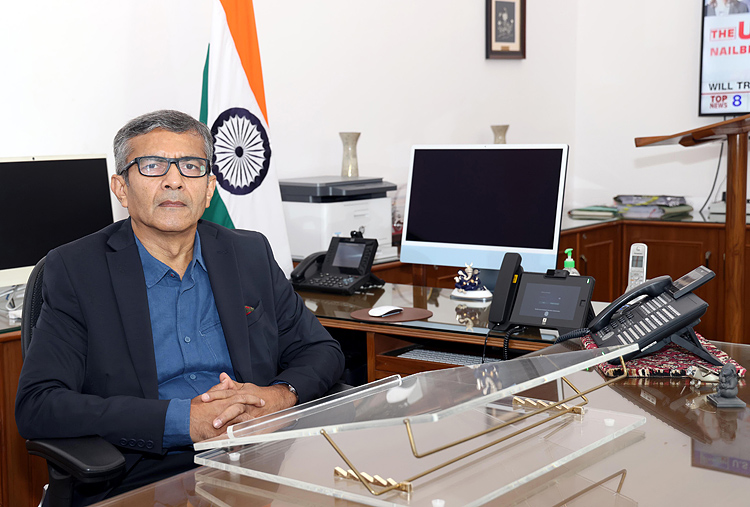
Following the retirement of Samir V. Kamat, Defence Secretary Rajesh Kumar Singh has assumed the additional charge of Chairman of the Defence Research and Development Organisation (DRDO), placing one of the country's most critical defence technology institutions under the stewardship of the government's top defence bureaucrat at a time when India is seeking to accelerate military modernisation and strengthen indigenous capabilities.
The move comes amid growing expectations that DRDO will play a central role in advancing India's technological edge in emerging domains of warfare. It primarily aims to reduce dependence on foreign technology and imports.
The move comes amid growing expectations that DRDO will play a central role in advancing India's technological edge in emerging domains of warfare
Singh's appointment is being viewed as an opportunity to push through long-pending reforms within the defence research ecosystem. As Defence Secretary, he has already been closely involved in policy formulation, defence procurement and indigenous manufacturing initiatives.
His dual role is expected to facilitate greater coordination between the Ministry of Defence (MoD) and DRDO, potentially speeding up decision-making and project execution, which are often seen as major obstacles.
Industry experts and defence planners have identified four key areas where the new leadership is expected to focus.
The first is a comprehensive technology overhaul. As military competition increasingly shifts towards artificial intelligence, autonomous systems, cyber warfare and space-based capabilities, DRDO is expected to reorient a larger share of its resources towards next-generation technologies. This includes the development of artificial intelligence (AI)-based combat systems, advanced unmanned platforms, quantum technologies, and space-based Intelligence, Surveillance and Reconnaissance (ISR) assets.
Dual role is expected to facilitate greater coordination between the Ministry of Defence (MoD) and DRDO, potentially speeding up decision-making and project execution
While DRDO has achieved notable successes in missile systems, radar technologies and strategic programmes, analysts argue that future conflicts will be shaped by network-centric warfare and autonomous systems, areas where India must accelerate capability development.
The second priority is improving procurement efficiency and delivery timelines. Delays in defence projects have long been a concern for the armed forces. Expectations are growing that the organisation will work closely with the MoD to streamline research, testing and acquisition processes.
A major review of the Defence Acquisition Procedure (DAP) is also anticipated, with an emphasis on reducing process and approvals and ensuring that technological solutions reach the services faster. The armed forces have repeatedly highlighted the need for shorter development cycles to keep pace with rapidly evolving threats and technologies.
Future conflicts will be shaped by network-centric warfare and autonomous systems, areas where India must accelerate capability development
Self-reliance under the government's Atmanirbhar Bharat (Self-Reliance India) initiative is expected to form the third pillar of the reform agenda. Defence planners also argue that merely assembling foreign-origin systems under licence is insufficient for long-term strategic autonomy.
The focus is likely to shift towards securing complete domestic intellectual property rights and indigenous design capabilities across major defence platforms. Such an approach would allow India to upgrade, export and sustain military systems without dependence on foreign vendors or technology providers.
It is important to highlight that true technological sovereignty can only be achieved when critical technologies are designed and controlled within the country rather than acquired through technology transfer agreements.
A major review of the Defence Acquisition Procedure (DAP) is also anticipated, with an emphasis on reducing process and approvals and ensuring that technological solutions reach the services faster
The fourth challenge before the new DRDO leadership is strengthening collaboration with private industry, startups, micro, small and medium enterprises (MSMEs), and academic institutions.
Although DRDO has increasingly partnered with private companies in recent years, experts say significant gaps remain between laboratory research and large-scale production.
Additionally, greater integration with the private sector is expected to improve manufacturing efficiency, shorten development timelines and promote innovation.
Industry leaders have long advocated a model in which DRDO focuses on advanced research and technology development while private firms drive production, commercialisation and export opportunities.
Industry leaders have long advocated a model in which DRDO focuses on advanced research and technology development while private firms drive production, commercialisation and export opportunities
Singh's appointment comes at a crucial juncture for India's defence sector. With rising security challenges and growing emphasis on indigenous military capability, the government is looking to transform DRDO from a research-driven organisation into a more agile and outcome-oriented institution capable of delivering cutting-edge technologies to the armed forces.
The defence secretary, in his role as interim chairman, is tasked with translating policy intent into measurable outcomes that will be closely watched by the military, industry and the strategic community alike.
The success of DRDO's next phase may ultimately determine how quickly India can achieve its ambition of defence indigenisation across the major platforms and systems.
Manish Kumar Jha is a Consulting & Contributing Editor for SP's Aviation, SP's Land Forces and SP's Naval Forces and a security expert. He writes on national security, military technology, strategic affairs & policies.