

The insightful articles, inspiring narrations and analytical perspectives presented by the Editorial Team, establish an alluring connect with the reader. My compliments and best wishes to SP Guide Publications.

"Over the past 60 years, the growth of SP Guide Publications has mirrored the rising stature of Indian Navy. Its well-researched and informative magazines on Defence and Aerospace sector have served to shape an educated opinion of our military personnel, policy makers and the public alike. I wish SP's Publication team continued success, fair winds and following seas in all future endeavour!"

Since, its inception in 1964, SP Guide Publications has consistently demonstrated commitment to high-quality journalism in the aerospace and defence sectors, earning a well-deserved reputation as Asia's largest media house in this domain. I wish SP Guide Publications continued success in its pursuit of excellence.
Indian Air Force is looking for 500 Indigenous Systems to Strengthen Surveillance along Enemy Frontiers
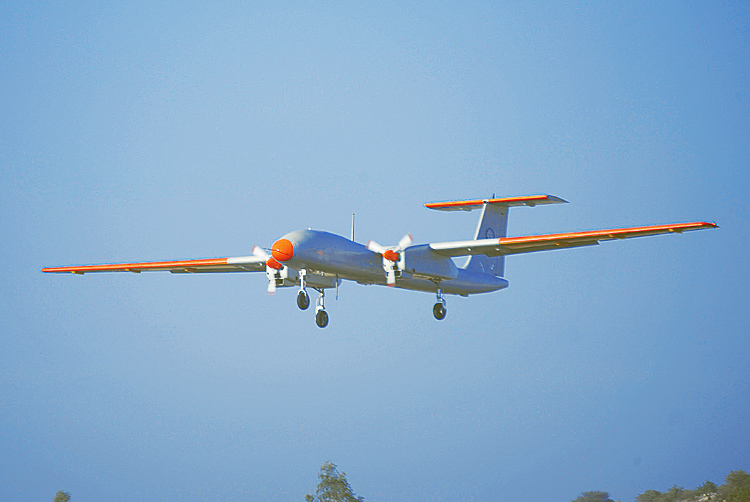
In a significant move to strengthen its Intelligence, Surveillance, and Reconnaissance (ISR) capabilities, the Indian Air Force (IAF) has begun searching for 500 low-cost, indigenous expendable spy drones that can be launched from canisters or catapults without a runway.
The IAF has issued a Request for Information (RFI), inviting responses by January 12, 2027.
Designed to penetrate hostile airspaceand gather real-time intelligence, these small unmanned systems aim to fill a critical gap in India's airborne surveillance network.
Designed to penetrate hostile airspaceand gather real-time intelligence, these small unmanned systems aim to fill a critical gap in India's airborne surveillance network
The proposed drones reflect a changing character of modern warfare, where the ability to detect an adversary's radar and air defence infrastructure before launching an operation can be as important as the strike capability itself.
The IAF's requirement is for low-cost, small-form-factor platforms capable of intercepting radar emissions and identifying their direction.
In simple terms, these are specialised electronic surveillance drones designed to locate hostile radar systems by detecting the electromagnetic signals they transmit. Their electro-optical and infrared (EO/IR) sensors will provide day-and-night imagery, allowing operators to observe and identify potential targets.
These are specialised electronic surveillance drones designed to locate hostile radar systems by detecting the electromagnetic signals they transmit
One of the most important requirements is the ability to operate in a Global Navigation Satellite System (GNSS)-denied environment. This means the drones must continue navigating and carrying out their missions even when satellite navigation signals are jammed or disrupted by an adversary.
Such a capability is now highly relevant along India's northern and western frontiers, where electronic warfare could complicate conventional surveillance and navigation.
According to the IAF's requirements, the drones should be capable of flying at altitudes of up to 25,000 feet, remaining airborne for six hours and covering distances exceeding 200 km. Additionally, they must also be operationally simple. A two-person crew should be able to launch multiple drones within a 10-minute window, enabling rapid deployment when intelligence requirements emerge.
The drones must continue navigating and carrying out their missions even when satellite navigation signals are jammed or disrupted by an adversary
Despite being described as expendable, the platforms are expected to have a safe recovery mechanism. This allows them to be retrieved and reused for subsequent missions. This requirement is significant because it combines the operational flexibility of unmanned systems with the cost advantages of repeated deployment.
The proposed drones will not replace the IAF's existing airborne early-warning
Airborne Warning and Control System (AWACS) aircraft primarily provide a wide-area picture of the airspace, tracking hostile aircraft and missile activity from relatively secure positions.
The proposed drones will not replace the IAF's existing airborne early-warning and surveillance platforms. Instead, they will add another layer to a broader ISR architecture
Intelligence, Surveillance, Target Acquisition and Reconnaissance (ISTAR) platforms, meanwhile, gather information about ground targets, often from stand-off distances. The new drones are intended to perform a more specialised role: penetrating contested areas and detecting radar emissions.
This capability is particularly relevant in the context of China's expanding military infrastructure across the Line of Actual Control (LAC) and Pakistan's integrated air defence network. Modern air defence systems are designed to detect and engage incoming aircraft and weapons, making the identification of radar locations and various patterns important.
For the IAF, the requirement also reflects a larger concern about the limited size of India's airborne surveillance fleet. Its existing network relies heavily on Israeli-origin Heron and Searcher unmanned aerial vehicles, alongside a small number of airborne early-warning and control platforms.
The IAF is pursuing several programmes to strengthen its airborne surveillance capabilities
The limitations have, at times, required the armed forces to employ platforms beyond their original operational roles. During military tensions with China, the Navy's P-8I long-range maritime reconnaissance aircraft were also deployed to monitor developments along the Himalayan frontier.
This demonstrated the importance of flexible surveillance assets, but also underlined the pressure on India's existing ISR resources.
The IAF is pursuing several programmes to strengthen its airborne surveillance capabilities. These include six upgraded Netra Mk-1A Airborne Early Warning and Control (AEW&C) aircraft and six larger Netra Mk-II platforms. The programmes are expected to improve India's ability to monitor airspace, detect incoming threats and coordinate operations. However, translating these projects into operational capability will take time.
The programmes are expected to improve India's ability to monitor airspace, detect incoming threats and coordinate operations
India's acquisition of MQ-9B Predator drones from the United States is another major component of its unmanned surveillance plans. Under the October 2024 agreement, India contracted for 31 MQ-9B remotely piloted aircraft at a reported cost of around ₹32,000 crore. The IAF is allocated eight of these platforms, while the Navy and Army will receive the remainder. Deliveries are expected to begin in 2029, leaving a considerable gap before the fleet becomes fully operational.
The programme will also require close integration of sensors, electronic intelligence systems, secure communications, and navigation tech, among others.
The programme for 500 drones could provide a significant production opportunity for the domestic industry in domestic electronics, miniaturised sensors and autonomous navigation.
Manish Kumar Jha is a Consulting & Contributing Editor for SP's Aviation, SP's Land Forces and SP's Naval Forces and a security expert. He writes on national security, military technology, strategic affairs & policies.