
The insightful articles, inspiring narrations and analytical perspectives presented by the Editorial Team, establish an alluring connect with the reader. My compliments and best wishes to SP Guide Publications.
"Over the past 60 years, the growth of SP Guide Publications has mirrored the rising stature of Indian Navy. Its well-researched and informative magazines on Defence and Aerospace sector have served to shape an educated opinion of our military personnel, policy makers and the public alike. I wish SP's Publication team continued success, fair winds and following seas in all future endeavour!"

Since, its inception in 1964, SP Guide Publications has consistently demonstrated commitment to high-quality journalism in the aerospace and defence sectors, earning a well-deserved reputation as Asia's largest media house in this domain. I wish SP Guide Publications continued success in its pursuit of excellence.
This article examines the principal achievements and new initiatives undertaken by General Anil Chauhan during his tenure as CDS, which is set to conclude on May 30, 2026.
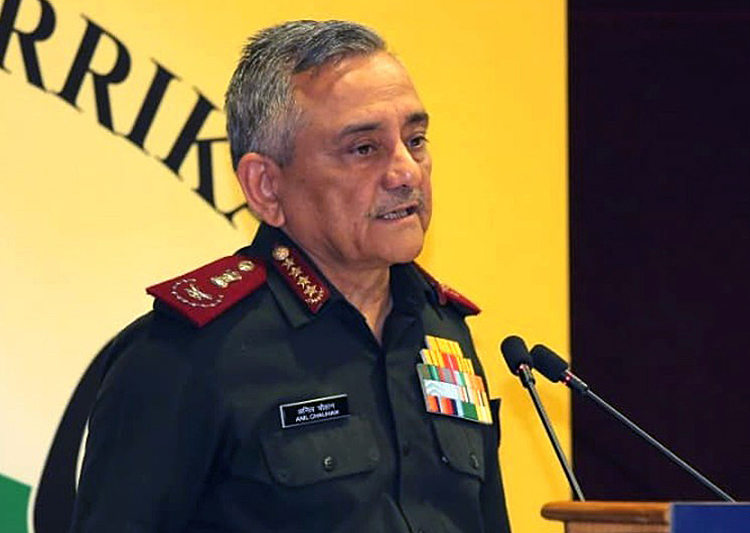
When General Anil Chauhan assumed office as India's second Chief of Defence Staff (CDS) on September 30, 2022, the post itself was at a crossroad. The tragic passing of General Bipin Rawat in December 2021 had left a nine-month vacuum at the apex of India's higher defence architecture, and fundamental questions about the relevance and scope of the CDS institution remained unanswered. Over the next three-and-a-half years, General Chauhan would not merely fill the vacancy — he would reshape the very contours of India's defence integration agenda, launch a suite of new initiatives, and, in the process, deliver the most consequential structural reforms the Indian Armed Forces have witnessed since independence.
Born on May 18, 1961, General Chauhan is an alumnus of the National Defence Academy (NDA), Khadakwasla, and the Indian Military Academy (IMA), Dehradun. Commissioned into the 11th Gorkha Rifles on June 13, 1981, he accumulated nearly four decades of distinguished service before his first retirement in May 2021.
General Chauhan would reshape the very contours of India's defence integration agenda, launch a suite of new initiatives, and, in the process, deliver the most consequential structural reforms the Indian Armed Forces have witnessed since independence
His career is notable for its breadth: he commanded an Infantry Division in the sensitive Baramulla sector of Jammu & Kashmir, led a Corps in the North East, and served as the General Officer Commanding-in-Chief (GOC-in-C) of Eastern Command — the formation directly responsible for India's land frontier with China. He also held the critical appointment of Director General of Military Operations (DGMO), giving him an intimate understanding of real-time operational decision-making. Decorated with the Param Vishisht Seva Medal (PVSM), Uttam Yudh Seva Medal (UYSM), Ati Vishisht Seva Medal (AVSM), Sena Medal (SM), and Vishisht Seva Medal (VSM), General Chauhan brought to the CDS office a rare combination of operational credibility, strategic depth, and institutional memory.
Prior to his re-appointment, he had been serving as Military Advisor in the National Security Council Secretariat (NSCS), further sharpening his grasp of the intersection between military capability and national security policy.
If General Chauhan's tenure is to be remembered for a single, transformative initiative, it is the advancement of the Integrated Theatre Command (ITC) framework — India's long-delayed answer to the question of how a nation with three separate services, seventeen single-service commands, and a two-front strategic challenge should organise itself for modern, multi-domain warfare.
For decades, India's military structure had operated on a World War II-era model: the Army, Navy, and Air Force maintained separate command hierarchies, planned in silos, and coordinated largely through goodwill and ad hoc liaison. While the Kargil Review Committee (1999) and the Naresh Chandra Committee (2012) had recommended integrated theatre commands, progress had been glacial, hampered by inter-service turf wars, institutional inertia, and a lack of political will.
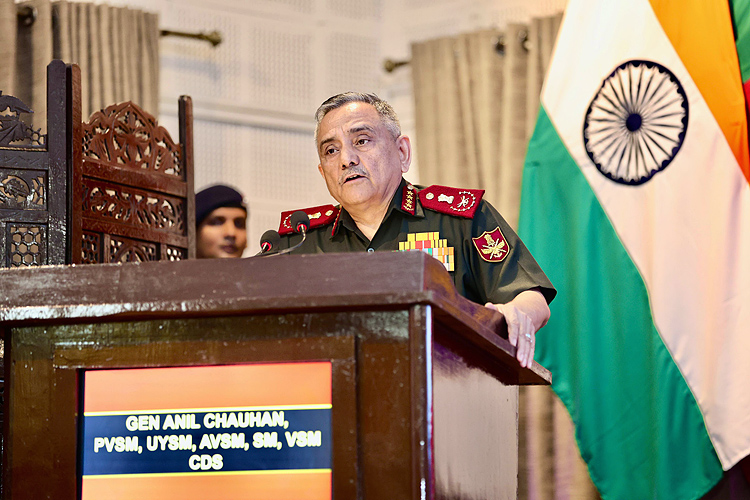
Under General Chauhan's stewardship, the military conducted an exhaustive deliberative process — referred to in internal circles as "Operation Tiranga" — to design a viable theatre command architecture. By early 2026, a finalised framework for three Integrated Theatre Commands was submitted to the Ministry of Defence for government approval:
This framework represents a fundamental restructuring of India's military geography, moving away from service-specific fiefdoms towards theatre-level integration where a single commander wields authority over all land, air, and naval assets in a given operational theatre.
If General Chauhan's tenure is to be remembered for a single, transformative initiative, it is the advancement of the Integrated Theatre Command (ITC) framework
General Chauhan identified approximately 197 integration initiatives required to bring the theatre command vision to fruition. By the end of his tenure, 163 of these tasks had been substantially progressed. To build consensus within an institution resistant to change, he personally conducted more than 100 talks and seminars at military establishments across the country — an unprecedented level of personal advocacy by a CDS.
General Chauhan recognised early that the greatest obstacle to theaterisation was not structural design but institutional mindset. Decades of single-service culture had fostered what he described as "entrenched mindsets" and "protectionism" — the instinctive tendency of each service to guard its assets, roles, and budgets against perceived encroachment.
His response was the articulation of "Jointness 2.0" — a conceptual shift that moved the integration agenda beyond the earlier paradigm of inter-service camaraderie towards a fundamentally different operating philosophy: shared doctrine, shared planning, and shared execution.
Binding Joint Authority for the CDS: In June 2025, a pivotal reform empowered the CDS to issue binding "Joint Instructions" and "Joint Orders" to all the three services. This was a watershed moment — the CDS could now move beyond mere coordination to exercising genuine operational command authority.
Separation of Operational and Administrative Functions: General Chauhan championed the principle of separating operational functions from "Raise, Train, Sustain" (RTS) responsibilities. Under this model, theatre commanders would focus exclusively on warfighting, while service chiefs would retain administrative authority.
General Chauhan articulated 'Jointness 2.0' — a conceptual shift that moved the integration agenda beyond the earlier paradigm of inter-service camaraderie
Joint Operations Centre (JOC): A fully operational tri-service Joint Operations Centre has been scheduled to be established in New Delhi by May 2026, providing a permanent, real-time fusion centre for intelligence, surveillance, and operational coordination.
Resource Optimisation: The restructuring involved de-layering headquarters and reallocating approximately 500 officers and 2,000 personnel from other less critical billets to support the new joint structures.
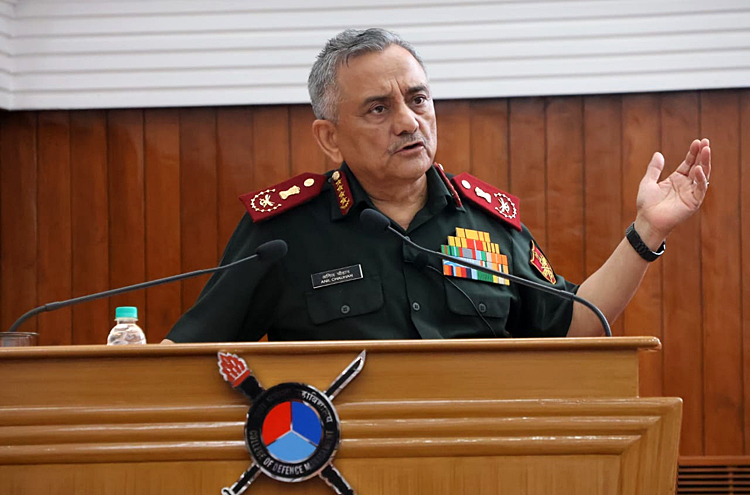
The Ministry of Defence's designation of 2025 as the "Year of Reform" provided General Chauhan with both a mandate and a deadline. He used it to accelerate the pace of change across multiple axes:
In August 2025, General Chauhan formally released the declassified version of the Joint Doctrine for Cyberspace Operations — a keystone document that, for the first time, provided a unified strategic framework for the planning and execution of cyberspace operations across all three services.
The doctrine acknowledged an uncomfortable truth: that modern warfare involves "bytes as well as bullets," and that cyberspace is a domain that challenges traditional notions of territorial integrity. By providing a common lexicon, shared threat assessments, and integrated operational guidelines, the doctrine enabled synchronised, faster, and more effective responses to complex, multi-domain cyber threats.
Operation Sindoor demonstrated that the jointness reforms were not merely theoretical — real-time coordination between the Army, Navy, and Air Force was a tangible operational reality
General Chauhan was among the first Indian military leader to articulate a comprehensive vision for multi-domain operations (MDO) — the convergence of effects across physical, synthetic (cyber and electromagnetic), and cognitive realms.
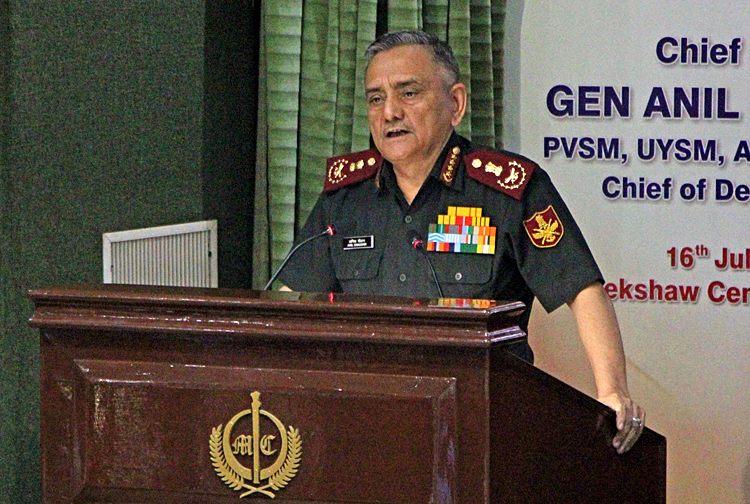
General Chauhan was a vocal and persistent advocate for Atmanirbharta (self-reliance) in defence, but he brought a distinctive candour to the discourse. While celebrating the progress of India's defence industrial ecosystem, he did not shy away from publicly criticising domestic defence manufacturers who engaged in "over-promising and under-delivering." In late 2025, he issued a pointed warning to Indian defence industry players, urging them to be truthful about indigenous capabilities, cost-competitive, and patriotic in their dealings.
The true test of any military reform comes in the crucible of operations. Operation Sindoor — India's military response to the Pahalgam terrorist attack of 22 April 2025 — provided that test.
Over three-and-a-half years, General Chauhan advanced the structural integration of India's armed forces farther than any predecessor, while simultaneously establishing the CDS as a position of genuine operational authority and strategic vision
During the four-day operation (7–10 May 2025), India conducted precision strikes against terrorist infrastructure while maintaining escalation dominance over Pakistan. General Chauhan later described the operation as "unique" — a largely non-contact, non-kinetic engagement that blended traditional military capabilities with cyber, space, and electromagnetic spectrum operations.
General Chauhan used the lessons of Operation Sindoor to reinforce his reform agenda, urging the armed forces not to prepare for "a repetition of the previous Sindoor" but to anticipate and prepare for future challenges of a different character and scale.
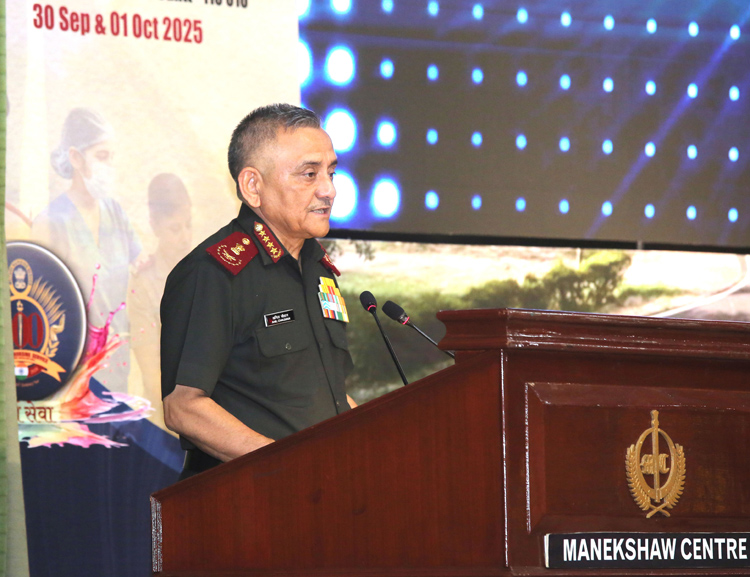
On the perennial debate over defence spending, General Chauhan rejected the traditional "guns versus butter" binary, arguing that smart defence expenditure directly contributes to national economic growth. He indicated that the defence allocation — hovering just under 2 per cent of GDP — was adequate provided the economy maintained healthy growth and inflation remained stable.
General Anil Chauhan inherited an institution in transition and a post in search of definition. Over three-and-a-half years, he provided both: advancing the structural integration of India's armed forces farther than any predecessor, while simultaneously establishing the CDS as a position of genuine operational authority and strategic vision. His initiatives — from theatre commands and Jointness 2.0 to the Joint Doctrine for Cyberspace Operations and the JAI Triad — constitute a coherent, mutually reinforcing agenda that has fundamentally altered the trajectory of India's military modernisation.
Whether history judges him as the architect who completed the transformation or as the visionary who set it irreversibly in motion will depend on what his successors do with the foundation he has laid. What is already beyond dispute is that General Chauhan took a post diminished by tragedy and vacancy and, through force of intellect, institutional savvy, and relentless personal engagement, transformed it into the engine of India's military future.