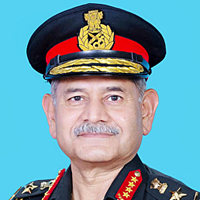
The insightful articles, inspiring narrations and analytical perspectives presented by the Editorial Team, establish an alluring connect with the reader. My compliments and best wishes to SP Guide Publications.
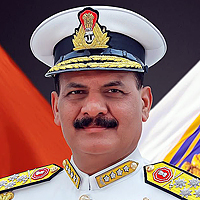
"Over the past 60 years, the growth of SP Guide Publications has mirrored the rising stature of Indian Navy. Its well-researched and informative magazines on Defence and Aerospace sector have served to shape an educated opinion of our military personnel, policy makers and the public alike. I wish SP's Publication team continued success, fair winds and following seas in all future endeavour!"

Since, its inception in 1964, SP Guide Publications has consistently demonstrated commitment to high-quality journalism in the aerospace and defence sectors, earning a well-deserved reputation as Asia's largest media house in this domain. I wish SP Guide Publications continued success in its pursuit of excellence.
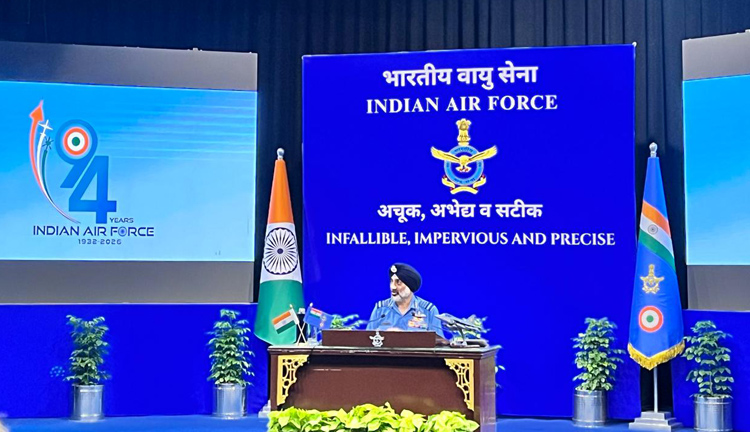
29 Squadrons, 36–40 Fighters a Year and an Air Force Built for the Next War. In his final press conference before superannuation, Air Chief Marshal A.P. Singh offers a candid roadmap for fighter strength, jointness, theatre commands and next-generation air power.
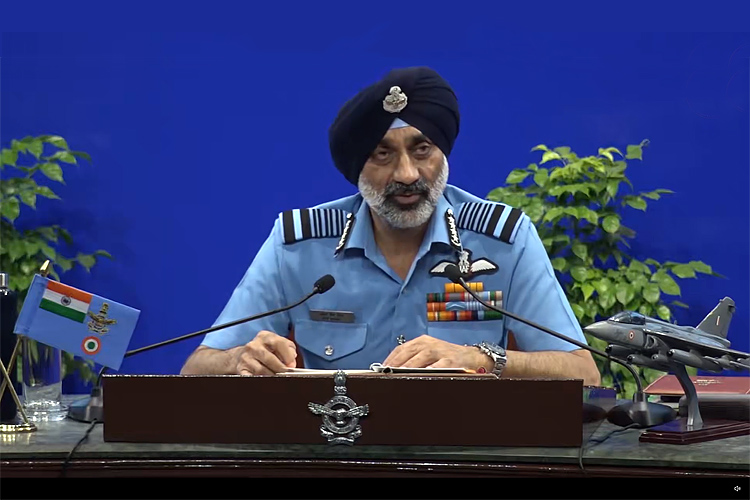
"Technology delayed is technology denied", that recurring refrain from Air Chief Marshal A.P. Singh perhaps best captures the central message of his final annual press conference as Chief of the Air Staff ahead of the 94th IAF Day on October 8, 2026.
With the IAF's fighter strength down to 29 squadrons against a sanctioned strength of around 42, Singh was unusually direct about the consequences of delayed inductions. The force needs to induct 36–40 fighter aircraft every year i.e roughly two squadrons annually, simply to arrest the decline and begin moving back towards its sanctioned strength. And even that, he made clear, is not the ultimate requirement, "Actually, we need even more than that."
The force needs to induct 36–40 fighter aircraft every year i.e roughly two squadrons annually, simply to arrest the decline and begin moving back towards its sanctioned strength
For an Air Chief preparing to hand over command at the end of October, the assessment was strikingly candid. But the briefing was about much more than fighter numbers. Singh spoke about the shape of India's future air power, a force built around manned and unmanned systems, long-range precision weapons, integrated air defence, satellites, sensors, data networks and artificial intelligence, operating as an increasingly interconnected combat architecture.
He also addressed the difficult questions surrounding Tejas Mk1A delays, the MRFA programme, AMCA, a possible fifth-generation capability gap, theatre commands, indigenous engines, Astra missiles and the prioritisation of India's aerospace development programmes. The larger message was unmistakable. India needs to move faster, not merely in acquiring platforms, but in developing, integrating and fielding technology.
The IAF's fighter strength has fallen to 29 squadrons, well below the sanctioned 42. The retirement of legacy aircraft, including the MiG-21 fleet, has widened the gap at a time when the induction of replacement aircraft has not kept pace.
Singh said the IAF needs to induct 36–40 fighters every year in the coming years. The immediate objective is to prevent the force from falling below 30 squadrons and then begin rebuilding towards the sanctioned level. But the Chief went further. Even if the IAF succeeds in reaching 42 squadrons, he suggested that the force would need more than that to meet the demands of India's security environment.
An order is not an operational capability
That distinction is significant. The debate isn't simply about restoring the IAF to an old authorised figure; it is about determining what level of air power India actually requires in an environment shaped by two-front contingencies, increasingly sophisticated air-defence systems, long-range weapons and the arrival of fifth-generation fighters in the region.
The Air Chief also made another important point, India cannot expect one fighter type to do everything. The future fleet, he said, will require a "happy mix" of three or four fighter types, because no single aircraft can efficiently perform every role or necessarily offer the most cost-effective solution across the spectrum.
That points towards a layered combat fleet involving Tejas Mk1A, Tejas Mk2, MRFA and eventually AMCA, alongside the existing Su-30 MKI, Rafale, MiG-29, Mirage 2000 and Jaguar fleets. The challenge is making the transition between these generations without allowing the force structure to fall further.
The annual induction requirement also puts the spotlight firmly on India's aerospace production capacity. HAL has indicated a target of increasing Tejas production, while the MRFA programme could provide another stream of aircraft once contracted and production begins in India. Additional Su-30 MKI aircraft are also part of the near-term equation. If these programmes move according to plan, the IAF believes it can begin approaching the required annual induction rate.
India cannot allow a capability gap to develop simply because the preferred indigenous programme takes longer than anticipated
But the underlying issue remains timeliness. An order is not an operational capability. Between sanction and squadron service lie design, production, systems integration, testing, weapons qualification, training and acceptance. That is why Singh's repeated criticism of delays has been so pointed.
The Tejas Mk1A was expected to become one of the principal answers to the IAF's fighter shortage. Instead, its delayed induction has become a source of operational concern. Singh acknowledged that the delay had gone on much longer than anticipated and said it was hurting the IAF.
Ambition has to be matched by development capacity
The engine-supply bottleneck has been the most visible problem, but it is not the entire story. With engines now becoming available, the programme has had to work through the remaining integration and validation issues, including radar and weapons-related challenges. The question is not whether an engine is available, but whether the complete Mk1A configuration can be delivered, validated and inducted into operational service.
For the IAF, every additional delay has a direct bearing on squadron strength. And this is where Singh's phrase "technology delayed is technology denied" acquires operational significance. India can develop an indigenous fighter, but if the aircraft arrives years after the capability gap emerges, the development success does not translate quickly enough into combat strength.
The proposed 114-aircraft Multi-Role Fighter Aircraft programme therefore assumes considerable importance. Singh indicated that the IAF hopes to conclude the MRFA contract during the current financial year, subject to the remaining negotiations and commercial issues.
MRFA is not a substitute for indigenous programmes. It is a bridge between today's capability requirement and the future fleet
The programme is expected to provide a major boost to fighter strength and, importantly, create another production stream at a time when the IAF needs to increase annual induction rates. But MRFA is not a substitute for indigenous programmes. It is a bridge between today's capability requirement and the future fleet.
The most strategically consequential part of the fighter discussion concerned AMCA. India's indigenous Advanced Medium Combat Aircraft remains the IAF's long-term fifth-generation solution. But the operational requirement cannot simply wait for technology to mature indefinitely.
Singh said the arrival of fifth-generation aircraft in India's neighbourhood is a cause for concern. If AMCA faces significant delays, the IAF may have to consider another platform to bridge the gap. Russia has offered the Su-57, but Singh made clear that no decision has been taken.
The significance of the statement lies less in the Russian aircraft itself than in the underlying operational logic: India cannot allow a capability gap to develop simply because the preferred indigenous programme takes longer than anticipated.
That is a difficult balancing act, protecting the strategic objective of indigenous fifth-generation capability while ensuring that the IAF does not fall behind the regional threat environment.
One of Singh's more consequential observations concerned India's indigenous aerospace development ecosystem itself. India is simultaneously pursuing Tejas Mk1A, Tejas Mk2, AMCA and the Twin Engine Deck Based Fighter, along with missiles, radars and other aerospace technologies.
The future is not a drone force fighting a separate war alongside the conventional air force. It is a networked force in which drones, fighters, missiles, sensors, electronic warfare and air defence contribute to the same operational objective
Singh questioned whether the country is spreading limited design and development resources too thinly. If the same organisation and teams are working simultaneously on several major programmes, resources and specialist manpower inevitably have to be divided. His answer was not to abandon indigenous programmes. It was to prioritise them more sharply.
The question of whether the country needs additional institutional capacity, potentially even another Aeronautical Development Agency was raised in this context. The underlying proposition is straightforward: ambition has to be matched by development capacity.
Singh also provided an update on the indigenous Astra air-to-air missile family. The IAF's future combat capability will not be determined by aircraft alone. The Astra Mk2 is midway through its R&D phase, while work on the Astra Mk-3 has entered its initial stage.
That is strategically significant because the effectiveness of a modern fighter increasingly depends on the quality of its sensors, data links and weapons. A sophisticated fighter with inadequate weapons or incomplete systems integration cannot deliver its full combat potential. The IAF's objective, therefore, is to build an entire ecosystem around the platform.
Singh's position on theatre commands was also nuanced. The IAF is not opposed to theatre commands and recognises the importance of jointness. But Operation Sindoor has altered the context in which the theatreisation debate is taking place.
The Chief argued that the lessons of the operation need to be incorporated before the final structure and sequencing are settled. The issue is not whether the Army, Navy and Air Force should operate jointly, that they must.
The more difficult question is how India's limited high-end combat assets, particularly fighters, strategic airlift, airborne surveillance and other specialised capabilities, should be allocated across theatres without unnecessarily fragmenting their effectiveness.
For the IAF, this is particularly important because air power is inherently flexible. Aircraft can be moved rapidly across geographical theatres, allowing the Service to concentrate combat power where it is required. Any future theatre architecture therefore has to preserve that flexibility while delivering the advantages of joint command and integrated operations.
On drones, Singh's message was equally clear. The IAF does not envisage creating a separate drone force. Instead, unmanned systems and loitering munitions will increasingly become part of the existing force structure and operate alongside manned aircraft, air defence, precision weapons and other systems.
Singh described drones as "evolutionary" rather than "revolutionary" for the IAF. The distinction matters. The future is not a drone force fighting a separate war alongside the conventional air force. It is a networked force in which drones, fighters, missiles, sensors, electronic warfare and air defence contribute to the same operational objective.
The experience of Operation Sindoor has reinforced that approach, with Indian loitering munitions playing an operational role.
Artificial intelligence is rapidly moving from experimentation into the operational architecture of the IAF.
Singh stressed that AI will assist commanders and operators while the human remains in the decision-making chain. The next technological leap, therefore, is not simply about acquiring AI tools, but building the data, connectivity, computing and command architecture that allows them to work reliably in combat.
The IAF is also expanding its role in the space domain. Singh said the force is working on space situational awareness, while using satellites to support communications, intelligence, surveillance and reconnaissance and other operations.
The weaponisation of space is also being examined, although work remains at the research and development stage. The direction is clear: the boundaries between air and space operations are becoming increasingly interconnected.
For Singh, genuine aerospace self-reliance ultimately has to include propulsion. He reiterated the need for an Indian fighter engine, describing the programme as a potential launch pad for future aerospace development. The significance goes beyond the engine itself.
A domestic fighter engine would create capabilities across materials, metallurgy, hot-section technology, manufacturing, testing and certification that could feed into future generations of military and civilian aerospace programmes.
The Tejas experience has demonstrated the vulnerability created when a critical component remains dependent on an overseas supplier. For India to become genuinely self-reliant in military aviation, the ambition must therefore extend from airframe to engine, radar, weapons, electronic warfare, software and sustainment.
Few recent IAF Chiefs have spoken as openly about the shortcomings of India's defence production system as Singh. At Aero India 2025, his blunt criticism of HAL's pace of Tejas production became public. He questioned whether the organisation was operating with the urgency required and famously said he was "not confident of HAL" and that it did not appear to be operating in "mission mode."
His criticism was not a rejection of indigenous capability. His argument has consistently been that India must build at home, but it must also deliver on time. In subsequent public addresses, Singh expanded the argument beyond aircraft. Technology sitting in a laboratory is not enough. A technology has to be developed, tested, scaled, certified, manufactured and fielded.
He has repeatedly called for a whole-of-nation approach, bringing together the armed forces, industry, researchers, academia, regulators, quality agencies, incubators and investors. That is particularly relevant to drones and other rapidly evolving technologies, where the development cycle can be dramatically shorter than the traditional defence acquisition cycle.
The final annual press conference of Air Chief Marshal A.P. Singh's tenure leaves behind a picture of an IAF undergoing a fundamental transition.
It is an Air Force that needs more fighters, but also one that recognises that air power is no longer defined by fighters alone. It is fighters plus drones, Weapons plus sensors, Satellites plus data, AI plus human judgement, Air power plus jointness, Indigenous design plus industrial-scale production, and above all, technology plus speed of execution.
The numbers are stark. 29 fighter squadrons today, 36–40 aircraft required every year, and a sanctioned strength of 42 that the Air Chief himself suggests may no longer be enough.
The answer will not come from one programme. It will require Tejas Mk1A to arrive, Tejas Mk2 to mature, MRFA to move, AMCA to remain on schedule, indigenous weapons to advance, drones to proliferate, AI to be integrated, space capabilities to expand and ultimately India to develop its own fighter engine.
As Singh approaches the end of his tenure, his most persistent warning may prove to be his most important one:
Technology is useful only when it reaches the war fighter while it is still relevant.