
The insightful articles, inspiring narrations and analytical perspectives presented by the Editorial Team, establish an alluring connect with the reader. My compliments and best wishes to SP Guide Publications.

"Over the past 60 years, the growth of SP Guide Publications has mirrored the rising stature of Indian Navy. Its well-researched and informative magazines on Defence and Aerospace sector have served to shape an educated opinion of our military personnel, policy makers and the public alike. I wish SP's Publication team continued success, fair winds and following seas in all future endeavour!"

Since, its inception in 1964, SP Guide Publications has consistently demonstrated commitment to high-quality journalism in the aerospace and defence sectors, earning a well-deserved reputation as Asia's largest media house in this domain. I wish SP Guide Publications continued success in its pursuit of excellence.
Inducted into the IAF in 1963, the MiG-21 was India's first supersonic jet fighter and played a critical role in transforming the IAF into a formidable air power in the subcontinent
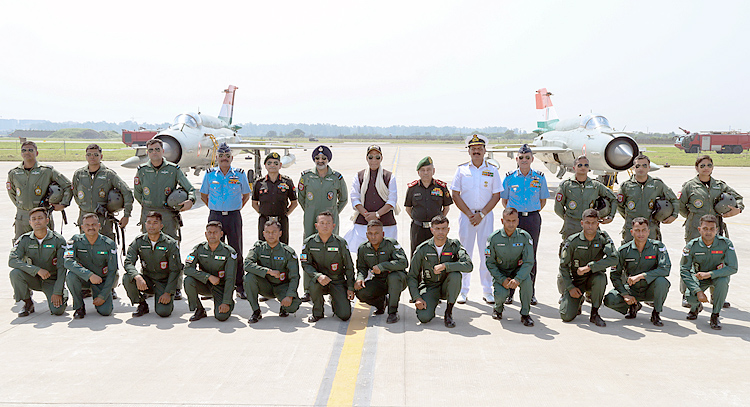
The Indian Air Force (IAF) is set to retire the last remaining squadrons of the MiG-21 by the end of 2025, bringing the curtain down on more than six decades of service by one of the world's most iconic fighter jets. The last of the MiG-21 jets, belonging to number 23rd Squadron, called "Panthers", have been given a farewell at the decommissioning ceremony at the Chandigarh Air Force station.
Giving a full ceremonial honour to such a legacy, Air Chief Marshal A.P. Singh flew the sortie of the MiG-21 Bison aircraft with call sign Badal 3.
Giving a full ceremonial honour to such a legacy, Air Chief Marshal A.P. Singh flew the sortie of the MiG-21 Bison aircraft with call sign Badal 3. Dilbagh Singh, who became the IAF Chief in 1981, led the first MiG-21 Squadron here in 1963.
Bidding farewell, Defence Minister Rajnath Singh called the MiG-21 a mighty machine and a national pride, said there is a deep attachment to the aircraft that shaped our confidence.
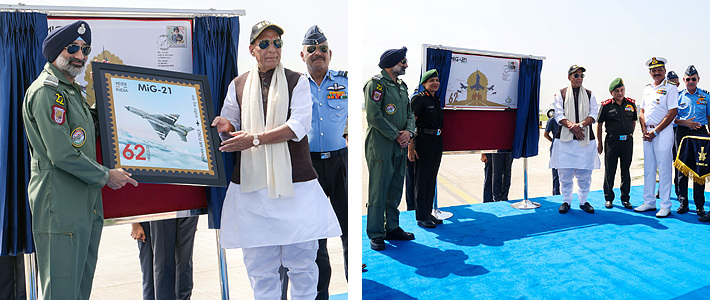
"The history of military aviation is incredible. The MiG-21 added many proud moments in our military aviation journey," the defence minister said.
Lately, while it had mixed reviewsfrom critics, but was remembered with deep respect by generations of pilots for its versatility. The MiG-21 leaves behind a complex but storied legacy.
Inducted into the IAF in 1963, the MiG-21 was India's first supersonic jet fighter and played a critical role in transforming the IAF into a formidable air power in the subcontinent. Built under license from the Soviet Union, the delta-winged interceptor was a product of Cold War engineering and served in various upgraded forms for over 60 years.
The aircraft saw action in multiple conflicts, including the Indo-Pak wars of 1965 and 1971, as well as the Kargil War of 1999.
The aircraft saw action in multiple conflicts, including the Indo-Pak wars of 1965 and 1971, as well as the Kargil War of 1999. Most notably, in February 2019, a MiG-21 Bison flown by Wing Commander Abhinandan Varthaman shot down a Pakistani F-16 during an aerial dogfight—an extraordinary feat that brought the ageing platform back into the spotlight.
While its combat record is impressive, the MiG-21 has also drawn criticism for its high accident rate. Since the 1970s, over 400 MiG-21s have been lost in crashes, claiming the lives of more than 200 pilots. Mechanical failures, outdated systems, and a challenging flight profile led to its grim nickname.
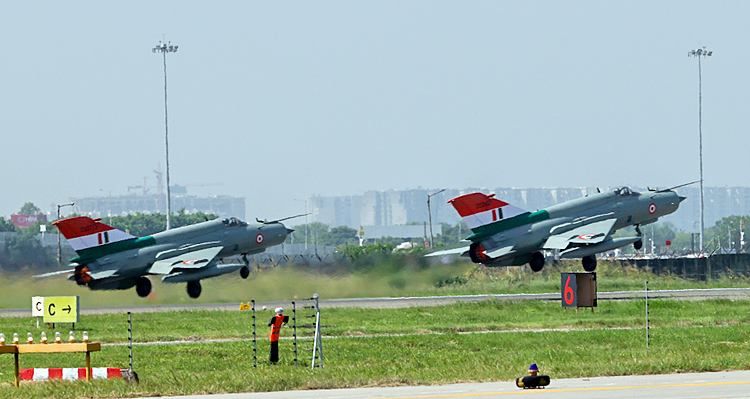
Despite these challenges, the aircraft remained a mainstay of the IAF due to delays in the procurement of modern replacements and the gradual phasing out of other Soviet-era platforms.
"Operating the MiG-21 was never easy, but it made men out of boys," said a retired IAF Air Marshal. "It demanded precision, discipline, and raw courage."
The last MiG-21 squadrons—currently based in Rajasthan and Punjab—are expected to be decommissioned by December 2025.
The IAF currently operates a shrinking number of MiG-21 Bison variants, the most advanced and heavily upgraded version of the aircraft. These are now being replaced by more modern platforms such as the indigenous HAL Tejas, the French Rafale, and soon, the upcoming fifth-generation AMCA (Advanced Medium Combat Aircraft).
As India bids farewell to the MiG-21, it also closes a defining chapter in its defence history. From Cold War relic to national icon, the aircraft's journey has been one of resilience, adaptation, and undying service.
The retirement is part of a broader modernisation drive to streamline the IAF's fleet and enhance operational readiness. The last MiG-21 squadrons—currently based in Rajasthan and Punjab—are expected to be decommissioned by December 2025.
A ceremonial flypast is being planned as a tribute to the MiG-21's long-standing service. Veterans and aviation enthusiasts alike are expected to attend, celebrating the aircraft not just as a machine but as a symbol of India's military aviation journey.
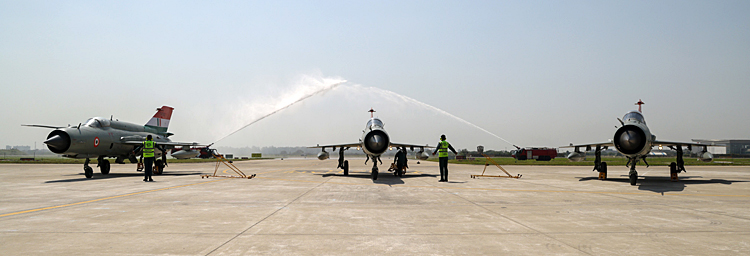
"The MiG-21 was never just a jet—it was a rite of passage," said Group Captain Sanjay Tyagi (Retd), a former MiG-21 pilot. "Its retirement marks the end of an era, but its legacy will continue in the skies through the people it shaped and the history it helped write."
As India bids farewell to the MiG-21, it also closes a defining chapter in its defence history. From Cold War relic to national icon, the aircraft's journey has been one of resilience, adaptation, and undying service.
In the annals of Indian military aviation, the MiG-21 will forever soar—not for its flaws, but for its fierce spirit and unforgettable impact.
Manish Kumar Jha is a Consulting & Contributing Editor for SP's Aviation, SP's Land Forces and SP's Naval Forces and a security expert. He writes on national security, military technology, strategic affairs & policies.