The insightful articles, inspiring narrations and analytical perspectives presented by the Editorial Team, establish an alluring connect with the reader. My compliments and best wishes to SP Guide Publications.
"Over the past 60 years, the growth of SP Guide Publications has mirrored the rising stature of Indian Navy. Its well-researched and informative magazines on Defence and Aerospace sector have served to shape an educated opinion of our military personnel, policy makers and the public alike. I wish SP's Publication team continued success, fair winds and following seas in all future endeavour!"

Since, its inception in 1964, SP Guide Publications has consistently demonstrated commitment to high-quality journalism in the aerospace and defence sectors, earning a well-deserved reputation as Asia's largest media house in this domain. I wish SP Guide Publications continued success in its pursuit of excellence.
During a visit to the Aerospace business of Godrej Enterprises Group facility in Maharashtra, advanced machining systems, aerospace-grade materials and tightly controlled production environments offered a clearer picture of how India's aerospace manufacturing ecosystem is evolving.
India's aerospace manufacturing sector is entering a more consequential phase. For over two decades, India's role within the global aerospace ecosystem was largely defined by offset obligations, licensed production, machining contracts and supply-chain participation. Today, however, the industrial conversation is shifting toward a more demanding objective: building credible aero engine manufacturing capability supported by advanced materials expertise, process discipline, certification maturity and engineering depth.
That transition is becoming increasingly visible inside a small but growing cluster of Indian aerospace manufacturing facilities now operating at globally benchmarked process standards. Among them is the Aerospace business of Godrej Enterprises Group.
The facility operates less like a conventional industrial shop-floor and more like a tightly controlled aerospace production ecosystem, one where repeatability, traceability and process reliability define competitiveness.
During a recent visit to the company's manufacturing operations in Maharashtra, the scale of ambition became evident not through corporate presentation, but through the manufacturing environment itself. The facility operates less like a conventional industrial shop-floor and more like a tightly controlled aerospace production ecosystem, one where repeatability, traceability and process reliability define competitiveness.
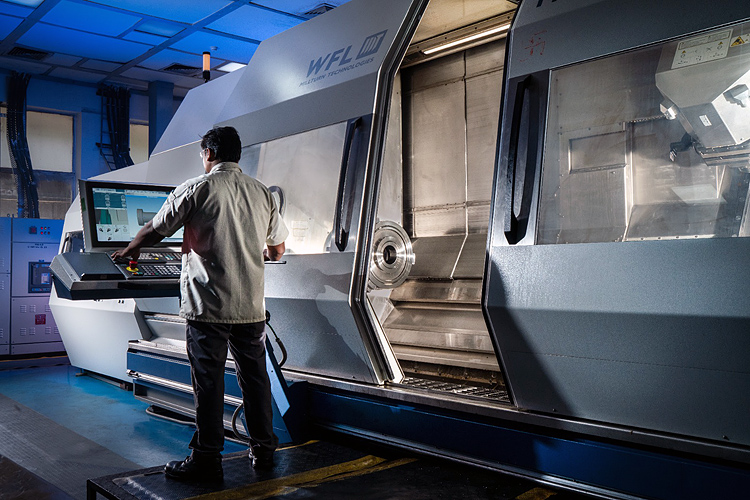
Across the production areas, advanced CNC machining systems work continuously on aerospace-grade titanium, aluminium, steel and nickel-based alloys including Inconel. Structural fabrications, aero-engine tubing systems, ducting assemblies, mounting brackets and actuators move through highly controlled manufacturing and inspection stages designed around zero-defect aerospace requirements.
The Aerospace business of Godrej Enterprises Group currently operates from a dedicated 35,000 sq. ft. manufacturing facility in Vikhroli, Mumbai, supporting high-precision and high-complexity aerospace production. What differentiates the company within India's private aerospace manufacturing ecosystem is its claim of having developed capability across all modules of an aero engine, an area traditionally dominated by global engine majors and highly specialised suppliers.
Godrej Enterprises Group's Aerospace business has been part of India's strategic manufacturing ecosystem since the 1980s. Today, it works with some of the world's largest aerospace and engine manufacturers including Boeing, Safran Aircraft Engines, GE Aerospace, Rolls-Royce, Honeywell, and Pratt & Whitney.
What differentiates the company within India's private aerospace manufacturing ecosystem is its claim of having developed capability across all modules of an aero engine, an area traditionally dominated by global engine majors.
As Maneck Behramkamdin, Business Head, Aerospace Business, Godrej Enterprises Group notes, "Aero engine ecosystems are built on deep engineering capability, uncompromising quality, resilient supply chains, and sustained execution credibility. Our journey reflects the trust we have earned from global OEMs and our long-term commitment to indigenising critical aerospace systems."

That capability does not emerge overnight. Inside the facility, advanced CNC machining systems work continuously on titanium and other difficult-to-machine aerospace alloys used in critical aviation applications. Coolant streams pour constantly across cutting surfaces as enclosed machining cells shape complex geometries to extremely tight tolerances. Sparks from high-speed cutting operations illuminate sections of the shop-floor while nearby welding stations and fabrication areas handle intricate aerospace assemblies under tightly controlled process conditions. The infrastructure is built around highly automated, computer-controlled manufacturing systems designed to deliver the repeatability, precision and consistency demanded by modern aerospace programmes. Nearby, integrated hot-forming sections with robotic furnace and press operations handle specialised aerospace structures and thin-wall aero-engine components. The facility supports hot-forming capability up to 600 tonnes, with furnace temperatures reaching nearly 900°C for shaping high-strength aerospace-grade materials.
The company has secured globally recognised aerospace certifications including AS9100 and NADCAP approvals, benchmarks that require years of process maturity, audit readiness, and manufacturing consistency.
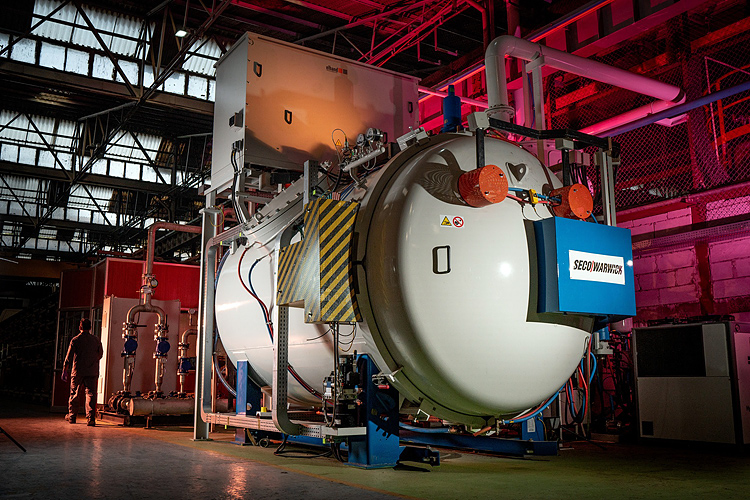
The manufacturing ecosystem also includes specialised brazing infrastructure operating between 480°C and 1300°C, supporting aerospace manufacturing processes that demand extremely high metallurgical precision and reliability. Vacuum heat treatment systems and tightly controlled process environments further reinforce the aerospace-grade manufacturing discipline visible across the facility. The scale of the upcoming expansion, however, reflects where the company sees the future heading.
But beyond the machinery itself, what defines the environment is process discipline. At nearly every stage of the production line, components carry coded traceability markings. Each part can be digitally tracked through its production lifecycle, from raw material stage to machining, inspection, treatment, and final delivery.
Inspection systems are deeply embedded into the manufacturing chain. Dedicated radiological testing, dye penetrant inspection processes designed to identify microscopic flaws or porosity, and highly controlled quality systems underline the reality that aerospace manufacturing operates under zero-defect expectations.
A dedicated R&D centre and specialised design office focused on mechanical and electromechanical actuation systems are supporting a gradual transition toward build-to-spec capability.
The company has secured globally recognised aerospace certifications including AS9100 and NADCAP approvals, benchmarks that require years of process maturity, audit readiness, and manufacturing consistency. Executives explained that certification progression itself reflects the layered nature of aerospace manufacturing credibility: first regulatory approvals from civil aviation authorities, followed by rigorous qualification and approval processes from global OEMs.
And consistency is ultimately what aerospace manufacturing is built on.
One of the clearer takeaways from the visit was that aerospace manufacturing complexity is no longer limited to machines alone. It increasingly lies in the combination of advanced materials, tightly controlled processes and specialised manpower required to work with them consistently.
Across the facility, components are manufactured using aerospace-grade titanium, aluminium, steel and nickel-based superalloys including Inconel, along with columbium (niobium)-based high-performance materials used in advanced aero-engine applications. Many of these materials are difficult to machine because of their heat sensitivity, structural behaviour and stringent tolerance requirements. Certain carbon-related aerospace processes are also carried out under controlled atmospheric conditions where process stability becomes critical.
Godrej Enterprises Group has committed approximately ₹100 crore over the next three years toward aerospace expansion, including investments in research and development, advanced digital manufacturing technologies, new product development, and future-ready engineering systems.
During the walkthrough, company executives remarked that the most complex challenge in aerospace manufacturing is not necessarily the machinery itself, but developing people capable of operating within such demanding process environments. "The most complex challenge is not the machines, it is developing skilled people capable of operating at aerospace-grade precision." According to executives, operators and technicians are extensively trained in-house on specialised functions, materials and machine systems to achieve the levels of repeatability and process discipline expected in aerospace manufacturing.
Even with increasing digital integration and automation, aerospace production remains heavily dependent on highly trained manpower. At the same time, much of the aerospace-grade raw material still needs to be imported. Yet, the company believes India continues to remain competitive because of its skilled workforce, manufacturing adaptability and labour advantage.
Like much of India's aerospace ecosystem, the majority of current work remains build-to-print, with components manufactured against customer-owned specifications. The longer-term transition toward build-to-spec capability, however, has already begun.
The company has clearly begun positioning itself for the next phase. A dedicated R&D centre and specialised design office focused on mechanical and electromechanical actuation systems are supporting a gradual transition toward build-to-spec capability. Executives also pointed to indigenous development work on critical aerospace systems including actuators, a significant step in moving beyond precision manufacturing toward integrated engineering participation.
The ambition is visible not just in capability development, but also in scale. Godrej Enterprises Group has committed approximately ₹100 crore over the next three years toward aerospace expansion, including investments in research and development, advanced digital manufacturing technologies, new product development, and future-ready engineering systems.
The company is also preparing for its next major industrial leap. By 2027, aerospace operations are expected to move into a significantly larger integrated manufacturing ecosystem around Khalapur in Maharashtra. Spread across nearly 100 acres and planned across multiple plants, the upcoming facility is designed to support higher production volumes, future aerospace programmes, export opportunities, and deeper systems integration. The scale of planned expansion reflects the broader confidence emerging around India's aerospace manufacturing trajectory.
Maharashtra, with its industrial infrastructure, engineering ecosystem, and proximity to logistics and port networks, is increasingly positioning itself as a serious aerospace manufacturing hub.
Yet perhaps the most important takeaway from the visit was this:
Can Indian aerospace companies move beyond execution and become deeper engineering partners? Can they transition from manufacturing parts to designing systems? Can India eventually capture greater ownership within the aerospace value chain rather than remaining largely a precision manufacturing base?
Those answers will take time. But walking through facilities like this offers a clearer picture of where India's aerospace manufacturing ecosystem is heading.