

The insightful articles, inspiring narrations and analytical perspectives presented by the Editorial Team, establish an alluring connect with the reader. My compliments and best wishes to SP Guide Publications.

"Over the past 60 years, the growth of SP Guide Publications has mirrored the rising stature of Indian Navy. Its well-researched and informative magazines on Defence and Aerospace sector have served to shape an educated opinion of our military personnel, policy makers and the public alike. I wish SP's Publication team continued success, fair winds and following seas in all future endeavour!"

Since, its inception in 1964, SP Guide Publications has consistently demonstrated commitment to high-quality journalism in the aerospace and defence sectors, earning a well-deserved reputation as Asia's largest media house in this domain. I wish SP Guide Publications continued success in its pursuit of excellence.
NASA is gearing up to begin a new era of deep space exploration by returning humans to moon after about half a century, as a step to go to Mars and beyond.
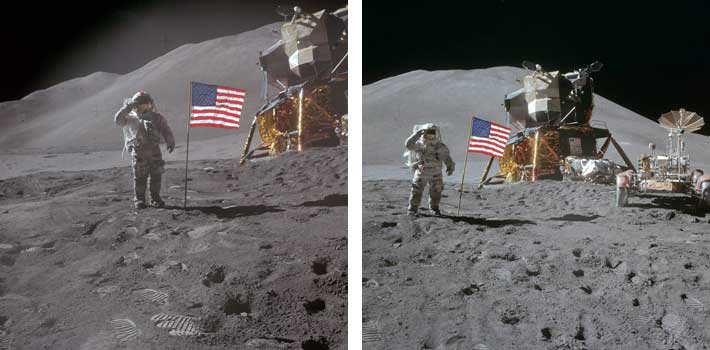
Fifty years ago, a historic feat was achieved that expanded the horizons of space exploration for humans. Apollo 15, the seventh Apollo mission and the first of three Apollo “J” missions by NASA (National Aeronautics and Space Administration) was launched with Commander David R. Scott, Command Module Pilot Alfred M. Worden, and Lunar Module Pilot James B. Irwin for the Moon expedition over longer duration with enhanced scientific instrument. Apollo 15 was the first mission where astronauts used the Apollo Lunar Surface Drill (ALSD) and the Lunar Roving Vehicle (LRV).
Building on this mission, NASA is now preparing to launch the first module of its Artemis Program, a mission with which NASA plans to land the first woman and the first person of color on the Moon to explore more of the lunar surface.
During Apollo 15, Scott and Irwin landed on the Moon. They used the ALSD at the location where several scientific instruments were set up during the nearly 67 hours for which the astronauts were on the lunar surface. The tool was a rotary-percussive drill that used a combined motion that hammered a rotating drill bit into the surface to create a hole. The overall purpose of gathering core samples was part of NASA’s lunar geology studies to learn more about the composition of the Moon and discover more about its history by looking at different kinds of rocks, including some from below the surface, NASA informed.
The Apollo program allowed 12 American astronauts to walk on the moon with a total of 11 spaceflights conducted during the program.
Scott and Irwin touched down at the Hadley-Apennine site and conducted four spacewalks, including three excursions using the LRV, for a combined total of 19 hours. They also deployed an experiment package and collected 170 pounds of rock and soil samples to return on Earth. With a brief test drive of LRV or Rover, Scott also became the first human to drive on the Moon.
The Apollo program allowed 12 American astronauts to walk on the moon. A total of 11 spaceflights were conducted during the program, the first four of these tested the equipment used in the Apollo Program and six out of the remaining seven flights landed on the lunar surface. The first Apollo flight happened in 1968, the first moon landing in 1969 and the last moon landing took place in 1972.
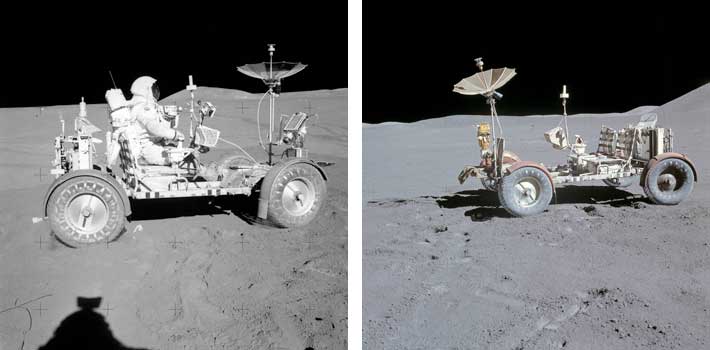
Now, NASA is gearing up to return to the Moon with the Artemis missions. The program features a new drill headed to the lunar surface as a commercially delivered payload via the Commercial Lunar Payload Services initiative. The Regolith and Ice Drill for Exploring New Terrain (TRIDENT) is key to locating ice and other resources on the Moon. Furthermore, TRIDENT is a rotary-percussive drill, but unlike its Apollo counterpart, TRIDENT does not require astronauts to work it manually.
As a part of Artemis, there will even be Polar Resources Ice Mining Experiment-1 (PRIME-1), the inaugural in-situ resource utilisation demonstration on the Moon. For the first time, NASA will robotically sample and analyse for ice from below the surface. PRIME-1 will be utilizing TRIDENT to drill in a single location at a site with a high probability of presence of water (in liquid or ice form). It will drill down about 3 feet (1 meter) below the surface, each time bringing up samples that NASA will analyse with a scientific instrument – the Mass Spectrometer observing lunar operations (MSolo).
As a part of Artemis, there will even be Polar Resources Ice Mining Experiment-1 (PRIME-1), the inaugural in-situ resource utilisation demonstration on the Moon.
The Hadley Rille, which is a long, deep channel-like gorge in the Moon’s surface, situated at the base of the Apennines Mountains,is north of the Moon’s equator where Apollo 15 landed while the PRIME-1’s destination is the Moon’s South Pole – a location where NASA has previously detected water from space.
About a year after the PRIME-1 mission, NASA plans to send an exploratory rover – Volatiles Investigating Polar Exploration Rover, or VIPER – to the surface. NASA’s first mobile robotic mission to the Moon, VIPER will carry a TRIDENT drill and scientific instruments that will enable it to directly analyse water ice on the surface and subsurface of the Moon at varying depths and temperature conditions. VIPER is scheduled to explore multiple sites on the lunar South Pole for about 100 days.
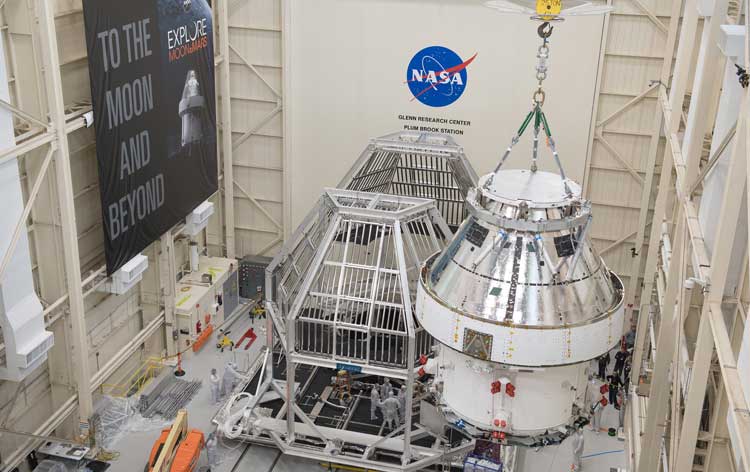
Additionally, NASA has a new rocket for Artemis, the Space Launch System (SLS), which will carry the Orion spacecraft on top. Orion that can carry up to four astronauts, will orbit the Moon. A spaceship, called the Gateway, will be orbiting the Moon like the Moon orbits Earth. Orion will connect to the Gateway and astronauts will go from Orion to the Gateway. This is where astronauts will live while orbiting the Moon and take trips to get to work on the lunar surface. Then they will return to Gateway. When all of their work is finished, the crew will return to Earth aboard Orion, the space agency had stated.
Through Artemis, NASA affirmed that it is preparing to send new capabilities to the Moon that will enable people to stay there for longer than ever before, because learning how to find and use water would be a key to living and working on the Moon and other deep space destinations. Artemis’ Moon mission, scheduled to take humans on our natural satellite is especially a step to taking humans to Mars.
Artemis’s first stage is expected this year and the landing of the first crew is scheduled for 2024.
“As we prepare to send humans forward to the Moon and ultimately to Mars,” former NASA Administrator Jim Bridenstine had remarked about the program, “the scope and nature of the Artemis program will build on our partnerships in low-Earth orbit and result in NASA leading the largest and most diverse international space effort in history to the Moon.”
In one of the episodes of “Houston We Have a Podcast”, the official podcast of the NASA Johnson Space Center from Houston, Nujoud Merancy, Chief of the Exploration Mission Planning Office stated that while Apollo was more about getting to the Moon as fast as one can, with Artemis, the focus is on becoming sustainable, which means to be able to explore for longer durations, potentially build bases, but also demonstrate things needed to go to Mars. “And all of the things you need to go to Mars, involve much longer durations, surface stays on Mars are basically 30 days to 6 months, so you need to be able to do long duration stays and have a long-term buildup of stuff,” she added. Another difference is that while for Apollo it was an equatorial orbit, for Artemis it will be a polar lunar orbit, which means it goes North - South instead of East - West, around the Moon.
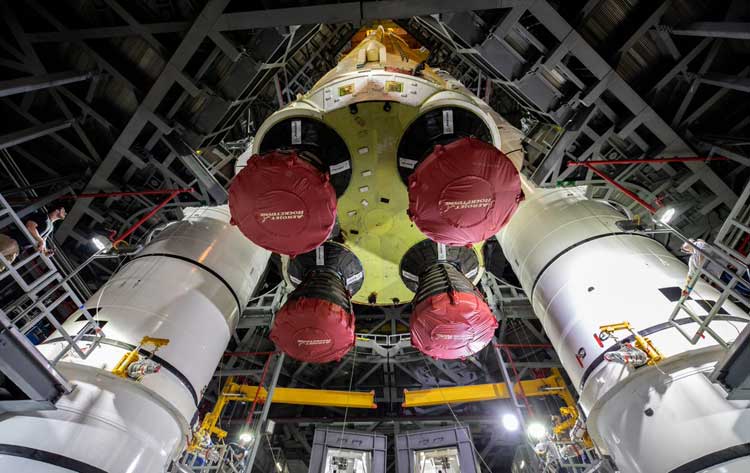
Nevertheless, Artemis is created on the framework of its twin sister from half a century ago as various things from Apollo are being reused or improvised upon. “I mean the enormous vehicle assembly building at Kennedy Space Center, was built for Apollo. It stacked the shuttle, it launched all of the U.S. elements to the space station, and now it's going to stack SLS and Orion for Artemis. So, even some of those features we have from Apollo, are still around helping us out today, and the physics didn't change. So how you design a trajectory to the Moon, a lot of that math is exactly the same, and we're just using it differently, Merancy added, hoping that once we fly Artemis 3, it will only be the first of many flights to the Moon and then Mars.
Artemis’s first stage is expected this year and the landing of the first crew is scheduled for 2024. The program will take place in three stages:
Being the sole natural satellite of our planet and the closest celestial body to earth, the moon has been of interest of space enthusiasts and a window to deeper space exploration. Going ahead, as plans surface about having a base on the moon and discovering its minerals resources, more and more moon expeditions are expected. About eight have already launched mission to the moon. Here’s a timeline of all the moon missions that have taken place globally till now:
Lunar Missions

 Luna 1 - Jan 2, 1959 - Flyby
 Pioneer 4 - Mar 3, 1959 - Flyby Luna 2 - Sep 12, 1959 - Impact Luna 3 - Oct 4, 1959 - Probe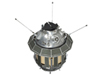
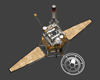 Ranger 1 - Aug 23, 1961 - Attempted Test Flight Ranger 2 - Nov 18, 1961 - Attempted Test Flight
  Ranger 3 - Jan 26, 1962 - Attempted Impact Ranger 4 - Apr 23, 1962 - Impact Ranger 5 - Oct 18, 1962 - Attempted Impact Luna 4 - Apr 2, 1963 - Flyby
 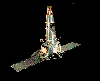 Ranger 6 - Jan 30, 1964 - Impact Ranger 7 - Jul 28, 1964 - Impact
 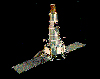 Ranger 8 - Feb 17, 1965 - Impact Ranger 9 - Mar 21, 1965 - Impact Luna 5 - May 9, 1965 - Impact Luna 6 - Jun 8, 1965 - Attempted Lander Zond 3 - Jul 18, 1965 - Flyby Luna 7 - Oct 4, 1965 - Impact Luna 8 - Dec 3, 1965 - Impact
 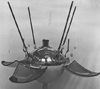 Luna 9 - Jan 31, 1966 - Lander Luna 10 - Mar 31, 1966 - Orbiter Surveyor 1 - May 30, 1966 - Lander Explorer 33 - July 1, 1966 - Attempted Orbiter Lunar Orbiter 1 - Aug 10, 1966 - Orbiter Luna 11 - Aug 24, 1966 - Orbiter Surveyor 2 - Sep 20, 1966 - Attempted Lander Luna 12 - Oct 22, 1966 - Orbiter Lunar Orbiter 2 - Nov 6, 1966 - Orbiter Luna 13 - Dec 21, 1966 - Lander
 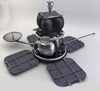 Lunar Orbiter 3 - Feb 4, 1967 - Orbiter Surveyor 3 - Apr 17, 1967 - Lander Lunar Orbiter 4 - May 8, 1967 - Orbiter Surveyor 4 - Jul 14, 1967 - Attempted Lander Explorer 35 (IMP-E) - Jul 19, 1967 - Orbiter Lunar Orbiter 5 - Aug 1, 1967 - Orbiter Surveyor 5 - Sep 8, 1967 - Lander Surveyor 6 - Nov 7, 1967 - Lander
 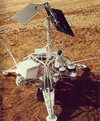 Surveyor 7 - Jan 7, 1968 - Lander Luna 14 - Apr 7, 1968 - Orbiter Zond 5 - Sep 15, 1968 - Return Probe Zond 6 - Nov 10, 1968 - Return Probe Apollo 8 - Dec 21, 1968 - Crewed Orbiter
 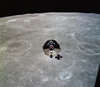 Apollo 10 - May 18, 1969 - Orbiter Luna 15 - Jul 13, 1969 - Orbiter Apollo 11 - Jul 16, 1969 - Crewed Landing Zond 7 - Aug 7, 1969 - Return Probe Apollo 12 - Nov 14, 1969 - Crewed Landing
  Apollo 13 - Apr 11, 1970 - Crewed Landing (aborted) Luna 16 - Sep 12, 1970 - Sample Return Zond 8 - Oct 20, 1970 - Return Probe Luna 17 - Nov 10, 1970 - Rover
 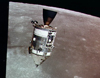 Apollo 14 - Jan 31, 1971 - Crewed Landing Apollo 15 - Jul 26, 1971 - Crewed Landing Luna 18 - Sep 2, 1971 - Impact Luna 19 - Sep 28, 1971 - Orbiter
  Luna 20 - Feb 14, 1972 - Sample Return Apollo 16 - Apr 16, 1972 - Crewed Landing Apollo 17 - Dec 7, 1972 - Crewed Landing
 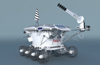 Luna 21 - Jan 8, 1973 - Rover Explorer 49 (RAE-B) - Jun 10, 1973 - Orbiter
  Luna 22 - Jun 2, 1974 - Orbiter Luna 23 - Oct 28, 1974 - Lander
 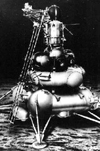 Luna 24 - Aug 14, 1976 - Sample Return
 Hiten - Jan 24, 1990 - Flyby and Orbiter
 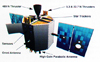 Clementine - Jan 25, 1994 - Orbiter
AsiaSat 3/HGS-1 - Dec 24, 1997 - Lunar Flyby
Clementine - Jan 25, 1994 - Orbiter
AsiaSat 3/HGS-1 - Dec 24, 1997 - Lunar Flyby 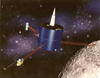 Lunar Prospector - Jan 7, 1998 - Orbiter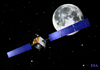
 SMART 1
- Sep 27, 2003 - Lunar Orbiter
SMART 1
- Sep 27, 2003 - Lunar Orbiter 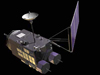 Kaguya (SELENE)
- Sep 14, 2007 - Lunar Orbiter
Kaguya (SELENE)
- Sep 14, 2007 - Lunar Orbiter Chang'e 1
- Oct 24, 2007 - Lunar Orbiter
Chang'e 1
- Oct 24, 2007 - Lunar Orbiter 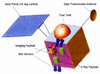
 Chandrayaan-1
- Oct 22, 2008 - Lunar Orbiter
Chandrayaan-1
- Oct 22, 2008 - Lunar Orbiter 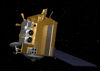 Lunar Reconnaissance Orbiter
- June 17, 2009 - Lunar Orbiter
LCROSS
- June 17, 2009 - Lunar Orbiter and Impactor
Chang'e 2
- Oct 1, 2010 - Lunar Orbiter
Lunar Reconnaissance Orbiter
- June 17, 2009 - Lunar Orbiter
LCROSS
- June 17, 2009 - Lunar Orbiter and Impactor
Chang'e 2
- Oct 1, 2010 - Lunar Orbiter 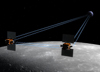 Gravity Recovery And Interior Laboratory (GRAIL)
- Sep 10, 2011 - Lunar Orbiter
Lunar Atmosphere and Dust Environment Explorer (LADEE)
- Sep 6, 2013 - Lunar Orbiter
Chang'e 3
- 01 December 2013 - Lunar Lander and Rover
Gravity Recovery And Interior Laboratory (GRAIL)
- Sep 10, 2011 - Lunar Orbiter
Lunar Atmosphere and Dust Environment Explorer (LADEE)
- Sep 6, 2013 - Lunar Orbiter
Chang'e 3
- 01 December 2013 - Lunar Lander and Rover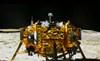 Chang'e 5 Test Vehicle
- 23 October 2014 - Lunar Flyby and Return
Queqiao
- 20 May 2018 - CNSA (China) Lunar Relay Satellite
Chang'e 4
- 7 December 2018 - CNSA (China) Lunar Farside Lander and Rover
Chang'e 5 Test Vehicle
- 23 October 2014 - Lunar Flyby and Return
Queqiao
- 20 May 2018 - CNSA (China) Lunar Relay Satellite
Chang'e 4
- 7 December 2018 - CNSA (China) Lunar Farside Lander and Rover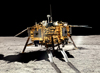
 Beresheet
- 22 February 2019 - SpaceIL and IAI (Israel) Lunar Lander
Chandrayaan 2
- April 2019 - ISRO (India) Moon Orbiter, Lander, and Rover
Beresheet
- 22 February 2019 - SpaceIL and IAI (Israel) Lunar Lander
Chandrayaan 2
- April 2019 - ISRO (India) Moon Orbiter, Lander, and Rover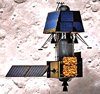
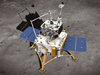 Chang'e 5
- 23 November 2020 - CNSA (China) Lunar Sample Return Mission
Chang'e 5
- 23 November 2020 - CNSA (China) Lunar Sample Return Mission 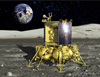
 Luna 25
- 1 October 2021 - Russian Lunar Lander
CAPSTONE
- NET 20 October 2021 - Lunar Navigation Test Orbiter
LunaH-Map
- Fall 2021 - Lunar Orbiting CubeSat
Lunar Flashlight
- Fall 2021 - Lunar Orbiting CubeSat
Lunar Ice Cube
- Fall 2021 - Lunar Orbiting CubeSat
Lunar InfraRed imaging (LunIR)
- Fall 2021 - Lunar Flyby and Technology Test CubeSat
Cislunar Explorers
- Fall 2021 - Lunar Technology Test CubeSats
OMOTENASHI
- Fall 2021 - JAXA (Japan) Lunar Lander CubeSat
EQUULEUS
- Fall 2021 - JAXA (Japan) L2 Orbit Lunar CubeSat
Luna 25
- 1 October 2021 - Russian Lunar Lander
CAPSTONE
- NET 20 October 2021 - Lunar Navigation Test Orbiter
LunaH-Map
- Fall 2021 - Lunar Orbiting CubeSat
Lunar Flashlight
- Fall 2021 - Lunar Orbiting CubeSat
Lunar Ice Cube
- Fall 2021 - Lunar Orbiting CubeSat
Lunar InfraRed imaging (LunIR)
- Fall 2021 - Lunar Flyby and Technology Test CubeSat
Cislunar Explorers
- Fall 2021 - Lunar Technology Test CubeSats
OMOTENASHI
- Fall 2021 - JAXA (Japan) Lunar Lander CubeSat
EQUULEUS
- Fall 2021 - JAXA (Japan) L2 Orbit Lunar CubeSat 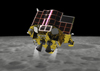 SLIM
- January 2022 - JAXA (Japan) Lunar Lander
Peregrine Mission 1
- Early 2022 - Lunar Lander
IM-1
- Early 2022 - Lunar Lander
SLIM
- January 2022 - JAXA (Japan) Lunar Lander
Peregrine Mission 1
- Early 2022 - Lunar Lander
IM-1
- Early 2022 - Lunar Lander Korea Pathfinder Lunar Orbiter
- 1 August 2022 - KARI (South Korea) Lunar Orbiter
XL-1 Lander
- December 2022 - Lunar Lander
Prime 1
- December 2022 - Lunar Lander
Korea Pathfinder Lunar Orbiter
- 1 August 2022 - KARI (South Korea) Lunar Orbiter
XL-1 Lander
- December 2022 - Lunar Lander
Prime 1
- December 2022 - Lunar Lander 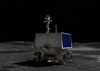 VIPER
- Late 2023 - Lunar South Pole Rover
VIPER
- Late 2023 - Lunar South Pole Rover  Chang'e 7
- 2024 - CNSA (China) Lunar Survey Mission
Chang'e 6
- 2024 - CNSA (China) Lunar Sample Return Mission
Lunar Trailblazer
- 1 February 2024 - Lunar Orbiting Small Satellite
Chang'e 8
- TBD - CNSA (China) Lunar Technology Test
Chang'e 7
- 2024 - CNSA (China) Lunar Survey Mission
Chang'e 6
- 2024 - CNSA (China) Lunar Sample Return Mission
Lunar Trailblazer
- 1 February 2024 - Lunar Orbiting Small Satellite
Chang'e 8
- TBD - CNSA (China) Lunar Technology Test
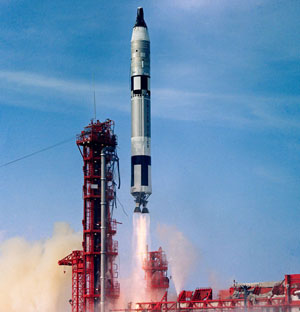
This year NASA also marked 55 years of Gemini X that was part of NASA’s Gemini Program, an early NASA human spaceflight program that helped the agency prepare for the Apollo lunar landings. Ten crew flew missions on the two-man Gemini spacecraft in 1965 and 1966. The primary goals of Project Gemini included proving the techniques required for the Apollo Program.
The first seven Gemini missions in 1965 and early 1966 demonstrated the spacecraft’s space worthiness, the feasibility of spacewalking, extended flight durations to 14 days, and demonstrated space rendezvous and docking techniques. The goals of the three-day Gemini X mission included docking with one target vehicle, conducting a rendezvous with a second target, and performing two spacewalks.