The insightful articles, inspiring narrations and analytical perspectives presented by the Editorial Team, establish an alluring connect with the reader. My compliments and best wishes to SP Guide Publications.
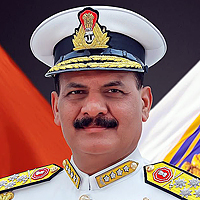
"Over the past 60 years, the growth of SP Guide Publications has mirrored the rising stature of Indian Navy. Its well-researched and informative magazines on Defence and Aerospace sector have served to shape an educated opinion of our military personnel, policy makers and the public alike. I wish SP's Publication team continued success, fair winds and following seas in all future endeavour!"

Since, its inception in 1964, SP Guide Publications has consistently demonstrated commitment to high-quality journalism in the aerospace and defence sectors, earning a well-deserved reputation as Asia's largest media house in this domain. I wish SP Guide Publications continued success in its pursuit of excellence.
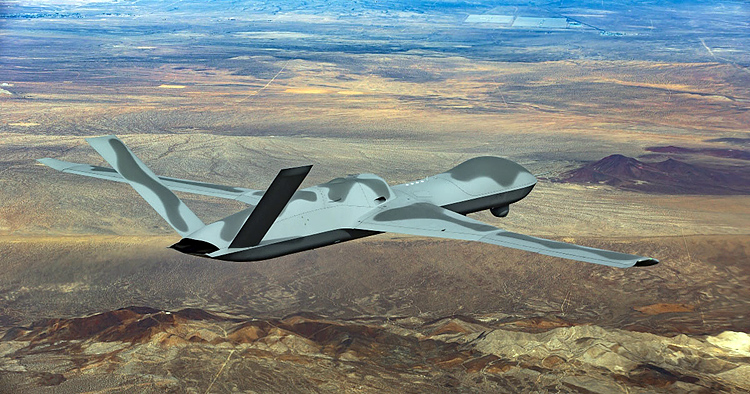
On July 21, General Atomics Aeronautical Systems, Inc. (GA-ASI) and Tactical Air Support, Inc. collaborated on a flight test during a large force exercise that demonstrated Infrared Search and Track (IRST) Multi-Ship Ranging (MSR). The test paired a manned Tactical Air Support F-5 Advanced Tiger with an unmanned GA-ASI Collaborative Combat Aircraft (CCA) test aircraft, highlighting how Human-Machine Teaming closes the kill chain using passive sensors and autonomy.
Both the CCA test aircraft and the F-5 were equipped with GA-ASI's TacACE® (Tactical Autonomy Ecosystem) software, which is based on the latest Autonomy Government Reference Architecture (A-GRA), the Agile Mission Suite (AMS-GRA). Each aircraft also carried an infrared search-and-track sensor. The live exercise proved that a CCA and a manned fighter can collaborate to fuse sensor data from AMS-GRA-compliant sensors to track, engage, and eliminate an airborne target while using a Beyond Line of Sight (BLOS) data link to accomplish seamless coordination between the two aircraft.
The demonstration utilized BLOS communication between the CCA and the airborne F-5, enabling the Advanced Tiger to send data about targets from an AMS-GRA-compatible system. These commands were relayed to the CCA's TacACE system. This flight showed that many companies' platforms can interoperate using the plug-and-play government reference architectures ecosystem. The U.S. Air Force isn't locked into using a single vendor or system.
The CCA test mission with the F-5 Advanced Tiger is part of GA-ASI's ongoing, coordinated campaign of flight tests that are building the foundation for operational human-machine teaming. Rather than a one-time demonstration, GA-ASI is executing a series of increasingly complex, operationally representative missions that combine live aircraft, live sensors, and mission autonomy. As a result, GA-ASI continues developing and testing the most capable and mission-ready autonomy-enabled and AMS-GRA-compliant CCAs in the world by showcasing real mission concepts of operations.
"With this flight, we moved beyond simply flying an autonomous jet and showed how a manned fighter and an autonomous CCA can work together to find, track, and engage a target using passive sensors and shared autonomy," said Michael Roberts, Advanced Programs Emerging Technology Director at GA-ASI. "This is the kind of operationally relevant mission that will allow autonomous CCAs to deploy alongside manned aircraft and deliver real combat capability for the warfighter. The flight test marks another milestone in warfighter adoption of the CCA solution and confirms its readiness for production."
Human-Machine Teaming – the pairing of human-flown warplanes with large numbers of highly autonomous wingmen – is the future of airpower. Recent F-35, F-22, and F-5 Advanced Tiger demonstrations validated the hardware, autonomy software, mission systems, networks, and other capabilities needed for this new chapter in combat.