The insightful articles, inspiring narrations and analytical perspectives presented by the Editorial Team, establish an alluring connect with the reader. My compliments and best wishes to SP Guide Publications.
"Over the past 60 years, the growth of SP Guide Publications has mirrored the rising stature of Indian Navy. Its well-researched and informative magazines on Defence and Aerospace sector have served to shape an educated opinion of our military personnel, policy makers and the public alike. I wish SP's Publication team continued success, fair winds and following seas in all future endeavour!"

Since, its inception in 1964, SP Guide Publications has consistently demonstrated commitment to high-quality journalism in the aerospace and defence sectors, earning a well-deserved reputation as Asia's largest media house in this domain. I wish SP Guide Publications continued success in its pursuit of excellence.
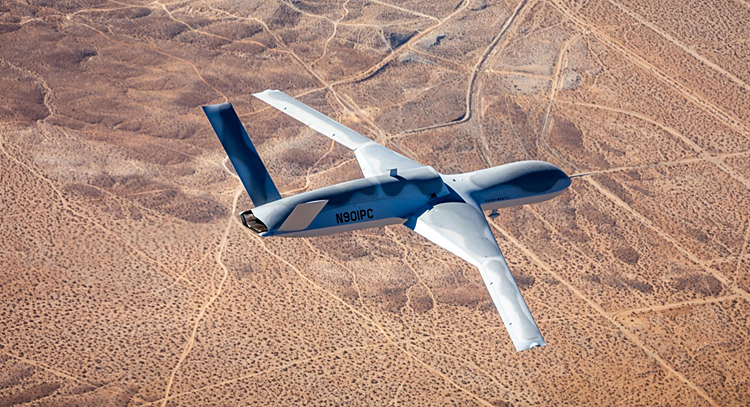
General Atomics Aeronautical Systems, Inc. (GA-ASI), the F-35 Joint Program Office, 309th Software Engineering Group, 461st Flight Test Squadron, 370th Flight Test Squadron, Lockheed Martin, and Autonodyne recently collaborated on a flight test that demonstrated advanced Manned-Unmanned Teaming. The test paired an F-35 Lightning II fighter jet with a GA-ASI Collaborative Combat Aircraft surrogate (MQ-20 Avenger®), highlighting the future of collaborative air combat missions.
The MQ-20 was equipped with GA-ASI's TacACE® (Tactical Autonomy Ecosystem) software, which is based on the latest government reference autonomy software architecture. The demonstration further proved the CCA surrogate and F-35's ability to use a tactical proliferated low Earth orbit data link to accomplish seamless coordination.
The demonstration utilized Beyond Line of Sight (BLOS) communications between an airborne MQ-20 and an F-35 on the ground, enabling the F-35 pilot to send tactical autonomy commands via a tablet in the cockpit. These commands were relayed to the MQ-20's TacACE, leveraging skills based on the Autonomy Government Reference Architecture (A-GRA), enabling rapid integration.
GA-ASI continues developing and testing the most capable and mission-ready Collaborative Combat Aircraft (CCA) in the world.
"This significant warfighter integration milestone is the beginning of operational readiness for the Collaborative Combat Aircraft and demonstrates the near-term opportunities for force integration," said Michael Atwood, vice president of Advanced Programs. "Events like these drive home GA-ASI's continued commitment to adoption of next-generation data links, mission autonomy, and unmanned air combat operations."
Manned-Unmanned Teaming — the pairing of human-flown warplanes with large numbers of highly autonomous wingmen — is the future of airpower. The recent F-35 and MQ-20 demonstration validated the hardware, software, networks, and other systems needed for this new chapter in combat. The MQ-20 successfully exchanged critical autonomous responses with the F-35, and the F-35 was able to send autonomy commands to the MQ-20 via a Bashi Pilot Vehicle Interface, directing the MQ-20 to execute tactical maneuvers, adjust waypoints, and pass ADS-B track data to the F-35.
GA-ASI's MQ-20 Avenger unmanned jet has served as a surrogate CCA for more than five years, both before and since the arrival of GA-ASI's purpose-built XQ-67A Off-Board Sensing Station and YFQ-42A jets.