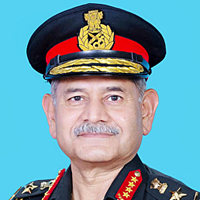
The insightful articles, inspiring narrations and analytical perspectives presented by the Editorial Team, establish an alluring connect with the reader. My compliments and best wishes to SP Guide Publications.

"Over the past 60 years, the growth of SP Guide Publications has mirrored the rising stature of Indian Navy. Its well-researched and informative magazines on Defence and Aerospace sector have served to shape an educated opinion of our military personnel, policy makers and the public alike. I wish SP's Publication team continued success, fair winds and following seas in all future endeavour!"

Since, its inception in 1964, SP Guide Publications has consistently demonstrated commitment to high-quality journalism in the aerospace and defence sectors, earning a well-deserved reputation as Asia's largest media house in this domain. I wish SP Guide Publications continued success in its pursuit of excellence.
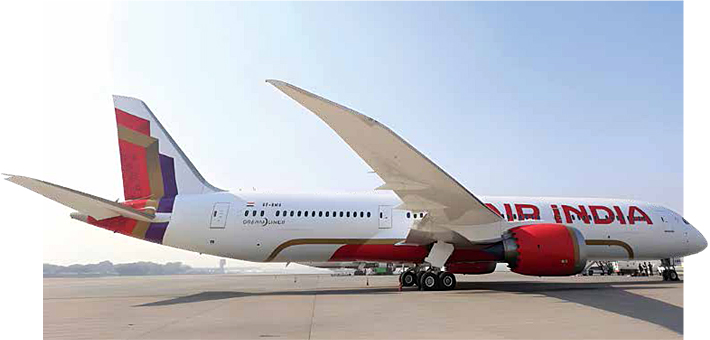
From Fleet expansion to System Building, Paul Righi, Vice President, Sales and Marketing, Eurasia, India, & South Asia, Boeing Commercial Airplanes talks to SP’s Aviation on Boeing’s long-term India play

SP’s Aviation (SP’s): With India’s aviation market reaching new heights, how is Boeing strengthening its presence and addressing the unprecedented demand for commercial aircraft?
Paul Righi (Paul): India’s aviation growth has entered a phase defined not only by scale but by structural transformation. Boeing’s recent Commercial Market Outlook projects that South Asia’s commercial fleet will nearly quadruple by 2043, with Indian carriers accounting for the majority of the region’s 2,800 plus new airplane deliveries. This growth is reshaping travel patterns enabling greater point-to-point connectivity across India and into international markets.
Boeing’s response to this demand is deliberately two-pronged. On the supply side, we are progressively increasing production rates across key programmes as supply-chain stability improves. Equally important, we are investing in the ecosystem that surrounds the aircraft–engineering capability, maintenance readiness, logistics infrastructure, and workforce development, to ensure growth is sustainable and predictable.
Investments across co-production and co-development, MRO capability, spares availability, digital solutions for predictive maintenance, and workforce skilling, including programmes such as the Boeing Kaushal skilling programme, and STEM initiatives like the Boeing Sukanya Program, reflect this long-term approach. By combining advanced aircraft deliveries with deeper local capability, we are positioning India as a core pillar of Boeing’s global aviation ecosystem, not just a destination market.
“By combining advanced aircraft deliveries with deeper local capability, we are positioning India as a core pillar of Boeing’s global aviation ecosystem, not just a destination market”
SP’s: As India’s aviation sector scales rapidly, how is Boeing reinforcing its focus on safety and quality?
Paul: Safety and quality are foundational to how Boeing designs and builds airplanes, and that focus does not change with scale. As production rates increase, our priority has been to strengthen the discipline of our manufacturing system– to manufacture with greater consistency and conformance.
Over the past few years, Boeing has reinforced safety and quality through tighter process controls, enhanced training, and deeper, data-led engagement across our supplier base. This includes earlier identification of quality issues in the build process, clearer work instructions, and stronger accountability at each stage of production. These actions are delivering measurable results. We have reduced manufacturing defects by up to 40 per cent and cut the number of unfinished or pending jobs by approximately 60 per cent as aircraft move through final assembly. Addressing issues earlier improves production flow, stability, and confidence in the airplanes we deliver.
Scaling safely is not about speed; it is about discipline. By embedding quality into everyday operations, across engineering, manufacturing, and the supply chain, we are strengthening the systems that allow production to scale while maintaining the highest safety standards.
SP’s: How is Boeing helping India integrate sustainability into the next phase of its aviation growth?
Paul: Sustainability in aviation will be driven by practical solutions and Sustainable Aviation Fuel (SAF) is the most immediate lever available to reduce lifecycle emissions. Boeing’s focus in India is therefore on enabling SAF adoption through partnerships that address the entire ecosystem–from feedstock to certification and policy readiness. In this context, Boeing has partnered with Hindustan Petroleum Corporation Limited (HPCL) to advance sustainable aviation fuel pathways in India. The collaboration is focused on evaluating feedstock options, supporting fuel qualification and certification processes, and helping build the technical and regulatory foundations required for SAF production and use at scale.
India has strong underlying advantages including feedstock potential, refining expertise, and a rapidly growing aviation market, but SAF adoption will require alignment across industry, energy providers, and policymakers. Our work with HPCL is aimed at accelerating that alignment, moving beyond pilots and studies toward implementation ready pathways.
Over time, this approach can help India integrate sustainability into aviation growth in a way that is both economically viable and operationally credible. The objective is not incremental progress, but to enable SAF to become a practical component of India’s long-term aviation system.
“We are investing $100 million toward pilot training infrastructure and advanced training systems, recognising that fleet expansion must be matched by the availability of well-trained pilots and instructors.”
SP’s: Workforce readiness is often cited as a constraint to aviation growth. How is Boeing supporting India’s talent needs?
Paul: India’s advantage lies in talent at scale. The challenge is ensuring skills are built fast enough, and to global standards, to keep pace with aviation growth. Boeing’s approach focuses on readiness, not just numbers. We are investing $100 million toward pilot training infrastructure and advanced training systems, recognising that fleet expansion must be matched by the availability of well-trained pilots and instructors. This investment supports modern simulators, training facilities, and programmes designed to maintain the highest safety and operational standards as pilot demand accelerates. Beyond flight decks, our focus extends across the broader skilling ecosystem. Through structured skilling initiatives such as the Boeing Kaushal skilling programme, we are helping build industry ready capabilities across the aerospace supply chain, from technicians to supplier workforces. At the academic level, programmes including the National Aeromodelling Competition and the Boeing University Innovation Leadership Development (BUILD) initiative are engaging students and early-stage startups, encouraging innovation and practical problem-solving aligned with real-world aerospace challenges. Initiatives such as the Boeing Sukanya Program further strengthen this approach by expanding pathways for women in aviation and aerospace roles. Together, these efforts are aimed at creating a deep, diverse, and globally competitive talent base–one that can consistently support safety, quality, and reliability as India’s aviation sector scales.
SP’s: Looking ahead, what will distinguish India’s aviation growth from other markets?
Paul: What will distinguish India is not the pace of its aviation growth, but the way that growth is being structured. Many markets expand demand first and build capability later, often reacting to constraints after they appear. India has the opportunity to do the opposite–to build systems, skills, and institutions in parallel with scale.
Three factors make this possible. First, India is investing across the full aviation value chain simultaneously-infrastructure, manufacturing, maintenance capability, engineering, and talent, rather than treating them as sequential steps. Second, the depth and diversity of India’s talent pool allow capability to scale faster than in most markets, provided skilling and certification keep pace. Third, there is increasing alignment between policy intent and industry execution, which is essential for long-term predictability.
If this alignment holds, India’s aviation sector will be defined less by volume metrics and more by capability outcomes–how efficiently fleets are supported, how safely operations scale, and how consistently global standards are met. That shift from growth-led expansion to capability-led maturity is what will determine whether India’s aviation success is cyclical or enduring.