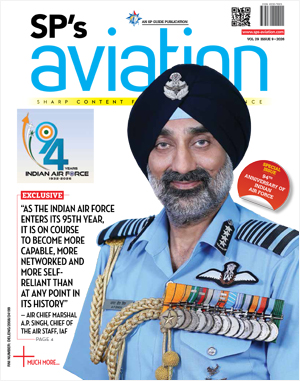

The insightful articles, inspiring narrations and analytical perspectives presented by the Editorial Team, establish an alluring connect with the reader. My compliments and best wishes to SP Guide Publications.
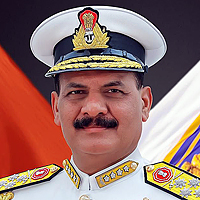
"Over the past 60 years, the growth of SP Guide Publications has mirrored the rising stature of Indian Navy. Its well-researched and informative magazines on Defence and Aerospace sector have served to shape an educated opinion of our military personnel, policy makers and the public alike. I wish SP's Publication team continued success, fair winds and following seas in all future endeavour!"

Since, its inception in 1964, SP Guide Publications has consistently demonstrated commitment to high-quality journalism in the aerospace and defence sectors, earning a well-deserved reputation as Asia's largest media house in this domain. I wish SP Guide Publications continued success in its pursuit of excellence.
The future of air power lies in integrating manned and unmanned platforms rather than treating them as competing alternatives. For India, translating technological advances into operational capability will require sustained procurement, industrial scale, clear doctrine, and commanders trained to employ these systems effectively.
In September 2026, the Indian Air Force conducted its inaugural Dronathon at the Pokhran Field Firing Range. More than twenty domestic manufacturers, startups, and MSMEs demonstrated unmanned aerial systems under operational conditions in the desert. The Vice Chief of the Air Staff released the IAF Unmanned and Autonomous Systems Roadmap. The venue says everything. Not an aerospace exhibition. A firing range. The sky above Pokhran was filled with unmanned systems — ISR platforms, loitering munitions, swarm drones, and electronic warfare systems. The focus was entirely on the unmanned. The IAF was not there to watch. It was there to evaluate.
This trend is reflected globally. Ukraine produced 2.2 million drones in 2024. By early 2025, it was rolling out 2,00,000 FPV drones a month. In June 2025, 117 drones costing a combined $1,17,000 struck five Russian airbases simultaneously and damaged or destroyed over 40 aircraft worth more than $7 billion. This is war economics at scale. The argument from those numbers is seductive. Drones are cheap. They are expendable. They do not bleed. Why build a billion-dollar aircraft when you can build a thousand loitering munitions for the same cost? It is not a wrong question — rather, an uninformed one. But it is understandable why it gets asked.
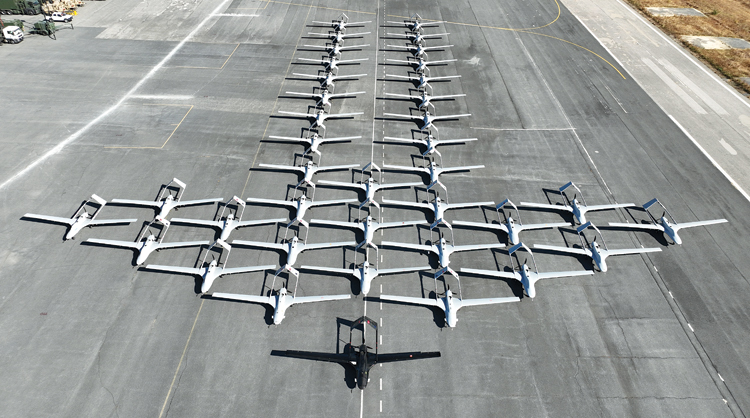
The mass-scale deployment of drones was first observed during the Nagorno-Karabakh conflict in 2020. Azerbaijan deployed its Bayraktar TB2 drones that cost roughly $5 million each. They systematically dismantled Armenian armour, air defences, and logistics. Armenia lost over 245 main battle tanks. All this at a fraction of the cost of a single manned fighter. Manned aviation on both sides barely featured after the opening exchanges. The lesson seemed clear that drones had arrived as decisive weapons.
But Nagorno-Karabakh had a specific condition. Armenia had legacy air defence systems. Its radar systems were destroyed before they could respond. Its EW capability was overwhelmed within days. The TB2 didn’t win because drones are inherently superior to manned aircraft. It won because Armenia had no credible counter. Change the adversary and the equation changes entirely.
What is missing is not technology. It is the scale of order that makes industry treat this as a serious line of business rather than a development project
In Ukraine, where both sides field capable EW, FPV drones are jammed routinely. Russia adapted by saturating numbers. Ukraine adapted by switching to fibre-optic-guided drones. This was a technological regression to mid-twentieth-century solutions. Three years of the most drone-intensive conflict in history have not produced a verdict in favour of drones alone. They have produced a constant adaptation cycle. No single platform dominates for long.
Operation Sindoor was a live demonstration of the unmanned case for the Indian audience. Scores of drone swarms engulfed the border skies several times during those 88 hours of the conflict. However, the strategic outcome that forced Islamabad to beg for a ceasefire came via manned systems themselves. Be it the longest recorded surface-to-air kill by an S-400 system, or the huge craters created by the Brahmos cruise missiles, they were operated from a manned platform. Despite the software advances in terms of network, synthetic radar displays, and data links, the decision and the action to shoot the enemy down were taken by a man/woman. The drones opened the door. The manned force walked through it.
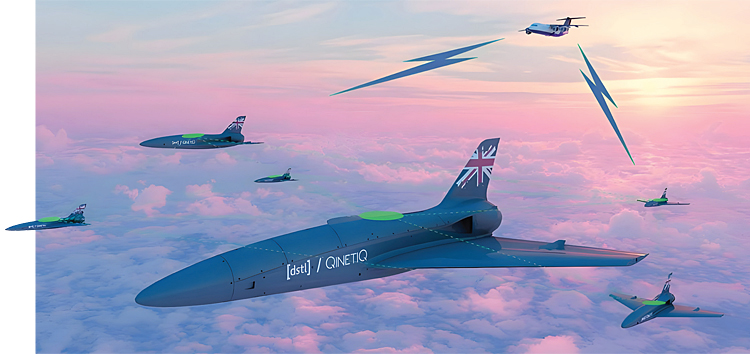
However, Op Sindoor also exposed a structural vulnerability that drones cannot fix. The IAF’s present fighter squadron strength stands at a lowly 29 against a touted figure of 42. In contrast, the PLAAF is inducting J-20 fifthgeneration fighters at an estimated 100-plus airframes per year. Even Pakistan has contracted Chinese J-35A stealth aircraft likely to be delivered by 2027. Realistically, India cannot close this gap with manned platforms alone. The only viable option remains to diversify. Build upon unmanned inventory to offset the manned advantage. This is possible at scale and within the timelines that no unmanned system can promise presently.
WHERE THE WORLD HAS LANDED
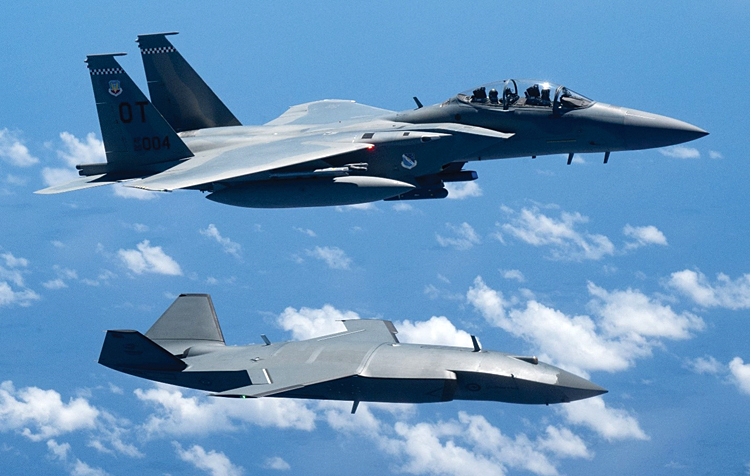
Every serious air force has reached the same conclusion. The answer is not replacement. It is collaboration. The US Air Force’s Collaborative Combat Aircraft programme selected two designs in 2024 — the General Atomics FQ-42A and Anduril FQ-44A. Both flew in 2025. Production contracts were awarded in June 2026, four months ahead of schedule. The target is more than 150 aircraft by the end of the decade, eventually approaching 1,000. The unit cost is approximately $30 million — one-third of an F-35. Unmanned aircraft are force multipliers for manned platforms, not substitutes.
China has also chosen to follow the MUMT path. The PLAAF released the first confirmed footage of its GJ-11 Sharp Sword UCAV flying in formation with a J-20 stealth fighter and a J-16D electronic warfare aircraft. Analysis hints at the J-20S as the intended command node, possibly controlling and directing unmanned wingmen while managing the entire air battle.
Unmanned aircraft are force multipliers for manned platforms, not substitutes
India itself subscribes to this idea. Dr Samir Kamat, DRDO Chairman, said in May 2026 that “manned fighters will form the backbone of aerial combat for the next two decades.” He said that the human in the loop remains irreplaceable in its present form. IAF Vice Chief Air Marshal Ashutosh Dixit said in June 2025 that fighter jets are here for a century. But the future belongs to Manned-Unmanned Teaming. Air Chief Marshal A.P. Singh put it most directly — drones are no longer merely eyes in the sky. They have become claws in the sky. The consensus thus suggests that MUM-T is the direction. The question now is whether India can build what MUM-T actually requires.
WHAT MUM-T NEEDS
Agreeing on the concept is the easy part. Building the ecosystem is the hard part. MUM-T is not a feature you add to an existing air force. It requires five things simultaneously.
The network comes first. The kill chain is dead. What replaces it is a kill web. Any sensor talking to any shooter through a resilient datalink, with a battle manager pairing them dynamically. That web must degrade gracefully under EW attack. Full connectivity when available. Autonomous fall back when not. NavIC on every combat platform, a hardened IACCS architecture, datalink resilience at all levels. These are minimum operational prerequisites.
Warfare is not all numbers; it is also a lot about the art of combat employment. Training is the answer to it all. One can be a brilliant aviator, but modern battle requires much more than that. It requires an air battle manager. One who can orchestrate CCAs and UCAVs from his cockpit in the air while flying his own aircraft. In a way, this is already happening. Modern aviators control their wingmen due to better data exchange owing to datalinks. The AMCA and Tejas Mk2 cockpit interfaces must be designed for MUM-T orchestration from day one, not retrofitted. EW literacy must be a baseline competency. The selection pipeline must reflect this. A pilot selected for his individual virtuosity but not his network instinct is the wrong man for the next war.
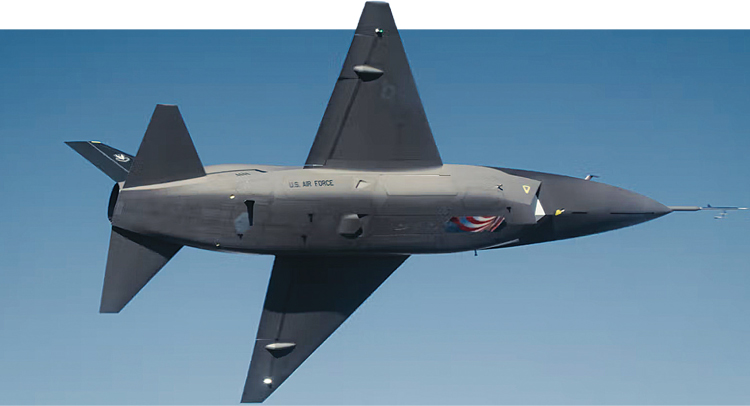
An industry with such initial capital investment would only sustain with scaled production. Indian ecosystem has still not projected such an appetite. The IAF places orders in tens, when the business requires hundreds, if not thousands, for any profit-making. The arithmetic is quite simple. One Tejas Mk1A costs roughly ₹550 crore. The same can fund 18 to 22 CATS Warriors at ₹25–30 crore each. The DAC greenlighting four Ghatak squadrons is just a beginning. India has the foundational programmes. HAL’s CATS Warrior is a low-observable loyal wingman designed to fly alongside Tejas, Rafale, and the future AMCA. DRDO’s Ghatak, a 13-tonne flying-wing stealth UCAV, has its SWiFT demonstrator already flown. The private sector ecosystem is maturing fast. Dronathon itself is evidence of that. What is missing is not technology. It is the scale of order that makes industry treat this as a serious line of business rather than a development project.
Doctrine must precede procurement, not follow it. India is building unmanned platforms without a published employment philosophy for them. Where does the human decisionmaker sit in the MUM-T architecture? How much autonomy does the unmanned node carry? Under what conditions does it act independently? These questions have no public answers in Indian doctrine. Platforms without doctrine are expensive ornaments. The Dronathon released a roadmap for the industry. It’s time the forces imagine and articulate the employment principles in the form of a doctrine.
India has historically been a rule-taker in international standards, not a rule-maker. As the rules are being written in the form of datalink standards, autonomy frameworks, and sensor fusion architectures, it is time India participates in the process. One doesn’t want to be inheriting these regulations five years down and rue a lost opportunity. Dronathon at Pokhran is precisely the mechanism that keeps industry and operators in a continuous learning loop. It must not remain an annual exhibition. It must become a permanent posture.
THE QUESTION THAT WAS NEVER THE RIGHT ONE
Manned versus unmanned was always a false choice. No serious practitioner has argued for pure substitution. The question has been doing the rounds for over a decade. The platforms have changed beyond recognition since then. The principle has not.
The right question is rather what is the correct combination at this stage of technological evolution? That question has no fixed answer. It shifts with every new EW system the adversary fields, every new loitering munition that enters inventory, every change in the order of battle on both sides of the line. Which is precisely why it cannot be answered by a procurement programme. It cannot be answered by doctrine alone. It has to be answered by the commander.
For Guderian, it was not a choice of tanks versus infantry. He understood how to combine them effectively in a battle to gain an upper hand against an enemy. Patton outsmarted the adversary by mastering the tempo of operations. These were military geniuses at play who used the same assets differently and innovatively.
But this time, there is a difference, and it matters. Rommel drove to the forward edge to read the ground. Guderian was present at the Meuse crossing. Their genius expressed itself in the battle. In a kill-web environment, where sensor-shooter pairing happens at the speed of electrons, the commander cannot be present in that sense. The battle moves faster than any human can follow at the point of execution. So the military genius moves. The commander moves upstream — into force design, into doctrine, into the architecture of the kill web itself.
A defence acquisition policy cannot decide the optimum ratio of manned to unmanned. In the end, it has to be decided by the commander who understands both the machine and the moment and has the judgement to know how to employ them. India is acquiring the platforms. The harder task is producing commanders who know how to use them. The question was never manned versus unmanned. It was always: what and how to employ?