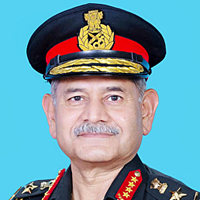
The insightful articles, inspiring narrations and analytical perspectives presented by the Editorial Team, establish an alluring connect with the reader. My compliments and best wishes to SP Guide Publications.
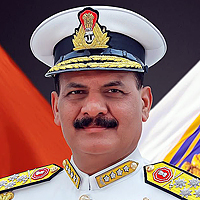
"Over the past 60 years, the growth of SP Guide Publications has mirrored the rising stature of Indian Navy. Its well-researched and informative magazines on Defence and Aerospace sector have served to shape an educated opinion of our military personnel, policy makers and the public alike. I wish SP's Publication team continued success, fair winds and following seas in all future endeavour!"

Since, its inception in 1964, SP Guide Publications has consistently demonstrated commitment to high-quality journalism in the aerospace and defence sectors, earning a well-deserved reputation as Asia's largest media house in this domain. I wish SP Guide Publications continued success in its pursuit of excellence.
India is expanding its civil aviation MRO infrastructure, but without deeper component repair capability, regulatory alignment and supply-chain control, it risks creating capacity without sovereignty and continued reliance on foreign maintenance ecosystems
India is entering what appears to be its long-awaited engine MRO moment. With Safran establishing its flagship LEAP and CFM56 engine overhaul facility in Hyderabad, expanding airframe maintenance capacity across multiple airports, and a rapidly growing fleet pipeline driven by IndiGo, Air India and Akasa, the country appears to be on the cusp of a maintenance renaissance. Yet behind this optimism lies a more uncomfortable truth, India is not yet building a sovereign aircraft maintenance ecosystem. It is building infrastructure. It does not yet have control.
In global aviation, dominance is no longer defined by who manufactures aircraft, but by who controls maintenance pipelines, spares access, certification authority, manpower supply chains, turnaround reliability and Power-by-the-Hour (PBH) economics. These invisible levers decide fleet availability, airline profitability, military readiness and even national mobility resilience. And today, India controls very few of them.
COMPONENT MRO
A sustainable MRO hub is not defined by airframe hangars or engine test cells alone but it is defined by component repair density. India today has limited depth in high-value component categories such as fuel systems, pneumatics, actuation, avionics LRUs, landing gear accessories and environmental control systems.
This creates the condition of a ‘missing middle’ in the maintenance value chain. Aircraft may be checked in India, engines may be overhauled in India, but a large share of components still fly abroad.
Until component repair depth increases dramatically, India will struggle to achieve true lifecycle maintenance independence, and that is exactly why India’s most serious MRO vulnerability is not engines, it is components. Giving his unbiased assessment on the topic, Sharad Agarwal, CEO, AI Engineering Services Limited (AIESL) says, “Today, it is nearly hundred per cent reliance on the overseas shops. Some of the OEMs are coming up with their shops, like Thales has come up for its shops, but then it is just the tip of the iceberg. The fact remains that most of the components are still going abroad.”
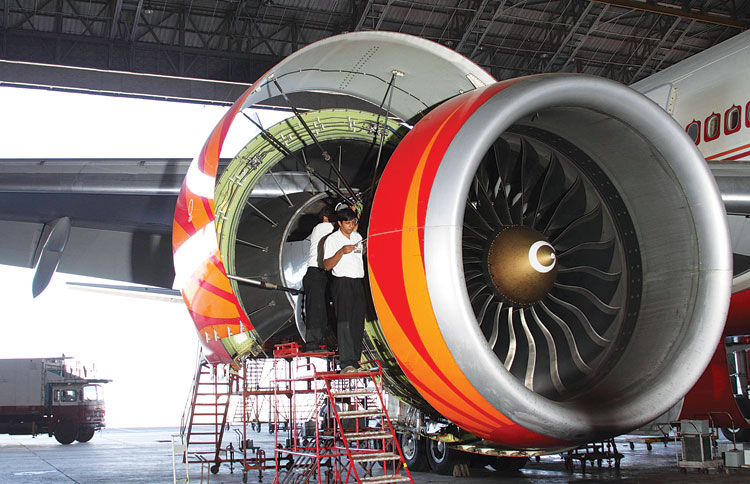
Drawing a sharp historical contrast he continues, “Thirty years back, everything was done in-house by Air India and Indian Airlines. Even today, AIESL is having beautiful shops located in Delhi and Mumbai, but then for want of any jobs these shops are likely to get shut down. And not only that, the people who are having correct experience will also lose their experience and it will be a loss for India.” In short, India is not losing buildings, it is losing capability memory and once experience disappears, rebuilding it takes decades.
Explaining the problem further, Anirrbban Bhattacharya, Director, Vector Technorium adds, “India is reasonably strong in line maintenance, base maintenance and select component repairs for A320 and B737 families… but when one looks at the entire lifecycle of an aircraft, the ecosystem is still incomplete.” He further goes on to list critical gaps, “APU overhaul, advanced avionics, landing gear, composite and nacelle repairs, engine accessories and tyre retreading these drive the majority of lifecycle cost and downtime.”
“India for now does not have enough depth to be categorised as completely independent… critical components such as bleed valves, ECUs, ADIRUs are yet to be explored,” adds, Sajumon M.P., Head, AOG Desk, Lufthansa Technik India.
India’s thin domestic rotable and LLP pools remain one of its most underestimated disadvantages. Chavan notes, “Unless we have large stocking such as surplus stocks similar to ones available in USA… the dependency on PBH will continue.”
Prakash Babu Devara, Head of Aviation Marketing, APAC Sales, Ramco, quantifies the impact with sobering clarity, “With only around 15–20 per cent of India’s commercial MRO serviced domestically and engine MRO largely overseas, local pools of rotables, LLPs, and engine components remain thin, stretching TAT and slowing AOG recovery. PBH pricing is less competitive versus global pools as operators face longer lead times and higher logistics costs.” PBH dominance determines who controls fleets and by the looks of things today, India does not. At the heart of this lies a structural truth that engine MRO does not exist in isolation; it is an ecosystem business.
INDIA’S ENGINE MRO MOMENT
India is finally witnessing the emergence of domestic engine MRO facilities for CFM56, LEAP and other high-volume powerplants. On paper, this should mark a turning point by reducing foreign dependence, cutting costs and retaining billions of dollars in annual maintenance spend within the country. But then again, engine MRO is not simply about hangars, tooling or test cells. A fully functional engine shop depends on a tightly integrated web of rotable and LLP pools, OEM-approved repair networks, high-speed customs clearance, predictable logistics corridors, data and tooling access, local component repair capability, and a deep bench of licensed manpower. In India, these layers still operate in silos. The result is an ecosystem that remains fragmented, a capacity that cannot scale with fleet growth, and an engine MRO sector that struggles to deliver the turnaround times, cost efficiencies, and reliability demanded by modern airline operations. While hangars are being built, material availability and repair development lag behind. This adds weeks to turnaround times, increases AOG exposure and weakens the commercial competitiveness of domestic engine shops even when labour costs are lower.
The arrival of Safran’s Hyderabad engine MRO marks a watershed for India. Yet industry leaders caution that infrastructure alone does not equal ecosystem maturity. When asked when will India’s MRO ecosystem mature, Ninad Chavan, CEO, Epsilon Aerospace candidly says that it will take some more years to build a complete ecosystem to support engine overhaul.
Seconding his thoughts Devara, says, “In my view, the real Engine MRO journey has just started in India. While the recent developments in OEMs setting up engine MRO shops and global MROs starting their operations to meet local demand is commendable progress, the broader support ecosystem still needs significant strengthening. Spares availability, component repair capabilities, and streamlined customs processes remain bottlenecks. Logistics and turnaround infrastructure are improving, but for high-volume engine and heavy maintenance work, consistency and speed are critical and these areas require deeper integration and investment before we can claim full readiness.”
REGULATION
Despite progressive reforms, taxation, GST treatment, import duties on spares, and compliance costs continue to disadvantage domestic MRO versus foreign shops in subtle but cumulative ways.
Ironically, Indian airlines still often find it cheaper and faster to send aircraft overseas not because India lacks technical competence, but because the system surrounding maintenance still favours foreign ecosystems.
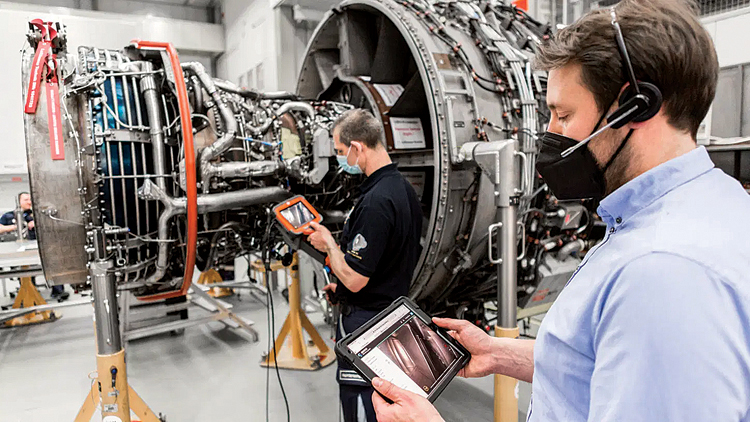
Thus, India’s biggest bottleneck is regulatory, not technical, Agarwal explains: “For doing any job on Indian-registered aircraft, the organisation has to be DGCA approved. CAR-66 requires that the engine CRS has to be issued by a licensed person, which is in deviation from EASA regulation. How do you get an Indian license holder who is having minimum two years’ experience in engine overhaul environment? For at least the first two years, the organisation may have to continue running without DGCA approval, which defeats the purpose.” Unless certification pipelines are modernised, India risks building global-grade hangars that cannot scale.
THE SUPPLY CHAIN WOES
Customs delays, documentation complexity, bonded warehouse constraints, re-export procedures and GST-related compliance continue to extend turnaround cycles, especially for AOG material movements. While policy reforms have improved certain processes, India still lacks the frictionless spares movement environment that is enjoyed by its neighbours Singapore, Dubai and Kuala Lumpur. In an industry where hours matter, days of delay become a strategic handicap.
As Indian carriers increasingly operate under PBH contracts and lease penalty regimes, even minor delays translate into major cost escalations directly undermining the value proposition of domestic MRO.
Thus, customs friction remains India’s most persistent operational handicap. Chavan is blunt. He goes on to describe how customs clearance is still a nightmare to many MROs. “The concession and exemption are comparatively easier for operators than MRO,” Chavan adds.
Stressing this further Devara says, “Delays in customs clearance, caused by complex tariff structures, inconsistent classification, and manual documentation, stretch AOG recovery and turnaround times. High logistics costs, limited bonded warehousing near airports, and weak multimodal connectivity add to inefficiency.”
He outlines the necessary reforms, “Digitised, time-bound customs processes, fast-track AOG clearance, expanded bonded/free trade zones, integrated multimodal logistics corridors and shared inventory pools.” In aviation, every extra day becomes a strategic disadvantage.
THE MANPOWER ILLUSION
India also faces a looming AME and technician supply constraint. Fleet growth has outpaced training capacity just as the licensing pipelines remain slow and experienced manpower is increasingly being absorbed by overseas operators offering higher compensation. Without urgent expansion of training pipelines, instructor capacity, and faster certification pathways, India risks becoming hangar-rich but manpowerpoor.
Sharad Agarwal explains, “There are fifty odd schools producing approximately five thousand technicians per annum...there is no bottleneck in aircraft maintenance manpower but there is no basic training available in India which will train people towards engine or component maintenance.”
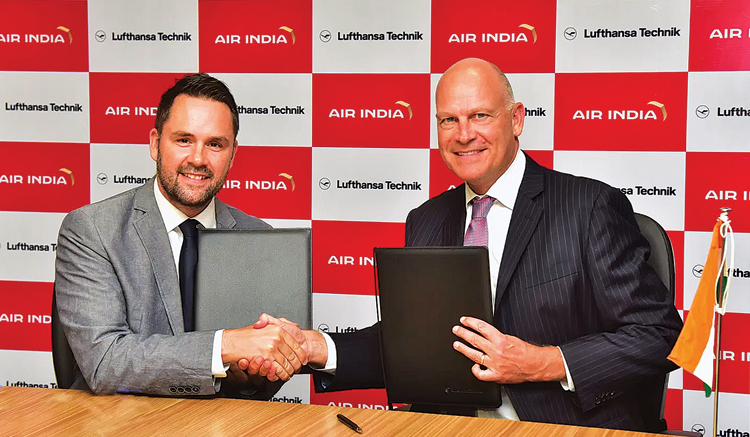
Ninad Chavan adds, “The advantage of low labour cost is lost if TAT is more than those offered by other countries.”
Bhattacharya’s most strategic warning is on manpower and retention, “Top global hubs invest in structured, career-track training for engineers and AMEs aligned with international licences and OEM standards. India must equally address the growing attrition of trained personnel to overseas carriers. Otherwise, India risks becoming a training ground for export talent rather than a long-term aviation career destination.”
Elaborating further, Anirrbban Bhattacharya adds, “Lower labour cost is often cited as India’s natural advantage, but labour represents only a small portion of total maintenance cost.” Structural disadvantages dominate, “Higher inventory carrying costs, limited pooling access, regulatory dependency and ecosystem immaturity elongate turnaround cycles even when shop-floor capability exists.”
CONCLUSION
India now stands at a threshold of upcoming MRO revolution. But the country, its politicians and all aviation stakeholders need to decide, it can either continue building hangars and hope ecosystems catch up or actually make a coordinated national push to develop spares pools, component repair depth, logistics corridors, manpower pipelines and OEM integration. The second path is the only one that will create sustainable aviation sovereignty.
Prakash Devara clarifies “Full MRO self-reliance is aspirational but not practical in the near term. The sustainable model is global integration with local strength.”
Until component repair depth increases dramatically, India will struggle to achieve true lifecycle maintenance independence, and that is exactly why India’s most serious MRO vulnerability is not engines, it is components
To sum it up, Bhattacharya feels what India is facing is not MRO issue, but as an aviation–economics issue, “To be counted among the world’s top five civil aviation MRO and broader aviation services hubs by 2030, India must take a holistic, ecosystem-level approach rather than looking narrowly at hangars and checks on aircraft. What global leaders such as Singapore, Dublin, Louisville, Amsterdam and Miami have shown is that aviation services are interlinked, MRO, leasing and financing, componen ts, training, regulatory alignment and global platforms converge to create a compelling value proposition.”
He stresses that control of high-value repairs, data access and regulatory alignment will define leadership, “Global MRO and component repair leadership only comes when OEMs are integrated into the value chain through formal partnerships, data licences and co-located advanced repair facilities. Without this, high-end LRUs, FADEC modules and composite repairs will remain structurally outside India.”
Bhattacharya sums it up saying, “Aviation services are interlinked, for example MRO, leasing, components, training, regulatory alignment and global platforms must converge.”
“To harness the anticipated $4 billion Indian MRO industry by 2030, tax and regulatory incentives, aggressive capital and infrastructure support and a nose-to-tail ecosystem are critical, Sajumon concludes.
By 2030, India will be operating one of the world’s largest commercial fleets. Whether that fleet is maintained largely at home or remains structurally dependent on foreign MRO hubs will depend on the decisions made today. India has built the hangars but now time is ripe for the country to build its own control.
Because in aviation, the real power does not lie in who buys aircraft, it lies in who keeps them flying and India’s real aviation race has only just begun.