

The insightful articles, inspiring narrations and analytical perspectives presented by the Editorial Team, establish an alluring connect with the reader. My compliments and best wishes to SP Guide Publications.

"Over the past 60 years, the growth of SP Guide Publications has mirrored the rising stature of Indian Navy. Its well-researched and informative magazines on Defence and Aerospace sector have served to shape an educated opinion of our military personnel, policy makers and the public alike. I wish SP's Publication team continued success, fair winds and following seas in all future endeavour!"

Since, its inception in 1964, SP Guide Publications has consistently demonstrated commitment to high-quality journalism in the aerospace and defence sectors, earning a well-deserved reputation as Asia's largest media house in this domain. I wish SP Guide Publications continued success in its pursuit of excellence.
The strategic lessons emerging from the recent US-Iran war in the Middle East reveal how air power, force generation and industrial capacity are becoming increasingly interconnected and interdependent, reshaping the conduct and economics of modern warfare
 | By AIR CHIEF MARSHAL V.R. CHAUDHARI (RETD), FORMER CHIEF OF THE AIR STAFF, INDIAN AIR FORCE |
The fragile ceasefire in the US/Israel-Iran war has led to much speculation on what the contours of conflict would look like if the ceasefire is violated. While analysts are still grappling with explanations for Iran’s stout defence against the might of the United States, it may be opportune to study the aspects of air power in the campaign.
THE DANGER OF PREMATURE CONCLUSIONS
Ten days into the air campaign, General Dan Caine, chairman of the Joint Chiefs of Staff, announced that Iranian launches of “one-way attack drones have decreased 83 per cent since the beginning of the operation.” This figure reflects a decline in observed launch rate — more an indicator of tactics than of stockpiles. Such announcements risk creating a misleading picture of how much of the threat has actually been eliminated, and can put war fighters at risk.
Functional damage assessment estimates how much of a target’s operational capability has survived after a strike, while target-system damage assessment evaluates whether the offensive campaign is degrading the adversary’s ability to fight. This is achieved via an intensive data-crunching process that may take weeks, if not months. The biggest pitfall of drawing lessons too early from any conflict is making conclusive arguments in the absence of target-system level assessments.
IRAN’S STRATEGY OF ATTRITION AND INVENTORY MANAGEMENT
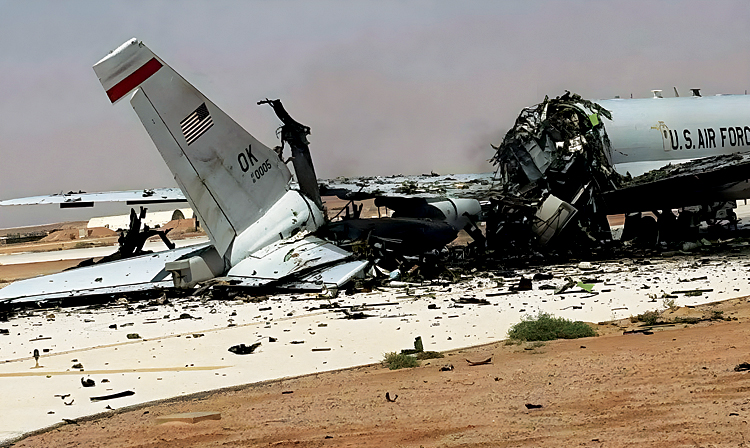
The euphoria over decimating Iran’s war-waging capacity was short-lived when Iranian drones and missiles struck Prince Sultan Air Base in Saudi Arabia, destroying an E-3 Sentry and damaging KC-135 tankers — not for the first time. Earlier in March, an Iranian attack had reportedly damaged at least five KC-135 tankers at the same base.
The pause in Iranian counter-attacks had given rise to speculation that their forces were decimated. It could instead have been a tactical recalibration — using the time to learn, adapt, and refine strategy. It could also have been deliberate stockpiling for larger, coordinated attacks later, a pattern not unlike Russian strikes in Ukraine. Or Iran simply realised that a lower but sustained launch rate is sufficient to maintain coercive pressure on Gulf States while conserving weapons for a protracted conflict. A strategy of attrition does not require maximum effort every day. Iran had, after all, kept the then fourth-largest army at bay for over eight years during the Iran-Iraq War — fighting through sustained but measured offensives that depleted Iraqi forces while preserving their own assets judiciously.
Observing the pattern of Iranian strikes over the first ten days, one notices a measured escalatory sequence: first military installations, then logistics hubs and communications nodes, and finally energy infrastructure. Each target system served a distinct coercive purpose. This kind of target sequencing is not characteristic of a force running low on munitions — it is consistent with deliberate inventory management.
DRONES, INDUSTRIAL CAPACITY, AND THE CHANGING LOGIC OF AIR CAMPAIGNS
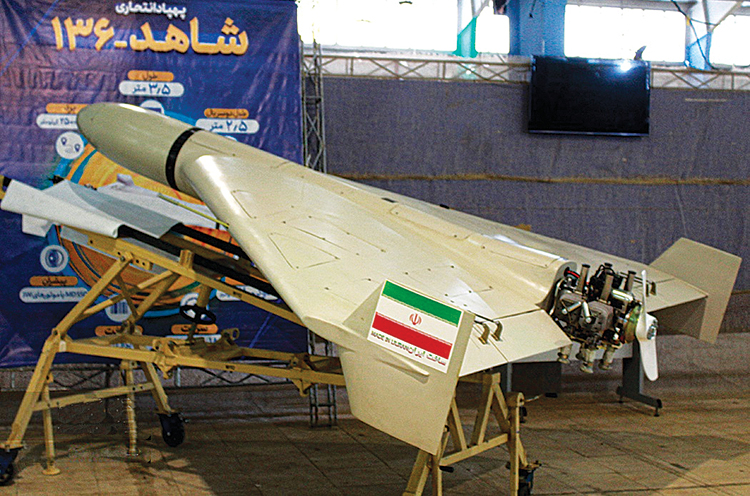
The US CJCS’s statement needs careful analysis. The Shahed-136, Iran’s primary drone weapon, requires no dedicated launch facility. It launches from an angled rail mounted on a pickup truck that can quickly relocate, minimising exposure to counter-strike. Airstrikes targeting Houthi missile and drone launch sites had previously failed to destroy the launchers precisely because they were dispersed, mobile, and difficult to locate. Iran’s dispersed drone production has similarly frustrated efforts to strike the full supply chain. Ballistic missiles — relying on large vehicles, fixed infrastructure, and longer preparation times — are easier to find, fix, and target. In all probability, the 83 per cent figure for “one-way drones”, likely bundled SSM capabilities into that count.
Iran has launched around 2,000 Shahed drones from a stock of over 10,000. This raises a critical question: how long can regional air defences sustain the expenditure of interceptors required to defeat continuous attacks? In the absence of layered air defences at US bases in the Middle East, American forces appear to have focused on the other side of the equation — degrading Iran’s ability to produce weapons and generate mass.
An unambiguous objective of Operation Epic Fury has been degrading not just Iran’s long-range weapons, but also its ability to replenish them. The targeting of Iran’s military-industrial complex is reminiscent of World War II strategic bombing campaigns against Germany and Japan — a scale of industrial targeting largely unseen in the decades since. Over the last four to five decades, US airpower has increasingly employed precisionguided munitions against fielded forces, command-and-control systems, and directly supporting infrastructure. Iran’s reliance on easy-to-produce, one-way attack drones has complicated this calculus — by repopulating the battlefield quickly, Iran has created more targets that US forces must find, track, and destroy, thereby increasing the time and effort required to achieve decisive effects. While emerging counter-drone technologies and low-cost interceptors may counter salvos or swarms of drones, such systems would be required in huge quantities, particularly if multiple interceptors are needed to defeat continuous waves of attacks during protracted conflicts.
TARGETING THE ENABLERS OF AIR POWER
In this conflict, asymmetric force levels compelled Iran to devise its counter-air campaign innovatively. Iran systematically targeted the enablers of American airpower — radar and communication infrastructure, aerial refuelling tankers, and Airborne Warning and Control Systems — located across US bases in Bahrain, Qatar, Kuwait, Saudi Arabia, and the UAE. By degrading these enablers, Iran could continue its drone and missile attacks with the same goal as traditional counter-air: to weaken the enemy’s ability to launch aerial attacks. When viewed against air power doctrines, Iran’s tactics relied on cheap drones and missiles rather than fighters and bombers to attain some level of ‘air denial’ to deny control of the air to the US forces. In an era where concealing high-value assets has become increasingly difficult due to persistent surveillance, long-range precision strikes has resulted in attrition that can exhaust defences. In more ways than one, they exposed the vulnerabilities of US airpower operating in forward locations, being under repeated attacks.
Giulio Douhet had foretold that “it is easier and more effective to destroy the enemy’s aerial power by destroying his nests and eggs on the ground than to hunt his flying birds in the air.” Iran’s strategy has followed precisely this principle, but through asymmetric means — targeting refuelling aircraft, AWACS, satellite communications terminals, early warning radars, and even damaging the primary sensor of the THAAD battery at Muwaffaq Salti Air Base. Degrading these systems has created coverage gaps and weakened the very defences designed to stop Iran’s own strikes. The targeting of tankers has forced a dilemma: forward-deploy them and risk further damage, or pull them back and reduce strike sorties and time on station.
LESSONS FOR FUTURE WARS: MASS, RESILIENCE, AND INDUSTRIAL CAPACITY
Operation Epic Fury has demonstrated that to address Iran’s advantage in mass production and employment of drones, highend offensive and defensive munitions alone are not sufficient. This has resulted in the resolve to choke force generation at its source — a doctrinal shift away from targeting deployed forces, toward attacking production facilities persistently, something the US military has not pursued at scale since World War II.
While Op Epic Fury may have been a relatively low-threat operation against Iran, the same template cannot be applied against a peer adversary. Attacking industrial sites on the territory of a nuclear-armed adversary would require sufficient air superiority and could be highly escalatory. Deep strikes against industrial facilities would require very long-range precision weapons, or fifth-generation fighters employing standoff weapons, supported by extensive SEAD/DEAD operations.
The lessons for us are direct and unambiguous. Our armed forces need more munitions, of more types, to compete with rivals that can build masses of drones and missiles. The most important takeaway is the vulnerability of forward airbases, particularly those that do not provide sanctuary to high-value assets. Hardening of airbase infrastructure is an investment that cannot be wished away. Dispersal, while a sound doctrinal precept, has practical limits — it requires pre-positioned equipment, trained personnel, and logistics infrastructure that takes years to build.
The return of mass is the next critical lesson. The flawed belief that quantity can be traded for quality has depleted our fighter strength and air defence systems. Sustained salvos can exhaust missile defences and reduce the capacity to absorb losses. What Iran has executed with ballistic missiles and cheap drones, China could execute at a far greater scale and sophistication. Our force structure and industrial base were built for a different era. The time for drastic reform is now.
The fragility of our system — with a handful of aging tankers and Airborne Warning and Control Systems — is not easily comprehended. Uncrewed platforms are undoubtedly cheaper and could provide the mass and resilience necessary, but cannot yet fulfil support roles like aerial refuelling or airborne command-and-control. The Indian Air Force’s pursuit of such capabilities through initiatives like the Mehar Baba Competition — this edition themed on collaborative drone-based surveillance radars — points in the right direction, but must be backed by serious industrial investment.
THE RETURN OF THE WAR ECONOMY
We need to go beyond paper plans and incentivise investments in the industrial base to increase surge and reserve production capacity. The private sector will always prioritise profit and be wary of investing in military goods. The government must create market incentives vital to building and maintaining a defence industrial base capable of supporting military requirements for a protracted conflict. A basic estimate of military needs over the duration of a conflict is vital for contemporary industrial planning — and developing these plans will require a new generation of thinkers, planners, and analysts across the armed forces and industry.
While we are on track to field new platforms and weapons over the next decade — from maneuverable hypersonic weapons to next-generation stealthy, long-range, unmanned aircraft — this calls for parallel developments in doctrine, training, and operational concepts. Planners must consider how increased attrition and material shortages could affect concepts of operations, and how force generation can be built around modularity and flexibility to adapt to unforeseen countermeasures.
The ongoing conflict has highlighted that warfare has come full circle — campaigns now seek to degrade an adversary’s ability to maintain their war economy and supply their military forces. The efforts to disrupt Iranian supply lines through economic sanctions, diplomatic pressure, maritime interdiction, and strikes against military-industrial facilities have created a new normal. Military planners must now consider various methods of impeding adversary war production over the duration of a protracted conflict.