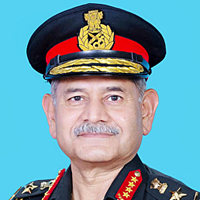
The insightful articles, inspiring narrations and analytical perspectives presented by the Editorial Team, establish an alluring connect with the reader. My compliments and best wishes to SP Guide Publications.
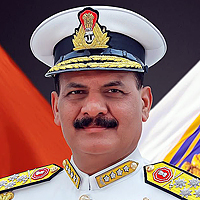
"Over the past 60 years, the growth of SP Guide Publications has mirrored the rising stature of Indian Navy. Its well-researched and informative magazines on Defence and Aerospace sector have served to shape an educated opinion of our military personnel, policy makers and the public alike. I wish SP's Publication team continued success, fair winds and following seas in all future endeavour!"

Since, its inception in 1964, SP Guide Publications has consistently demonstrated commitment to high-quality journalism in the aerospace and defence sectors, earning a well-deserved reputation as Asia's largest media house in this domain. I wish SP Guide Publications continued success in its pursuit of excellence.
On the occasion of the 93rd Indian Air Force Day, Air Chief Marshal A.P. Singh, Chief of the Air Staff, engaged in an in-depth conversation with Jayant Baranwal, Editor-in-Chief of SP’s Aviation, and shared his insights on specific issues concerning the Indian Air Force
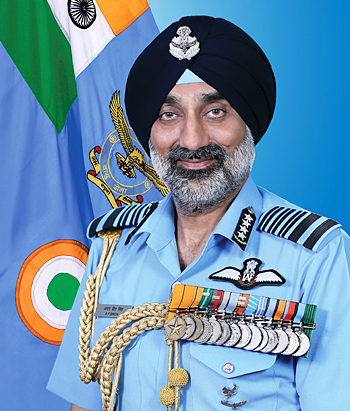
SP’s Aviation (SP’s): Operation Sindoor was led by the IAF. What are the takeaways from these Operations in terms of modernisation and capability enhancement of the IAF?
Chief of the Air Staff (CAS): Operation Sindoor reaffirmed the decisive role of air power as both the primary responder and a strategic deterrent. The operation highlighted the unique advantages of air power like strategic reach, rapid response, operational tempo, the ability to precisely control escalation and achieve desired effects while minimising collateral damage. In modern warfare, it is air power that offers the broadest spectrum of options, ranging from subtle deterrence to decisive victory.
Another key takeaway is the critical importance of escalation management. Intelligent, calibrated and precise employment of air power has demonstrated that air operations can be executed effectively without triggering uncontrolled escalation. This approach has allowed us to respond decisively to provocations while operating under the nuclear umbrella, reinforcing strategic stability.
Operation Sindoor also showcased the synergy between offensive and defensive capabilities. Advanced precision weapons and state-of-the-art strike systems restricted adversary operational freedom, while counter-drone systems effectively neutralied incoming threats.
“In modern warfare, it is air power that offers the broadest spectrum of options, ranging from subtle deterrence to decisive victory”
Modern conflicts have highlighted the importance of capacity along with capability, especially in protracted war scenarios. Achieving selfreliance is the key to fight and win the modern wars. Our military aerospace ecosystem is evolving with purpose and confidence, and moving steadily towards global standards. Strengthening indigenous systems remains central to the endeavour, ensuring resilience and self-reliance. With sustained emphasis on quality, innovation and scale we are well poised to realise the true spirit of Atmanirbhar Bharat - a self-assured, capable and globally competitive aerospace power. Indigenous platforms, weapons and sensor systems provide not only operational independence but also the flexibility to rapidly adapt and modify capabilities as per evolving threats. Initiatives like the LCA, AMCA, Akash systems and other indigenous programmes ensure that the IAF can sustain operations without over-reliance on external sources, strengthening both strategic autonomy and national security.
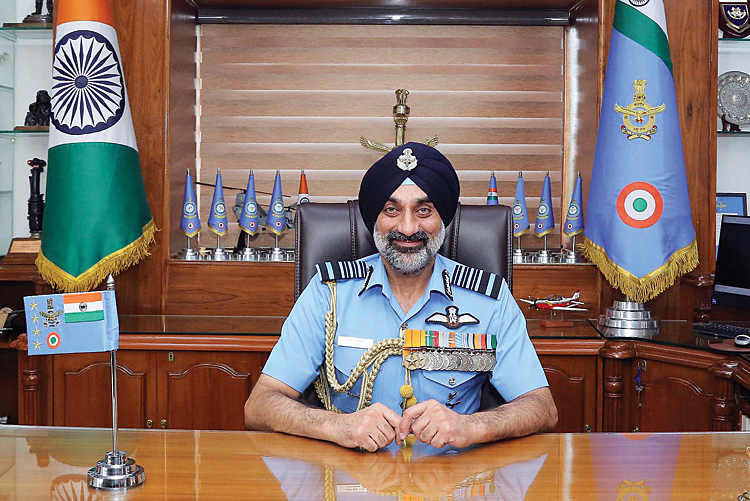
Looking ahead, the nature of warfare will be transformed by disruptive technologies such as autonomous systems, artificial intelligence, quantum computing, unmanned platforms and hypersonic weapons. To maintain our operational edge, the IAF is committed to integrating these technologies into our war fighting domains.
Achieving this requires a ‘Whole of Nation Approach,’ where the military, industry, academia, and government collaborate to ensure that the IAF remains at the forefront of technological adoption and future readiness.
SP’s: Given the time lines of Tejas Mk-1A, Mk-2 and the AMCA inductions, with possible further delays, do you think there is a requirement to immediately progress the MRFA programme? Will it be done under the ‘Make in India’ initiative?
CAS: The Indian Air Force has consistently aimed to balance operational readiness with the nation’s long-term goal of selfreliance in defence technology. Our focus remains on progressive indigenisation initiatives that enhance operational capability while strengthening India’s defence industrial ecosystem.
We are on the verge of inducting the LCA Mk-IA, with deliveries beginning shortly, and an additional 97 aircraft have been contracted. While some delays have occurred due to design and engine supply challenges, these are being addressed through close coordination with all stakeholders. Looking ahead, the IAF is closely collaborating with the DRDO on the LCA Mk-2 and the 5th Generation Advanced Medium Combat Aircraft (AMCA). The LCA Mk-2 is expected to achieve operational clearance by December 2027, while the AMCA, sanctioned with an allocation of `15,803 crore, plans to see its first prototype by September 2027, maiden flight by September 2028, and full certification by 2034. AMCA is being developed through a true public-private partnership, with multiple Indian defence companies actively participating alongside DRDO’s Aeronautical Development Agency. Together, these platforms will significantly enhance India’s air dominance capabilities in the medium to long term.
Combat enablers such as flight refuelling aircraft and AEW&C platforms are essential for extending reach, persistence, and operational flexibility, and therefore remain very high on our modernisation and capability development priorities
In parallel, the MRFA programme is being pursued to meet immediate operational requirements. This programme is aligned with the ‘Make in India’ initiative, emphasising maximising indigenous content, technology transfer, and establishing local manufacturing infrastructure, ensuring long-term sustainment and integration with home-grown weapons systems. In essence, MRFA serves as a bridge between immediate operational needs and our future indigenous fighter capabilities, ensuring that the IAF remains both capable today and self-reliant tomorrow.
SP’s: There is a definite need for more force multipliers in the IAF like the Refuellers, AWACS, UCAVs, etc. What are IAF’s plans for their acquisitions and inductions?
CAS: Combat enablers like FRAs and AEW&C platforms are crucial for enhancing the IAF’s operational flexibility and remain very high on our priority.
The Indian Air Force has made notable headway in strengthening its force-multiplying capabilities, particularly in the area of air-to-air refuelling. A contract has already been concluded for the wet lease of a Flight Refuelling Aircraft (FRA), which will be jointly utilised by the IAF and the Indian Navy for training purposes. We expect this aircraft to become operational within this year, significantly enhancing our training and operational readiness.
In parallel, the IAF is also processing a case for the procurement of six additional FRAs to meet long-term operational requirements. The responses to our Request for Proposal (RFP) are presently under evaluation. Combat enablers such as flight refuelling aircraft and AEW&C platforms are essential for extending reach, persistence, and operational flexibility, and therefore remain very high on our modernisation and capability development priorities.
Airborne Early Warning and Control (AEW&C) systems are a vital component of modern air power, and the Indian Air Force recognises the need to strengthen this capability in adequate numbers. To bridge the gap, we are pursuing multiple projects that will substantially enhance our airborne surveillance and command network in the coming years.
The AEW&C Mk-IA programme, based on the Embraer-145 platform, is being developed by the Centre for Airborne Systems (CABS) under the aegis of DRDO. Six such aircraft are planned for induction, each equipped with significantly upgraded radar ranges and advanced Mission System Avionics. These improvements will greatly enhance our ability to detect, track and manage air operations across a wide battle space.
The AEW&C Mk-II programme represents a major leap forward in indigenous capability. The design and development are being spearheaded by CABS, DRDO, under the ‘Make in India’ initiative. The Mk-II system will feature next-generation sensors, advanced electronic warfare suites, and extended endurance, offering far superior performance compared to earlier variants. Development of the mission systems is progressing well at DRDO, while contracts for structural modifications are being finalised with AIESL and ADS, Spain.
The Indian Air Force has made significant progress in strengthening its Unmanned Aerial System (UAS) capabilities, recognising the critical role these platforms play in modern air operations
Additionally, the IAF is also progressing plans to induct state-of-the-art Intelligence, Surveillance, Target Acquisition, and Reconnaissance (ISTAR) aircraft. These platforms, incorporating indigenous sensor technologies, will further enhance our situational awareness and provide critical capabilities for joint operations.
The Indian Air Force has made significant progress in strengthening its Unmanned Aerial System (UAS) capabilities, recognising the critical role these platforms play in modern air operations. A major milestone was the finalisation of the contract for 31 MQ-9B Sky/Sea Guardian RPAs on October 15, 2024. These systems will significantly enhance the IAF’s surveillance and reconnaissance capabilities, with eight systems earmarked for direct operational deployment of IAF.
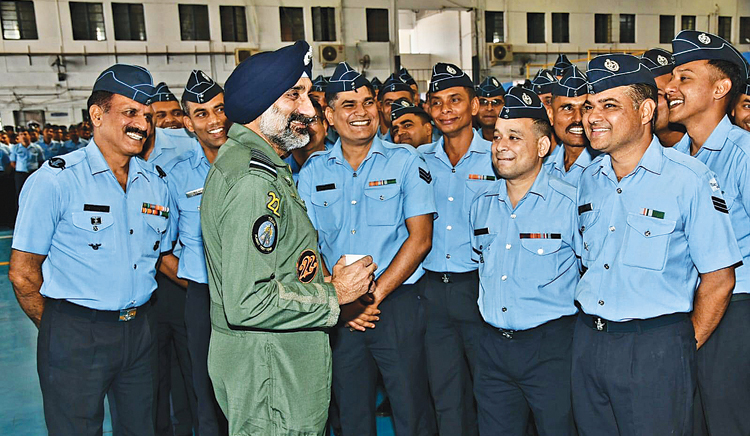
We are also pursuing a comprehensive upgrade of our existing RPA fleet, including India’s Heron UAVs, to add combat capabilities. These enhancements will enable extended range operations, improved performance in diverse environments, and the ability to carry weapons. This will significantly expand the operational utility of these platforms.
Additionally, the IAF is actively involved in the Remotely Piloted Strike Aircraft (RPSA) project, developed by the DRDO. Once operational, this system will introduce a new dimension to our offensive capabilities, providing precision strike options with strategic flexibility. Complementing these efforts, the IAF is progressing with the induction of HAROP loitering munitions, extended-range loiter munitions and manoeuvrable expendable aerial targets. Collectively, these systems will provide a decisive edge in both, surveillance and combat scenarios, ensuring readiness for the evolving spectrum of threats.
Collectively, these initiatives reflect our commitment towards building a robust, networked, and self-reliant airborne surveillance, an unmanned architecture for the future.
SP’s: Recently, there are talks about the need for Strategic Bombers in the IAF. What is your opinion on their requirements and the role they will play?
CAS: In today’s rapidly evolving security landscape, our sphere of operations is expanding to address emerging threats and growing capabilities of our potential adversaries. As we look beyond our national borders and into the Indian Ocean Region, it is clear that our air power must be projected further and more effectively. Strategic bombers offer a unique capability to strike targets at long ranges with precision, allowing us to exploit time-critical windows of opportunity. We have seen the effective use of bombers by the US Air Force in recent operations, and we believe they have a role to play in our own operational canvas. In line with the government’s vision for India’s role in the Indian Ocean Region, as outlined in the SAGAR concept, we are moving towards a more outward-oriented approach. As a ‘Preferred Security Partner’ and ‘First Responder’, we must recognise the need for the IAF to take a more active role in power projection and offensive strike capability across the IOR. Strategic bombers are currently being evaluated as part of our future modernisation roadmap. These platforms offer deeper reach and fortified deterrence for our nation, and we believe they have a vital role to play in our efforts to protect India’s interests.
SP’s: Future wars are moving towards Tech-enabled operations. How do you plan to keep the IAF personnel informed, educated and trained on these fast moving critical technologies?
CAS: As the aerospace domain rapidly evolves, the IAF recognises the imperative to equip our personnel with the knowledge and skills required to remain future-ready. Modern air operations increasingly rely on agile, autonomous and digitised high-technology platforms, demanding a multidisciplinary and forward-looking training approach.
To address this, we have identified specialised technological courses at premier institutes in India and abroad, focusing on areas such as Artificial Intelligence, Machine Learning, Nanoscience and Technology, Additive Manufacturing, Robotics, Mechatronics, Cyber Technology and Quantum Technologies. Our personnel are also continuously updated on global developments in aerospace and defence technologies.
Several initiatives have been undertaken to institutionalise this learning. The IAF has established a Weapon Systems School for specialised training on aerial and surface weapon platforms, remote aerial systems and intelligence operations. The Faculty of Space Studies at the College of Air Warfare has been transformed into a Centre of Excellence and a tri-services Nodal Training Centre, catering to emerging space-based operational requirements.
We actively encourage our personnel to contribute through service papers, participate in conferences and seminars, and pursue long and short-term courses through MoUs with universities and research institutions. Our training syllabus is regularly reviewed and updated to incorporate new technologies and evolving operational concepts.
I am proud to say that the IAF is proactively embracing these challenges. By fostering a culture of continuous learning, innovation, and adaptability, we are ensuring that our personnel are fully prepared to operate in the technology-driven battlefields of the future.
SP’s: India just made a successful foray back into Space after over 4 decades. What is your perspective on how ‘Space’ will be crucial in the future and enhancing our Space based capabilities? What is the progress on the setting of a ‘Space Command’?
CAS: The IAF has always played a lead role in the Gaganyaan programme, overseeing astronaut selection and training, including physical conditioning, flying, aero-medical preparation and crew recovery operations. Space has become a decisive domain in modern military operations, providing critical capabilities in communication, navigation, intelligence and surveillance. Recent conflicts have showcased the importance of Beyond-Line-of-Sight operations, highlighting that space-based assets offer a strategic advantage as the ultimate high ground. Recognising this, the Indian Air Force has adapted its operational doctrine to integrate space applications, acknowledging the fundamental role space plays in future warfare.
Space has become a decisive domain in modern military operations, providing critical capabilities in communication, navigation, intelligence and surveillance
To meet the growing operational demand, the Defence Space Agency (DSA) has been established as a tri-services organisation, serving as a key enabler for the space requirements of all three services. The establishment of a dedicated Space Command is underway, with the Defence Space Agency (DSA) laying the groundwork for India’s military space capabilities.
The space domain has evolved from a supporting function to a core enabler of air operations. Navigation, communications and precision targeting are increasingly dependent on resilient space-based systems. The Government’s approval of the SBS-III programme in 2023, aimed at launching 52 military satellites by 2029 under the DSA, will ensure India maintains access to critical space assets even in contested environments.
Complementary initiatives such as the SAMOOHA ELINT constellation, and the 29 technology challenges assigned to the IAF under the 75 Mission Defence Space Challenges, are driving innovation in space docking, on-orbit maintenance and advanced communication systems.
Through these concerted efforts, India is establishing a robust and resilient military space capability, positioning the IAF to operate effectively in the new frontier of space-enabled warfare.