
The insightful articles, inspiring narrations and analytical perspectives presented by the Editorial Team, establish an alluring connect with the reader. My compliments and best wishes to SP Guide Publications.

"Over the past 60 years, the growth of SP Guide Publications has mirrored the rising stature of Indian Navy. Its well-researched and informative magazines on Defence and Aerospace sector have served to shape an educated opinion of our military personnel, policy makers and the public alike. I wish SP's Publication team continued success, fair winds and following seas in all future endeavour!"

Since, its inception in 1964, SP Guide Publications has consistently demonstrated commitment to high-quality journalism in the aerospace and defence sectors, earning a well-deserved reputation as Asia's largest media house in this domain. I wish SP Guide Publications continued success in its pursuit of excellence.
How Air Power Shaped the USA/Israel–Iran War and Strategic Lessons from the Conflict
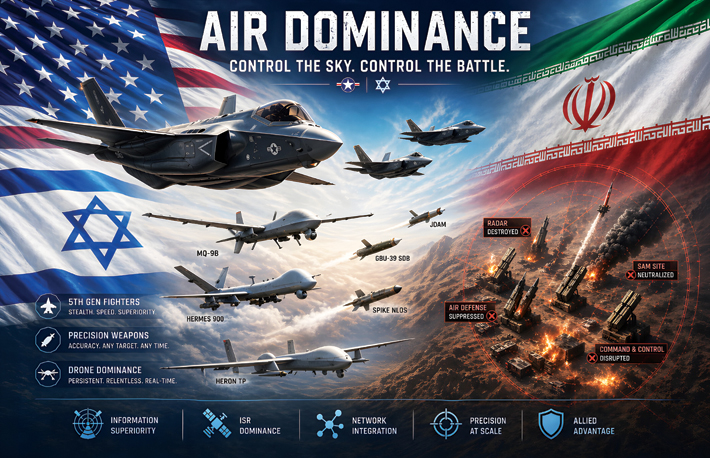
“The military mind always imagines that the next war will be on the same lines as the last. That has never been the case and never will be. One of the great factors on the next war will be aircraft obviously. The potentialities of aircraft attack on a large scale are almost incalculable.” – Ferdinand Foch
Air Power has played a pivotal role in every conflict since its inception at the beginning of the 20th century. This role of air power has become more critical when contextualised against national objectives and political intent. While a lot is being spoken about the exponential growth of drones and missiles, air warfare, doctrinally remains the cornerstone in winning any conflict. When guided by clearly spelt-out objectives, an air campaign can be decisive; the converse also holds true, as is evident in protracted conflicts across the world.
The ongoing Iran-USA/ Israel war has generated a debate on certain aspects of air warfare. It must, however, be viewed in the context of air power doctrine and multi-domain operations and the geographical distance between the combatant nations. Air superiority has always been the first goal in any war, and the same held primacy in this conflict, too. Now that there is a pause in operations, it is clear that air power achieved every tactical and operational objective, while the strategic outcome of the war remains a source of worldwide debate.
While, USA and Israel engaged around 15,000 targets in Iran (as quoted by Defense Secretary Pete Hegseth of the USA), Iran launched almost 7,000 drones and missiles. The damage achieved by the air strikes far outweighs the damage caused by drones and missiles from Iran. Analysis of the conflict brings out lessons, some of which would be applicable in our context too.
VALIDATION OF DOCTRINAL PRECEPTS OF AIR WARFARE
The modern air power doctrines stress the establishment of control of the air as a prerequisite for a successful air campaign. This was achieved in the initial days of the war through systematic degradation of the Iranian Air Force, which allowed almost complete freedom of operation for the USA and Israel. US and Israel used a combination of drones, loiter munitions, missiles and stand-off precision attacks by fighter aircraft to produce desired effects in a multi-domain operational scenario.
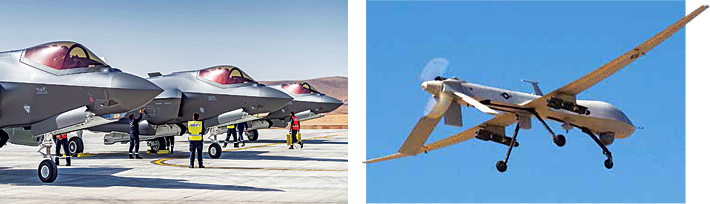
Slow-moving large-sized UAVs are vulnerable in highly contested airspaces. 24 MQ-9 Reapers and 18 Hermes/ Herons were lost, against the loss of just one F-15E and damage to one F-35A to Iranian air defences. This proves two things: firstly, the utility of large UAVs in contested air spaces and secondly, mission planning must cater for mobile, especially passive AD resources of the adversary, despite a high degree of control of air.
INTELLIGENCE SURVEILLANCE RECONNAISSANCE
ISR played an important role in the entire conflict, and Mossad penetrated the highest echelons of Iranian political and military leadership. The USA deployed assets for ISR and real-time intelligence; this led to the selective targeting of Iranian leadership throughout the war and the sabotage of numerous Iranian systems, especially AD systems. Credible intelligence led to the targeting of hardened underground facilities, missile and drone storage sites and military industrial complexes.
On the other hand, Iran was able to target US assets on the ground in virtually all Gulf nations based on quality intelligence through its proxies, supporters and its own TEE-01B satellite, drones like Shahed-147, Mohajer-6/10, Ababil and Fotros. It also used Agentic AI in processing SIGINT. Iran successfully employed its ISR resources to target AWACS and Tankers on the ground.
A major lesson in ISR was distinguishing between the real targets and decoys, persistence and timely intelligence to reduce sensor to shooter loop and the importance of HUMINT. It also brought out the challenges in acquiring and processing ISR data over a large geographic area (Iran is spread over a landmass of 1.64 million sq km). The gaps that increased with the passage of the war allowed Iran to successfully deploy its dispersed missiles and drones. This war once again underscores the importance of capacious ISR capability and capacity, especially while dealing with a geographically expansive adversary.
IMPORTANCE OF MANNED SYSTEMS
This war has opened a debate on manned versus unmanned aerial systems. Extensive use of unmanned systems by both Ukraine and Iran has been effective; however, the nation cannot gain control of the air with unmanned systems and missiles alone. Statistically, almost 90 per cent of drones and missiles were intercepted by US and Israeli air defence systems, against just two fighters being intercepted by Iranian air defences. Omni-role aircraft with stealth capability can engage multiple targets in a single mission with high accuracy and weight of attack while acting as a command node integrating precision fires in multiple domains. They create a favourable environment for land and maritime forces to operate with relatively greater freedom, which drones and missiles cannot achieve.
Modern multi role fighters undertake a range of functions simultaneously, from SEAD, long range precision strike, air-to-air, ISR and EW. Missile launchers need refurbishment after a few launches, while manned fighters can undertake multiple missions by day and night and most importantly, the manned fighter takes decision and can abort a mission, which is difficult for a missile. The major lesson is to have a judicious mix of manned and unmanned systems, rapidly achieve mannedunmanned teaming and supplement them with a mix of ballistic and cruise missiles with high accuracy and manoeuvrability to saturate adversary air defences.
AIR DEFENCE
This war demonstrated how low-cost cheap drones and missiles with cluster warheads can saturate air defences. At the same time, it brought out the inadequacies in the American approach to Air Defence, where they relied on expensive kinetic kill measures in the form of THAAD and Patriot systems driving up the cost of interception. US Air Defence philosophy relied heavily on kinetic options, and its low density and fixed large radars were successfully targeted by cheap Iranian drones due to disparate and thinly located air defence systems and large number of nations involved in defending US assets on ground.
US and Israel severely degraded the Iranian Integrated Air Defence system in the initial phase of the war using kinetic and soft kill systems. Lack of refined networking created gaps that could be exploited by the US and Israeli Air Forces. This proved critical for the subsequent employment of low-tech aircraft and other airborne systems. The challenges of completely decimating the air defences were also highlighted when an F-35 was engaged by an IR-based AD system, and an F-15 was shot down. Survivability of, especially highly mobile systems, passive AD systems and MANPADS must always be factored in mission planning. Continuous innovation in AD techniques of ambushing fighters remains relevant in present air warfare.
The modern air power doctrines stress the establishment of control of the air as a prerequisite for a successful air campaign
Air Defence needs to be multi layered, automated and net centric to deal with the entire range of aerial threats from low observable, low speed drones to hypersonic missiles, air launched supersonic weapons and multiple warheads in a single missile. Use of AI in target identification and interception for cost-effective air defence was proved by Israeli defences by achieving an almost 95 per cent interception rate in the initial phases of war. Scalable and modular solutions against cheap and massed drone attacks, including innovative interceptor drones, are necessary to achieve a cost balance. The USA used expensive missiles, aircraft and high-end weapon systems, driving up the cost of war adversely. Air Defence systems need to be scalable, modular, low-cost with high magazine depth to cater to the complete spectrum of threats.
IMPORTANCE OF GEOGRAPHY
Geography played a crucial role in this conflict. Despite engaging almost 15,000 targets and having overwhelming air superiority, both the USA and Israel could not completely destroy the missile and drone arsenal of Iran. This proves the importance of geography and the limits of conventional weapons. Iran effectively used mountainous terrain to its advantage in the form of missiles and drone cities deeply buried in its mountains, well dispersed over its large geographical area. Reports indicate that almost 40-50 per cent of its drone and 60 per cent of its missile arsenal remains intact. This proves that dispersed and deeply buried force can survive longer and remain effective against a sustained air campaign, while the cost of doing so may be huge.
Conventional weapons have limitations against deeply buried targets. The most powerful bomb of the USAF, GBU-57, can penetrate about 60-meter depth; however, Iran is believed to have constructed tunnels that are almost 500 meters deep. Iran also dispersed such facilities across the entire nation, thus straining the ISR and strike resources of US/Israel. This is an example of exploiting the limits of conventional weapons for force preservation; it also supports that targeting becomes harder even for a conventionally superior force. Iran learned this from the wars in Afghanistan, Iraq and Ukraine and implemented it on a large scale in its war strategy.
FORCE PROTECTION
Expensive force multipliers like AWACS, Air refuelers and special mission aircraft are critical to warfighting and limited in numbers. Both the Ukraine and Iran war have now underscored the effectiveness of long-range low observable drones against these assets if they are not protected, since loss of such platforms has a significant strategic impact.
These assets, by their size, can be easily picked up by aerial/space-based ISR systems or HUMINT. Their dispersed operations and preservation measures, including passive defence measures, are extremely relevant in modern warfare against low-cost drones. Even hardened shelters were seen to be rendered ineffective by accurate low-cost drones and air-launched precision weapons. A cost versus benefit analysis on hardening of infrastructure versus passive measures, dispersal and other actions needs to be a part of the overall operational plan, including positioning of AD assets to defend such assets.
CONCLUSION
The USA/Israel-Iran war has many lessons for air warfare in the future. Air power ensured outright success at the tactical and operational levels. Air power continues to be the instrument of choice especially, while dealing with a geographically distant theatre of operation. Going forward, affordable mass, magazine depth, scalable and modular systems are critical in a high intensity conflict where the adversary has the depth and endurance with asymmetric options. The cost of air warfare being very high, affordable mass can be created by mannedunmanned teaming, autonomous aerial systems and a combination of strike options including manned fighters, drones and missiles integrated with cyber and EW capabilities.
Most important takeaway perhaps is that Indian challenges are unique on its two fronts and hence, lessons from the ongoing conflicts must be adapted to the Indian context. The most important lesson is that a defensive approach can perhaps delay defeat but not win wars. While the latest generation fighters are critical to operate in highly contested air spaces and achieve control of air, contemporary fighters remain relevant to deliver the desired weight of attack once the desired degree of control of air is achieved. Air power is inherently offensive and needs to be deployed offensively to achieve cross-domain effects.