The insightful articles, inspiring narrations and analytical perspectives presented by the Editorial Team, establish an alluring connect with the reader. My compliments and best wishes to SP Guide Publications.

"Over the past 60 years, the growth of SP Guide Publications has mirrored the rising stature of Indian Navy. Its well-researched and informative magazines on Defence and Aerospace sector have served to shape an educated opinion of our military personnel, policy makers and the public alike. I wish SP's Publication team continued success, fair winds and following seas in all future endeavour!"

Since, its inception in 1964, SP Guide Publications has consistently demonstrated commitment to high-quality journalism in the aerospace and defence sectors, earning a well-deserved reputation as Asia's largest media house in this domain. I wish SP Guide Publications continued success in its pursuit of excellence.
The future of warfare lies not in choosing between manned and unmanned systems, but in integrating them. Human cognition, judgement and ethical decision-making, combined with the scale, affordability and versatility of unmanned platforms, can create a more effective and resilient combat capability.
 | By AIR MARSHAL A.K. BHARTI (RETD), FORMER DEPUTY CHIEF OF THE AIR STAFF, INDIAN AIR FORCE |
If the Armenia-Azerbaijan conflict of 2020 brought to fore the significance of unmanned aerial systems (UAS) on the modern battlefield, the ongoing Russia-Ukraine conflict has only cemented the position of unmanned systems as being the platforms of choice for the warring sides. In the recent Iran-US-Israel conflict, both sides, particularly Iran, has used the unmanned systems extensively.
This has led many to believe that the days of manned systems are numbered. While it is true that modern battlefield is undergoing its most profound transformation, something akin to the advent of the gun powder in medieval period and then more recently, the mechanised formations and the aviation platforms; it may be premature to write an ode to the manned systems, even in the distant future!
THE DISCOURSE
The discourse therefore need not be one versus the other – manned vs unmanned, rather it needs be manned with unmanned. The ready availability of relatively cheap unmanned systems, coupled with advancements in AI has incentivised even weaker protagonists to get into/ stay in conflict (Ukraine, Iran, Houthis). This is also the reason why modern conflicts rage on endlessly. The human as well capital costs with the present day small unmanned systems are low, there is no public pressure or incentive for countries to negotiate an early end to conflict. It has become relatively easy to get into conflict, and quite complex to get out of it.
This makes outside commentators believe that unmanned systems can do similar functions and bring about similar results (read victory) to the side employing it more effectively. However, one misses out the attainment of overall objectives of the conflict by these unmanned systems alone. Let us not get swayed by what one wave of 1,000 drones achieves, no doubt it carries explosives and is precise, and would cause damage to the intended target, but are such waves sufficient to achieve victory? The results of ongoing conflicts prove otherwise. In Russia-Ukraine context, both sides employ unmanned systems heavily, but none has achieved victory. Same with Iran. Houthis obviously are not fighting to win, at the most – to harass.
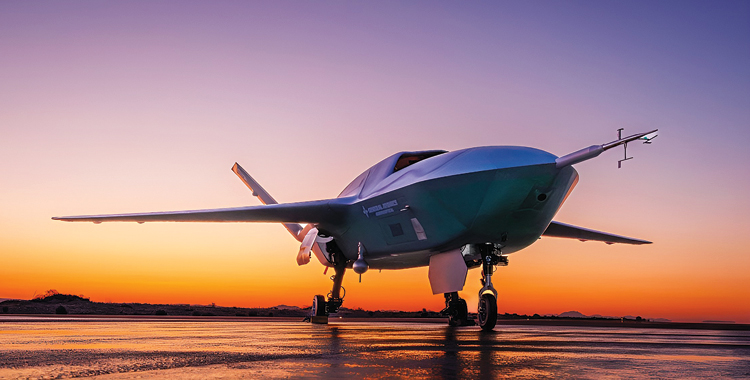
And therein lies the answer to what unmanned systems can achieve today and in the foreseeable future. It can slow down an advance, it can harass a defending force, but it cannot give you outright victory – definitely not today, and not in the foreseeable future. Victory is shaped by pulverising weight of attack, shock, speed and cognitive decision making, none of which are likely to be available as a package with any unmanned systems in near future. True, with the advancement of AI algorithms, the systems will get more and more autonomous, but battlefield is all about variables and improvisation, wherein human cognition would remain irreplaceable, at least for the near future.
And why I keep referring to ‘near future’ is due to the fact that I expect something to happen in this timeframe which will annul the advantage of mass, low observability and affordability of these low cost UAS. That something is the advent of robust counter UAS systems! Countries are already investing heavily into these systems and soon the advantage enjoyed by the present day UAS would be comprehensively challenged. If I were to draw a simile, we are in an era wherein the combat aircraft just came in – wait for the invention of radar (WW-II) – the balance would soon tilt. Effective counter UAS systems are on the horizon!
Unmanned systems rely heavily on numbers (to saturate enemy defences), data links and autonomous algorithms. Already, swarm interceptors are evolving which would negate the advantage of numbers, and data links are increasingly becoming susceptible to jamming and deception. Autonomous algorithms can be hacked into. Wait for quantum techniques to mature and the scenario with these autonomous systems would be different. Low observability of these platforms are soon going to be challenged with the advent of systems like Frequency Modulated Continuous Wave (FMCW) high band radars and Passive Coherent Locators. In their infancy, work on these systems is on and it is only a question of time before they are combat ready.
SYNERGISTIC EMPLOYMENT
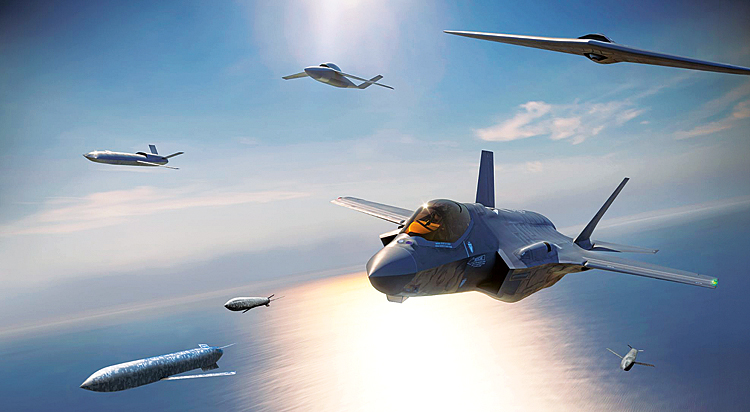
Therefore, it may be premature to summarily write off the manned systems, because once effective counters for unmanned systems are in place (it is bound to happen- that is the cycle of military technology), the entire doctrine of employment of unmanned systems would need a relook. The future lies not in replacing one with the other, but in mastering their integration. The discourse needs to move from Manned VERSUS unmanned to Manned WITH Unmanned.
Therefore, in times to come, a modus-vivendi would have to emerge between the manned and unmanned systems. The concept of MUMT (Manned Unmanned Teaming) is already taking shape. Commentators have been discussing this teaming for some time now, countries have been putting their R&D efforts in it, but in the noise of ongoing conflicts and glamorisation of swarm unmanned systems, their voices have largely been drowned. However, the future belongs to this team – the manned with unmanned. The human in the loop (or even on the loop) retains the cognition of the human mind, reacts to variables on the battlefield, sticks to ethics and commands the unmanned. The unmanned with their advantages of doing the dull, dirty and dangerous duties, synergise to pulverise the adversary and ensure victory, bringing the conflict to an expeditious end.
— The author was Director General Air Operations at Air HQ (VB), wherein he actively planned and coordinated missions during Operation Sindoor.