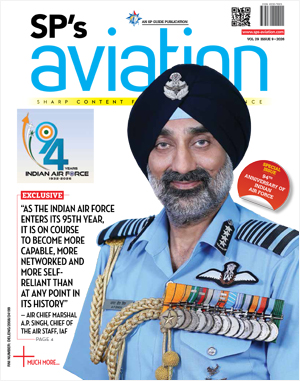
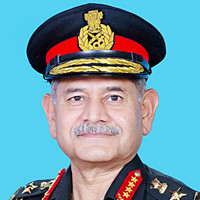
The insightful articles, inspiring narrations and analytical perspectives presented by the Editorial Team, establish an alluring connect with the reader. My compliments and best wishes to SP Guide Publications.
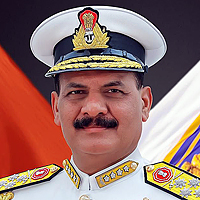
"Over the past 60 years, the growth of SP Guide Publications has mirrored the rising stature of Indian Navy. Its well-researched and informative magazines on Defence and Aerospace sector have served to shape an educated opinion of our military personnel, policy makers and the public alike. I wish SP's Publication team continued success, fair winds and following seas in all future endeavour!"

Since, its inception in 1964, SP Guide Publications has consistently demonstrated commitment to high-quality journalism in the aerospace and defence sectors, earning a well-deserved reputation as Asia's largest media house in this domain. I wish SP Guide Publications continued success in its pursuit of excellence.
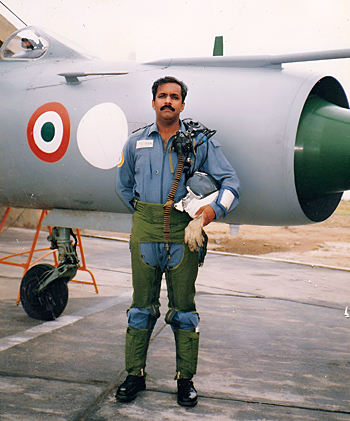
The MiG-21 left Indian Air Force service in September 2025 after decades of yeoman service to the Nation. A pilot who flew it, with utmost respect, instructed on it and commanded a squadron of it recalls a machine that demanded respect and repaid it in full.
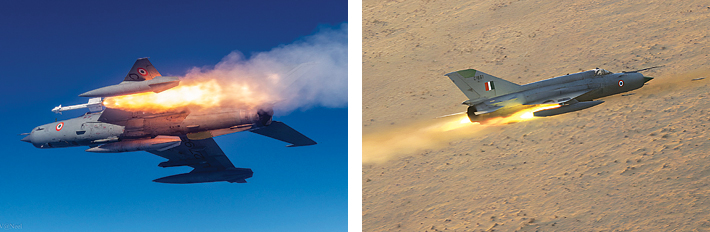
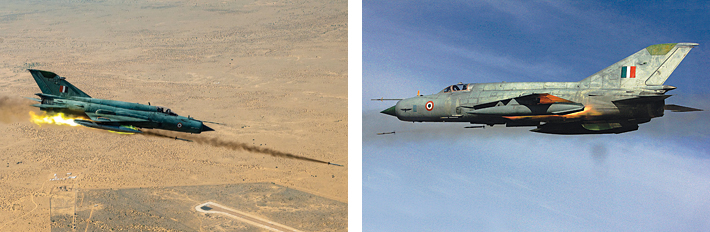
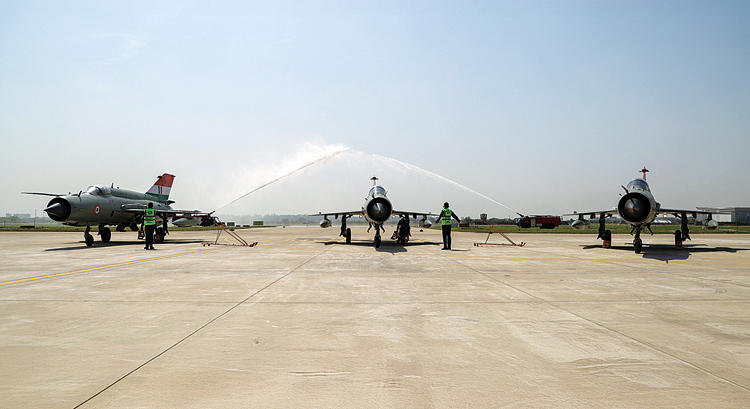
On September 26, 2025, at Chandigarh, the Indian Air Force bid farewell to the MiG-21. The aircraft had joined the service in 1963. For more than sixty years it flew from and over almost every terrain of the country, fought in every major conflict and trained generations of fighter pilots.
For those of us who spent our defining flying years in its narrow cockpit, the MiG-21 was never, just another type in the IAF inventory. It was a brother-in-arms. This is one pilot’s remembrance of that companionship.
FIRST IMPRESSIONS
The first feeling was of awe. Its shape, and its sheer dynamism overwhelmed a young pilot. Even when standing still on the ground, it carried a mystique that was hard to define. Its swept delta wing and needle nose seemed to be moving even when they were not.
It did not take long to learn the second lesson. If you did not respect the MiG-21, it did not pardon you. It was never pretentious. It did not have the refinements that later fighters would boast. What it lacked, it made up for by its simplicity and robustness. It always rewarded hard work, and always gave everything it had.
The MiG-21 was never designed to be used the way the Indian Air Force came to use it. Interceptor, ground-attack aircraft, trainer, reconnaissance platform: it was asked to do all of these, often in the same sortie. I am sure its designers would have been amazed at what the IAF achieved from and out of it.
EAST TO WEST: LEARNING THE TRADE
My first sortie in a MiG-21 was at Tezpur, in Assam, as an undertrainee pilot. The tenure was a massive dose of learning flying and above all developing the fighter pilot attitude – i.e. you just don’t give up. I learnt the art of healthy competition and, above all, the habit of relentless, uncompromising hard work. There were mistakes made, as there are in every learning process. Mistakes came with learning of lessons, because seniors were always there to hold your hand and guide you to the next level.
That next posting took me from the east to the west, to Pathankot. There, two MiG-21 squadrons shared an airbase and a defined patch of airspace. The spirited fight for flying slots within a day, a week or even a month was relentless. Both squadrons competed over how much they had flown. Course mates compared notes on who had logged more hours, what their range scores were, how many combat sorties they had flown. MiG-21 was always there - ever-ready and ever-smiling–as if it knew the foretold.
It was a healthy competition. Differences of opinion, big or small, were settled over a drink at the bar religiously. The MiG-21 was the great equaliser. It did not differentiate between squadron’s pilots. It recognised and rewarded sortie preparation, concentration, hard work and dexterity, and above all, the respect you had for the machine.
From Pathankot, I moved to the edge of the Thar desert, Suratgarh and from there to the foothills of the Himalayas – Bagdogra. MiG-21 continued to be my lifeline in the IAF.
This phase with the MiG-21, which began in 1989, continued without a break until 1996. I then completed the Flying Instructors’ Course and went on to instruct on the Kiran Mk I, IA and II. That tour lasted until 1999. Mid 1999, I was posted to the western-most corner of India: Naliya, in Gujarat.
NALIYA: A WELCOME LIKE NO OTHER
I remember the day I arrived at the base. I was walking into the base with my small family when the base hooters went off. I was perplexed. Was this a welcome, or a celebratory announcement of my arrival? It was an announcement yes, but not of or for me. The Kargil operations had begun. The IAF had started flying sorties in the northern sector, and other bases were being placed on maximum alert.
My stay at Naliya brought experience that few tours could match. I saw the Kargil operations from the Western Front. Our MiG-21 unit, (No. 45 Squadron), shot down an intruding Pakistan Navy ‘Atlantique’ reconnaissance aircraft over the Rann of Kutch on August 10, 1999. Later came the deployments of Operation Parakram. The MiG-21 remained the common denominator throughout.
With the MiG-21 by your side, those were the remarkable years. What changed was the experience one gained in piloting the aircraft in its various avatars. We flew over the Gulf of Kutch, the Arabian Sea, the Rann of Kutch and the Rajasthan desert to name a few. Every mission was different. The aircraft was always the same. MiG-21 took everything that was thrown at it and was always co-operative, provided it was treated with respect.
One learnt to pilot the machine across its full range of operating limits. As a trainee, that meant flying at the speed of the clock (in a trainer), on precise timings. On air tests, it meant taking the aircraft supersonic. On the air-toground practice firing range, we dropped bombs, fired rockets and front guns. Scores were good if one understood the theory and translated it faithfully using the platform. The scores were as good, or as bad, as one made them to be. One could never fault the MiG-21.
The healthy competition between MiG-21 squadrons continued at Naliya too, but now between neighbouring airbases. Association with MiG-21, was nothing but pursuing excellence (perfection) in everything one did or thought of doing.
FROM TRAINEE TO TEACHER
From the western boundary, I moved north, back to Pathankot. The responsibility was now supervisory: to prepare the next crop of pilots by instructing on the MiG-21. I had done some of this at Naliya, but at Pathankot it was the defining activity of the unit.
Until then, I had been the trainee in the twin-seater. Now I had, the honorous responsibility to train and groom the youngsters, and yet go on being a trainee. That is not a contradiction. One cannot instruct if one does not learn from each MiG-21 sortie. You could never take the machine for granted. It had to be a constant vigil.
Instructing on the MiG-21 was a challenge, no doubt. It was also deeply satisfying. Nothing matched the satisfaction when a trainee came back from his first solo and progressed through the assigned syllabus.
By 2002, the MiG-21 though an elderly statesman held its own, in the air as well as on the ground, against the bigger birds on the block: the MiG-29, the Mirage 2000 and the Su-30 MKI. Flown the way it was meant to be flown, it gave the big birds a scare many a times and a run for their money on other occasions. It offset its lack of modern avionics with its small size, its nimbleness and its maneuverability. It could fight, and fight it did.
COMMAND: PASSING ON THE FAITH
From Pathankot I went to learn the art of staff work in the salubrious climes of the Nilgiris, at the (DSSC) Wellington. This was followed by my command tenure, once again in a MiG-21 squadron. Our primary role was to train ab-initio pilots on the MiG-21, at Bhuj in Gujarat.
It was an extremely satisfying tenure. One could share one’s own experiences of the MiG-21 and present MiG-21 to young pilots as a companion. One could teach them that the MiG-21 was extremely faithful and a dedicated friend as long as you respected its limits. Teaching that respect was, perhaps, the most important lesson a commanding officer could pass on.
THE MEN BEHIND THE MACHINE
No tribute to the MiG-21 would be complete without a mention the countless technicians who kept it fly worthy. They always handed the pilot a MiG-21 in pristine condition. Their pride was at stake if the machine did not behave exactly as it was supposed to, which is to say flawlessly.
I was sometimes taken aback by their firmness in refusing to bring an aircraft to the flight line for flying until they were fully convinced of its health. The senior technicians, who had seen almost every season of the aircraft’s life, were priceless repositories of knowledge and experience. They taught a lot, and they taught well.
The joy in their eyes when a pilot came back from his/her first solo, and their sadness when a pilot did not come back, cannot be described, seeing is believing. So was the enthusiasm with which they offered an armed aircraft for a gunnery meet, and their unbounded joy when told that the scores were “just there”. Hats off to them!
AN EPOCH, NOT JUST AN AIRCRAFT
The MiG-21 has now passed into the annals of history of the Indian Air Force. But its era was an unparalleled epoch, and an unchallenged one. It was a brute, but a sublime one. It was sober to the core, yet it could be mischievous once in a while.
Every pilot who spent the defining years of his life in the MiG-21 cockpit would give the proverbial right arm for more time with this dream machine. To those who never had the chance to enjoy its grace: sorry, chaps, please blame your parents. No kidding.
One thing is certain. There will be no more “MiG-21 types”. MiG-21 was pure!
— The author is Additional Director General, Centre for Aerospace Power and Strategic Studies (CAPSS)