
The insightful articles, inspiring narrations and analytical perspectives presented by the Editorial Team, establish an alluring connect with the reader. My compliments and best wishes to SP Guide Publications.

"Over the past 60 years, the growth of SP Guide Publications has mirrored the rising stature of Indian Navy. Its well-researched and informative magazines on Defence and Aerospace sector have served to shape an educated opinion of our military personnel, policy makers and the public alike. I wish SP's Publication team continued success, fair winds and following seas in all future endeavour!"

Since, its inception in 1964, SP Guide Publications has consistently demonstrated commitment to high-quality journalism in the aerospace and defence sectors, earning a well-deserved reputation as Asia's largest media house in this domain. I wish SP Guide Publications continued success in its pursuit of excellence.
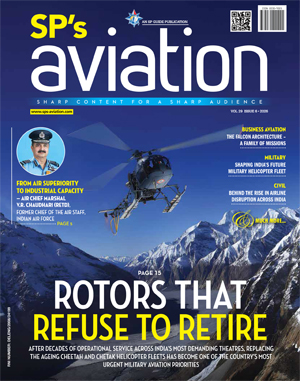
After decades of operational service across India’s most demanding theatres, replacing the ageing Cheetah and Chetak fleets has become one of the country’s most urgent military aviation priorities
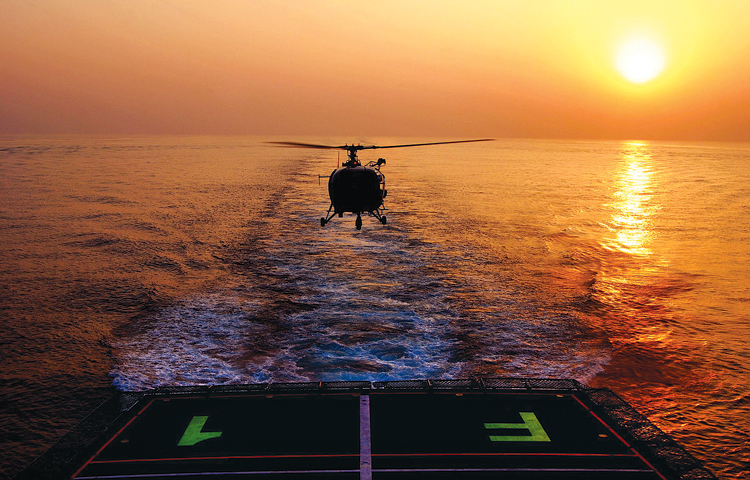
For more than six decades, the Cheetah and Chetak helicopters have been constants across India’s military landscape — from the icy heights of Siachen, the world’s highest battlefield at over 6,000 metres, to humanitarian missions following natural disasters. They have carried soldiers, evacuated casualties and served as lifelines to some of the most inaccessible regions on Earth. What was once a remarkable story of endurance has, however, become a story of dangerous delay.
THE LEGACY OF TWO AVIATION ICONS
The Chetak is based on the Aérospatiale Alouette III, which first flew in 1959, while the Cheetah derives from the SA-315B Lama, which first flew in 1969 and entered service in 1971. Both were manufactured under licence by HAL, with the Chetak entering Indian service in 1962 and HAL’s own production beginning in 1965; the Cheetah followed in 1976. Over the decades, HAL produced more than 600 of the two types for India’s Army, Air Force and Navy combined. The Cheetah, in particular, earned near-legendary status for its high-altitude performance — routinely flying from Siachen’s forward posts in conditions of extreme cold and thin air that pushed aircraft and crew to their absolute limits. The Chetak, meanwhile, became a versatile multi-role platform across all three services, from liaison and training to casualty evacuation and naval utility duties. Together, they formed the backbone of India’s light helicopter capability for a generation.
WHY REPLACEMENT HAS BECOME UNAVOIDABLE
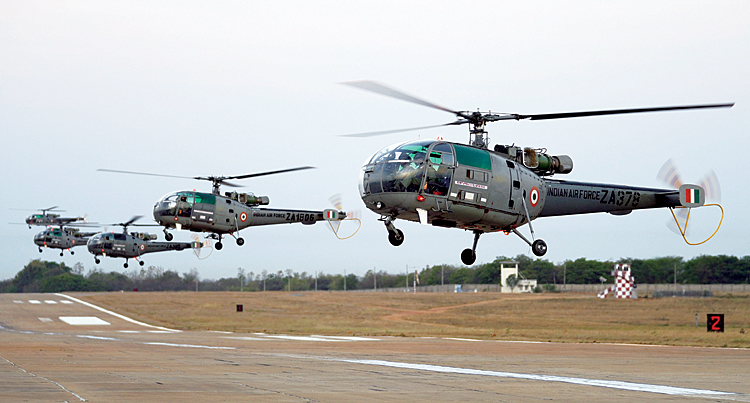
The numbers tell a stark story. Of the approximately 190 Cheetah and Chetak helicopters operated by the Indian Army Aviation Corps, around 30 are in maintenance at any given time — a serviceability deficit of roughly 15 per cent. Close to 130 of those 190 aircraft are between 30 and 50 years old. The Indian Air Force operates a further 120 of these helicopters, with around 25 in maintenance at HAL at any given moment — a deficiency exceeding 20 per cent. Across both services, more than 70 per cent of the combined fleet is over three decades old.
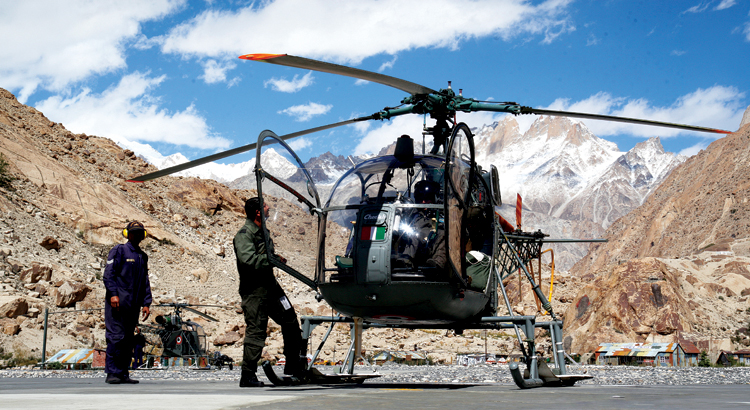
Sustaining such ageing platforms has become progressively harder. Sourcing spares for legacy systems is increasingly complex, maintenance man-hours per flying hour have risen substantially, and the skill base required to keep these aircraft airworthy is itself ageing alongside the machines it supports. Beyond the maintenance burden, modern operations demand capabilities the Cheetah and Chetak were never designed to provide: seamless day-and-night operation, integration with digital battlefield networks, advanced navigation systems, and substantially improved crew safety and situational awareness. The gap between what these platforms are capable of and what the armed forces now need them to do has been widening for years.
THE SAFETY IMPER ATIVE
On May 20, 2026, a Cheetah helicopter — operating in one of its re-engined Cheetal variants, itself a stopgap measure designed to extend the fleet’s declining service life — crashed in the highaltitude Tangste area of eastern Ladakh, near the Line of Actual Control with China. On board were Division Commander Major General Sachin Mehta and two pilots. All three survived with minor injuries; Army officials described the outcome as nothing short of a miracle, given the sheer difficulty of the mountainous terrain into which the aircraft came down. Photographs of the wreck — the tail section completely destroyed — went viral on social media and turned a longstanding defence procurement failure into a public conversation.
Military aviation experts are careful not to attribute any single accident solely to aircraft age; individual incidents have specific causes and court of inquiry findings must be awaited before conclusions are drawn. Nevertheless, there is broad consensus across the services that modern helicopter platforms provide substantial improvements in engine reliability, crashworthiness, flight management systems and pilot situational awareness. For aircrew operating in high-altitude terrain where weather can deteriorate in minutes and improvised landing zones are the norm rather than the exception, those improvements are not abstract. They represent the difference between a survivable forced landing and a fatal accident.
THREE DECADES OF PROCUREMENT FAILURE
The need for replacement has been formally recognised for more than two decades of active — and repeatedly frustrated — procurement attempts. The first RSH tender was cancelled in 2007 following allegations of procedural irregularities, after years of evaluation. A second tender in the early 2010s met a similar fate. A 2015 inter-governmental agreement with Russia for 200 Kamov Ka-226T helicopters — which would have resolved the problem at a stroke — collapsed due to sanctions complications and technology transfer disputes, dying quietly without ever being formally cancelled. The result: the armed forces continue to rely on helicopters that were supposed to be replaced many years ago. The challenge reflects broader institutional pathologies — endlessly revised qualitative requirements, shifting industrial policy priorities, and a procurement machinery whose timelines bear little relationship to operational urgency.
THE RSH PROGRAMME AND THE INDIGENOUS DIMENSION
The latest attempt to address the problem is the revived Reconnaissance and Surveillance Helicopter programme. In August 2025, the MoD issued a fresh Request for Information for 200 new helicopters — 120 for the Army and 80 for the IAF. A formal Request for Proposal is expected by early 2027. The programme, valued at an estimated ₹15,000–20,000 crore, will define Indian Army and Air Force light helicopter aviation for the next three to four decades. The new platforms are required for reconnaissance, surveillance, casualty evacuation, search and rescue, troop transport for special missions and support to civil authorities in emergencies — a broad mandate that reflects how much more the successors will be asked to do compared with their predecessors.
Running alongside, but critically distinct from the RSH, is HAL’s indigenous Light Utility Helicopter. The two are entirely separate programmes with different specifications, roles and procurement tracks, and conflating them understates the actual scale of the replacement challenge. The LUH is a 3-tonne singleengine helicopter powered by the HAL-Safran Shakti-1U turboshaft, designed primarily for lower-altitude utility operations, with high-altitude trials conducted successfully up to 6,500 metres including landings at Siachen forward posts. It features a modern glass cockpit, integrated health and usage monitoring systems, and provisions for electro-optical sensors. It received Initial Operational Clearance for the IAF variant in 2020 and the Army variant in 2021 — both years behind the original 2018 target, following persistent autopilot certification delays. As of mid-2026, around ten aircraft are ready at HAL’s Tumkur facility pending final certification. The MoD has approved 171 LUHs — 110 for the Army and 61 for the IAF — with HAL targeting eventual orders of up to 400 units across both services.
The LUH’s troubled timeline is instructive in itself: indigenous development offers genuine long-term strategic autonomy and must be supported, but it demands the kind of sustained, disciplined programme management that India’s defence acquisition system has not always been able to provide. The RSH, as an open competition, will test whether India can move with the urgency that the operational situation now plainly demands.
CONCLUSION
The Cheetah and Chetak have served India with distinction across six decades and some of the world’s most demanding operational environments. Their legacy is beyond dispute. But the May 20, 2026 crash in Ladakh — where a general officer and two pilots walked away from a wreck in mountainous terrain and counted themselves fortunate to do so — is not an isolated event. It is a signal from an ageing fleet operating under rising strain, in a strategic environment that has grown sharply more demanding since the 2020 stand-off along the Line of Actual Control.
The RSH programme, with its RFP expected by early 2027, and the LUH deliveries now beginning after years of delay, together represent the most credible pathway yet towards resolution. But the window for orderly transition is narrowing with every passing sortie. The question is no longer whether to replace the Cheetah and Chetak — that argument was settled long ago. It is whether India’s institutions can finally move with the urgency that these aircraft, and the crews who fly them daily in harm’s way, have long deserved.