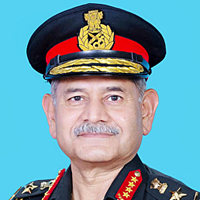
The insightful articles, inspiring narrations and analytical perspectives presented by the Editorial Team, establish an alluring connect with the reader. My compliments and best wishes to SP Guide Publications.
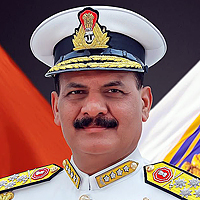
"Over the past 60 years, the growth of SP Guide Publications has mirrored the rising stature of Indian Navy. Its well-researched and informative magazines on Defence and Aerospace sector have served to shape an educated opinion of our military personnel, policy makers and the public alike. I wish SP's Publication team continued success, fair winds and following seas in all future endeavour!"

Since, its inception in 1964, SP Guide Publications has consistently demonstrated commitment to high-quality journalism in the aerospace and defence sectors, earning a well-deserved reputation as Asia's largest media house in this domain. I wish SP Guide Publications continued success in its pursuit of excellence.
While attention has long focused on replacing ageing helicopters, a broader transformation is underway. From indigenous combat aviation and naval modernisation to medium-lift selfreliance and upgrade programmes already under contract, India is laying the foundations for the most ambitious rotary-wing overhaul in its history.
For decades, military helicopter procurement in India was driven primarily by replacement needs. Today, that has changed. The Indian armed forces are no longer focused solely on retiring old platforms; they are seeking to transform how rotary-wing aviation contributes to national security — across the Army, Navy, Air Force and Coast Guard simultaneously. Taken together, and measured by contracts already signed, these initiatives represent one of the most significant military aviation modernisation efforts currently under way anywhere in the world.
The transformation is occurring against sharply changing security imperatives. India faces simultaneous pressure along its northern land borders and growing maritime responsibilities across the Indian Ocean Region. In both environments, helicopters offer a flexibility that fixed-wing aviation cannot match — and in both, India’s current fleet is under mounting strain.
THE LANDMARK PRACHAND ORDER
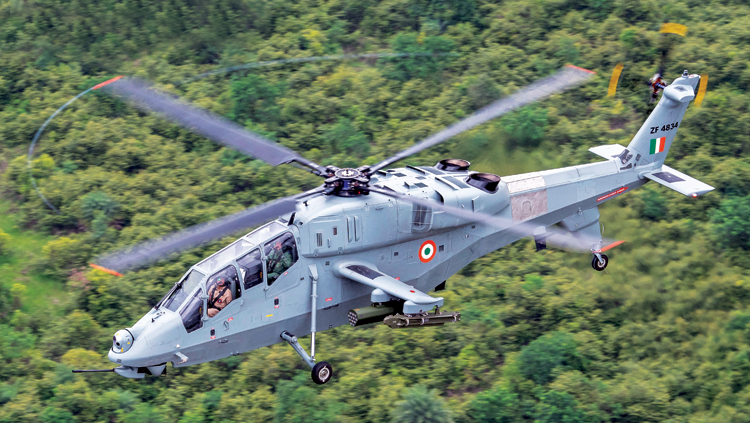
The single most significant milestone in India’s helicopter modernisation arrived on March 28, 2025, when the Ministry of Defence signed two contracts with HAL for 156 Light Combat Helicopters — the Prachand — at a combined value of ₹62,700 crore (approximately $7.5 billion). The first contract covers 66 aircraft for the Indian Air Force; the second provides 90 for the Indian Army. It is the largest indigenous helicopter order in Indian history.
The Prachand was conceived after the 1999 Kargil War exposed a critical gap: India had no dedicated attack helicopter capable of operating at high altitude. It can now operate above 5,000 metres — a capability no other dedicated attack helicopter in the world can match — making it uniquely suited to the contested terrain along the Line of Actual Control. Fifteen Limited Series Production variants are already in service with the IAF’s No. 143 Helicopter Unit at Jodhpur and with Army Aviation. Main production deliveries begin in 2027-28 and run through 2033 at approximately 30 aircraft per year. The order will also end the Mi-25/Mi-35 era, with the IAF planning to phase out its remaining Russian-origin attack helicopters by 2030-31 as Prachand inductions accelerate.
The Indian Army, meanwhile, completed receipt of six Boeing AH-64E Apaches in 2025 — the first three arriving in July, the final three in December — deployed with the 451 Army Aviation Squadron at Nagtalao, Jodhpur, for western desert sector operations. The IAF already operates 22 AH-64Es across two squadrons at Pathankot, inducted between 2019 and 2021.
THE NAVAL AVIATION IMPERATIVE
Nowhere is the modernisation imperative more visible than in the Indian Navy. The induction of 24 Sikorsky MH-60R Seahawks — ordered in 2020 under a $2.6 billion Foreign Military Sales agreement — has transformed India’s maritime antisubmarine warfare capability. INAS 334 ‘Seahawks’ was commissioned in Kochi in March 2024 and INAS 335 ‘Ospreys’ at INS Hansa, Goa in December 2025, completing the initial induction. The MH-60R was operationally deployed during Operation Sindoor in May 2025. Equipped with dipping sonar, sonobuoys, multi-mode radar, Hellfire missiles, and MK-54 torpedoes, it has introduced networked maritime warfare capabilities previously absent from India’s inventory. A $1.17 billion US-approved sustainment package notified to Congress in December 2024 keeps the fleet combatready through its service life.
Today, the Indian armed forces are seeking to transform how rotary-wing aviation contributes across the Army, Navy, Air Force and Coast Guard
With the indigenous replacement — the Deck-Based Multi-Role Helicopter (DBMRH), a navalised IMRH variant — estimated to be 8–9 years from production clearance and a further 2–3 years from meaningful induction, the Navy is already planning ahead. Naval Chief Admiral Dinesh Tripathi has publicly signalled that a follow-on order of 6–8 additional MH-60Rs is under consideration, with preparatory work expected to begin in 2026.
THE NAVAL UTILITY HELICOPTER PROGRAMME
Running alongside the high-end maritime strike mission is an equally urgent requirement: replacing approximately 60 HAL Chetak helicopters still operating from Indian warships — Alouette III derivatives based on a 1950s design — in the basic naval utility role. In August 2025, the MoD issued an RFI for 76 Naval Utility Helicopters (51 for the Navy, 25 for the Indian Coast Guard) under the ‘Buy & Make (Indian)’ category, with an estimated value of ₹5,000 crore and an RFP expected by early 2027. The requirement specifies a twin-engine platform with at least five years of proven naval service capable of 24-hour allweather operations from both ships and shore bases.
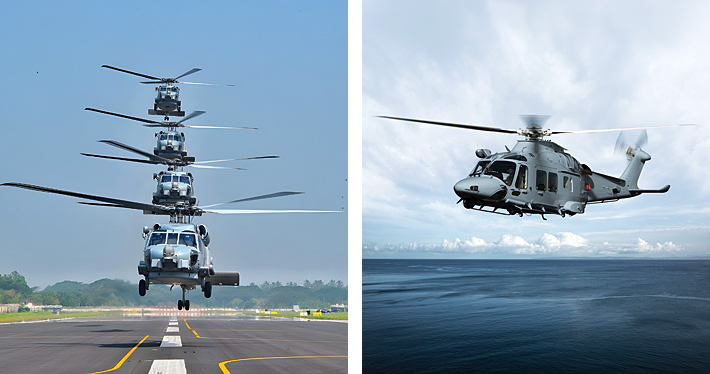
Three serious industrial partnerships have emerged. Leonardo and Adani Defence & Aerospace are offering the AW169M — a purposedesigned naval helicopter with folding rotor blades, shipboardoptimised undercarriage, and a certified 33-minute gearbox dry-run capability — through an MoU signed in February 2026. Airbus and Tata Advanced Systems are competing with the H160M via their Vemagal joint venture. HAL is in contention with its indigenous UH-M, though at approximately 5.7 tonnes its compliance with the under-5.5-tonne weight specification is uncertain.
MODERNISATION WITHOUT REPLACEMENT: THE MI-17V5 PROGRAMME
One of the most consequential elements of India’s helicopter overhaul is not a new platform at all — it is a committed upgrade of what already exists. The IAF operates 151 Mi-17V5 helicopters procured from Russia between 2008 and 2013, which remain its primary medium-lift workhorse. In April 2025, the MoD signed a ₹2,385 crore contract with Bharat Electronics Limited to equip the entire Mi-17V5 fleet with an indigenous Electronic Warfare suite — comprising a Radar Warning Receiver, Missile Approach Warning System, and Counter Measure Dispensing System — designed by DRDO’s Centre for Airborne Systems and Integrated Defence Combat Systems. The contract falls under the Buy (Indian-IDDM) framework, with most sub-assemblies sourced from Indian manufacturers. A parallel project upgrades 86 older Mi-17 and Mi-17 1V helicopters similarly, while the IAF has separately called on the private sector to develop indigenous composite main rotor blades — reducing dependence on Russian supply chains for the fleet’s long-term sustainment.
BUILDING THE FUTURE: THE INDIAN MULTI-ROLE HELICOPTER
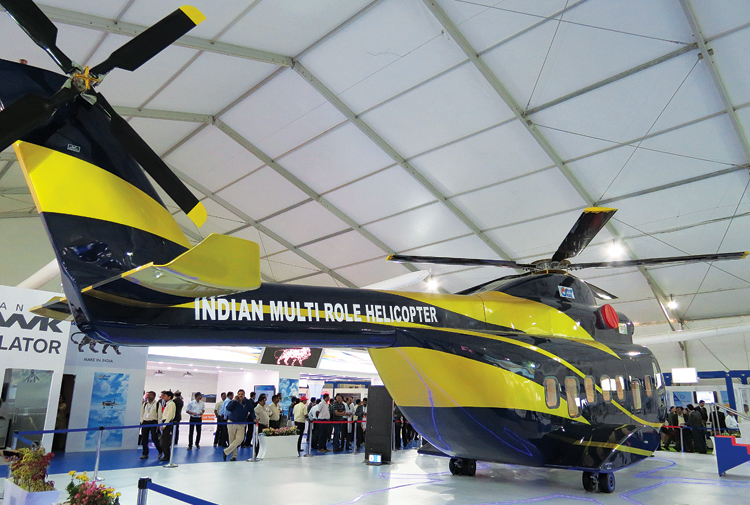
The most strategically important helicopter programme in India’s long-term roadmap is one that has not yet flown. The Indian Multi-Role Helicopter, under development by HAL in the 12.5-tonne class, is intended to replace the entire Mi-17 family — over 300 aircraft currently forming the logistical spine of Indian military aviation — across all three services and the Coast Guard. Then HAL Chairman D.K. Sunil, confirmed at the Paris Air Show in June 2025 that the company is self-funding early design work pending formal government sanction. A first flight is targeted for 2027-28, with production clearance estimated a further 8–10 years beyond that, placing large-scale service entry towards the mid-2030s. The navalised DBMRH variant adds folding rotor blades and tail boom for shipboard storage aboard INS Vikrant and INS Vikramaditya, with integration of the Aravalli engine being developed jointly with Safran. Over 550 units are planned across all variants in the first production decade.
THE INDIGENOUS IMPERATIVE
Underlying every programme is a common thread: the determination to build enduring domestic capability. India’s experience with the Mi-17 fleet since 2022 — where Russian supply chain constraints have complicated maintenance and spares procurement — has sharpened that imperative considerably. The Prachand is a fully indigenous combat helicopter in service. The IMRH targets 75 per cent domestic content. The Mi-17V5 upgrade fits indigenous EW technology to a Russian-built airframe. The NUH mandates local production under a Buy & Make (Indian) route. The approach is pragmatic — combining indigenous development, strategic partnerships and targeted foreign procurement — but the direction is unambiguous.
CONCLUSION
India’s rotary-wing modernisation is no longer a collection of individual procurement decisions. Contracts already signed — the ₹62,700 crore Prachand order, the $2.6 billion MH-60R deal, the ₹2,385 crore Mi-17V5 EW upgrade, the LUH programme — represent an aggregate well in excess of $15 billion, placing India among the world’s most active helicopter markets. What is emerging is not simply a more modern fleet, but a fundamentally different conception of what rotary-wing aviation means to Indian national security: networked, indigenous, survivable, and capable of operating from the Siachen Glacier to the depths of the Indian Ocean. The transformation is well under way. Delivering it, on time and at scale, is the harder task that now lies ahead.