
The insightful articles, inspiring narrations and analytical perspectives presented by the Editorial Team, establish an alluring connect with the reader. My compliments and best wishes to SP Guide Publications.
"Over the past 60 years, the growth of SP Guide Publications has mirrored the rising stature of Indian Navy. Its well-researched and informative magazines on Defence and Aerospace sector have served to shape an educated opinion of our military personnel, policy makers and the public alike. I wish SP's Publication team continued success, fair winds and following seas in all future endeavour!"

Since, its inception in 1964, SP Guide Publications has consistently demonstrated commitment to high-quality journalism in the aerospace and defence sectors, earning a well-deserved reputation as Asia's largest media house in this domain. I wish SP Guide Publications continued success in its pursuit of excellence.
Six aircraft, six missions, one idea - Dassault has built the Falcon family to bring the world within your reach
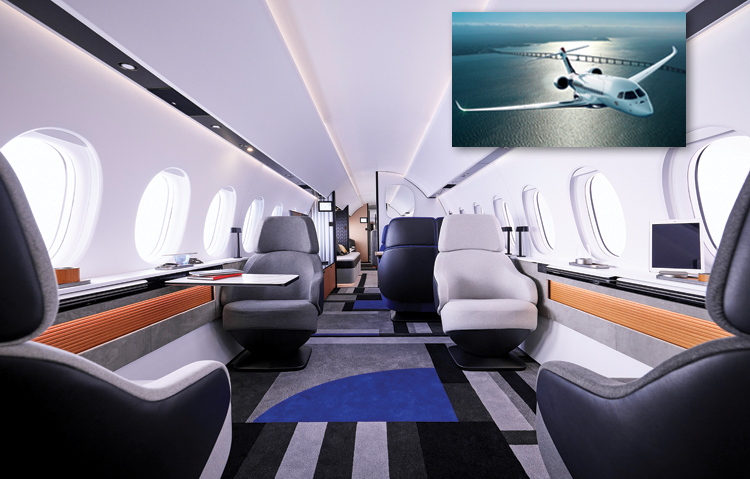
In business aviation, range figures and cabin dimensions often dominate conversations. Yet the true measure of a business aircraft lies not merely in how far it can fly, but in how effectively it enables its passengers to conduct business. The ability to reach airports closer to final destinations, operate from shorter runways, minimise travel time and deliver passengers in comfort can ultimately prove more valuable than adding a few hundred nautical miles of range.
This philosophy sits at the heart of the Falcon family from Dassault Aviation. Over decades, the French manufacturer has carved out a distinctive position in the business aviation sector by leveraging technologies and design principles developed through its military aviation heritage. The result is a family of aircraft that prioritises operational flexibility, aerodynamic efficiency and advanced flight-control technologies alongside luxury and long-range capability.
Rather than pursuing a one-size-fits-all approach, Dassault has developed a carefully structured portfolio in which every aircraft occupies a clearly defined position. From the efficient and versatile Falcon 2000LXS to the newly unveiled Falcon 10X flagship, each model has been engineered around the specific needs of a target customer base. Together, they form one of the industry’s most coherent product strategies, where technical capability and market positioning are closely aligned.
THE FOUNDATION OF THE FALCON BRAND
The defining characteristic of the Falcon family is its ability to combine long-range performance with access to airports that would otherwise be unavailable to aircraft of similar size and capability. This is achieved through advanced aerodynamics, sophisticated wing design and digital flightcontrol systems derived from technologies developed for Dassault’s combat aircraft programmes.
The company’s approach recognises a simple reality of business aviation. Travellers rarely measure the success of a journey by cruise speed alone. What matters is the total travel experience, from departure point to final destination. If an aircraft can access a smaller airport closer to a city centre, avoid a fuel stop or operate efficiently from challenging environments, it creates value that goes beyond performance figures in a sales brochure.
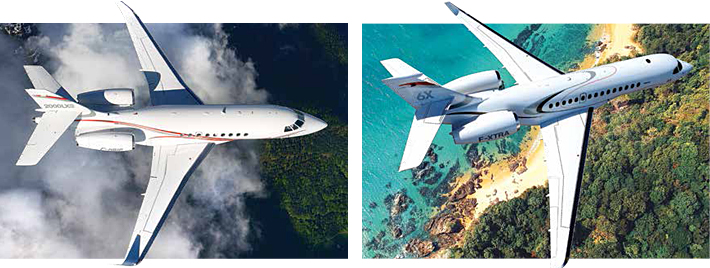
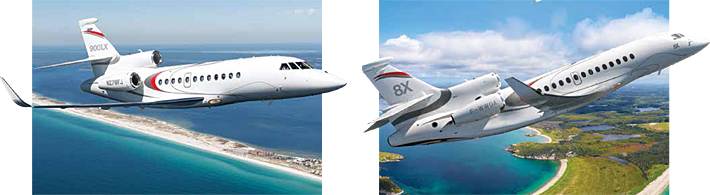
This philosophy is evident throughout the Falcon family, with each aircraft delivering a carefully balanced combination of range, efficiency, comfort and operational flexibility — and, increasingly, a clear position on sustainability. As scrutiny of aviation’s environmental footprint intensifies, Dassault has steadily built Sustainable Aviation Fuel (SAF) compatibility into its newer engine programmes, a thread that runs from the 6X’s PW812D through to the 10X’s Pearl 10X.
FALCON 2000LXS: THE PRACTICAL BUSINESS TOOL
Within the Falcon range, the Falcon 2000LXS serves as the entry point into large-cabin business aviation. Yet describing it simply as an entry-level product would significantly underestimate its importance.
The aircraft occupies a strategic position in the market by targeting operators who require substantial cabin space and transcontinental capability without the acquisition and operating costs associated with ultra-long-range platforms. For corporate flight departments, charter operators and owner-pilots, it represents a highly practical solution capable of handling the vast majority of business aviation missions.
Its appeal lies in the balance it strikes between capability and efficiency. With a range of approximately 4,000 nautical miles, the aircraft can connect major business centres across continents while maintaining operating economics that remain attractive in an increasingly cost-conscious environment. At the same time, the aircraft’s advanced wing design, featuring fulllength inboard slats that work in concert with its outboard slats, provides exceptional low-speed performance and short-field capability — reducing landing distance to as little as 2,260 feet at typical landing weight and opening up hundreds of airports that would otherwise be off-limits to jets of this size.
This operational flexibility allows the Falcon 2000LXS to access airports that can significantly reduce ground travel times for passengers. For many operators, this capability is more valuable than carrying additional fuel for missions they rarely fly. In that sense, the aircraft embodies the core Falcon philosophy: delivering practical business utility rather than pursuing performance figures for their own sake.
FALCON 900LX: THE ENDURING LOGIC OF THE TRIJET
Few aircraft illustrate Dassault’s willingness to challenge conventional industry thinking more effectively than the Falcon 900LX.
At a time when the market has largely standardised around twin-engine designs, the Falcon 900LX continues to offer a distinctive three-engine configuration — a layout it shares with the larger Falcon 8X, making the trijet a deliberate and enduring thread within Dassault’s current lineup rather than a single legacy holdover. While unconventional by modern standards, the architecture remains highly relevant for a specific segment of customers.
The aircraft appeals particularly to government operators, heads-of-state fleets and organisations that place a premium on redundancy, operational resilience and flexibility. The third engine provides additional performance margins, particularly when operating from challenging airports or in demanding environmental conditions, and contributes to the aircraft’s reputation for reliability and dispatch dependability.
With a range of approximately 4,750 nautical miles and high-Mach blended winglets that improve fuel efficiency, the Falcon 900LX is not simply a redundancy play. Its typical approach speed of around 111 knots, is a direct product of the trijet’s low-speed handling characteristics, and it is this combination of resilience and short-field manners that keeps the aircraft relevant to operators flying into demanding airports such as London City or high-elevation strips.
The Falcon 900LX occupies a niche that Dassault understands exceptionally well. Rather than competing directly on maximum range or cabin size, it serves operators whose missions demand a combination of flexibility, confidence and versatility. The aircraft’s continued presence within the Falcon portfolio — as the trijet architecture’s primary standard-bearer following the retirement of the Falcon 7X from production — demonstrates that product longevity often stems from addressing genuine customer needs rather than following broader market trends.
FALCON 6X: THE NEW BENCHMARK FOR CABIN EXPERIENCE
If the Falcon 2000LXS represents efficiency and the Falcon 900LX represents versatility, the Falcon 6X is arguably the embodiment of modern passenger expectations.
Business aviation has evolved significantly over the past decade. Travellers increasingly expect aircraft cabins to function as offices, conference rooms and private living spaces. Productivity, wellness and comfort have become as important as performance. The Falcon 6X was designed with these priorities firmly in mind.
Featuring the widest and tallest cabin of any purpose-built business jet currently in production in its segment, the aircraft represents a significant step forward in passenger experience. The spacious interior provides an environment designed to reduce fatigue during long journeys while enhancing productivity and comfort.
Yet the Falcon 6X is far more than a large cabin wrapped around a long-range airframe. The aircraft combines its passenger-focused design with a maximum range of approximately 5,500 nautical miles at Mach 0.80, or 5,100 nautical miles when cruising at the faster Mach 0.85, and a maximum operating speed of Mach 0.90. Advanced avionics, digital flight controls and the FalconEye Combined Vision System contribute to operational efficiency while enhancing situational awareness and safety — and, in practical terms, extend the aircraft’s reach into airports such as London City and Lugano, where low-visibility approaches would otherwise restrict access. The PW812D engines that power the 6X are also certified to operate on Sustainable Aviation Fuel blends, reflecting Dassault’s broader move toward lower-emission powerplants across the range.
The aircraft occupies a strategically important position within the Falcon family. It is aimed at customers who require genuine intercontinental capability but may not necessarily need the extreme range of flagship aircraft. In doing so, it captures a significant segment of the market where comfort, flexibility and efficiency intersect.
FALCON 8X: THE ULTIMATE EXPRESSION OF FALCON CAPABILITY
Among current production Falcons, the Falcon 8X most clearly demonstrates the full breadth of Dassault’s design philosophy.
The aircraft combines a range of approximately 6,450 nautical miles with operational flexibility that remains difficult to match. It can undertake true intercontinental missions while maintaining the ability to access airports that many aircraft in its category cannot serve.
This capability stems from a combination of advanced aerodynamics, sophisticated flight-control technologies and Dassault’s long-standing emphasis on low-speed performance. Like the Falcon 900LX, the 8X retains a threeengine configuration — in this case three Pratt & Whitney Canada PW307D turbofans — underscoring that the trijet is not a legacy compromise within Dassault’s design philosophy but a deliberate architectural choice carried through to its longest-range production aircraft. The result is an aircraft capable of connecting global business centres while simultaneously offering access to airports located closer to final destinations.
Falcon 10X represents Dassault’s vision for the future of business aviation, an aircraft conceived for a market increasingly dominated by customers who view business jets as extensions of their homes and offices
For multinational corporations, government operators and ultra-highnet-worth individuals, this capability translates directly into time savings. A long-range aircraft capable of operating into more restrictive airports can reduce overall travel time even if its competitors offer marginally greater range.
The Falcon 8X also serves as a showcase for Dassault’s military heritage. Its digital fly-by-wire flight-control system, derived from technologies developed for the Rafale combat aircraft, enhances safety, handling characteristics and passenger comfort while reducing pilot workload. The aircraft demonstrates how technologies originally developed for military applications can generate tangible benefits in the civil aviation sector.
FALCON 10X: DEFINING THE NEXT GENERATION
Set to become the flagship of the Falcon family, the Falcon 10X represents Dassault’s vision for the future of business aviation — and, with its formal unveiling in Bordeaux-Mérignac in March 2026 and entry into its flight-testing phase, that vision has now moved from concept to hardware.
The aircraft has been conceived for a market increasingly dominated by customers who view business jets as extensions of their homes and offices. These travellers require exceptional range, expansive living spaces and the latest technological innovations, but they are unwilling to compromise on operational flexibility.
With a maximum range of 7,500 nautical miles, a maximum operating speed of Mach 0.925 and what is expected to be the largest cabin in the purpose-built business jet sector — measuring 9 feet 1 inch wide and 6 feet 8 inches tall — the Falcon 10X has been designed to meet these expectations. Dassault has indicated the aircraft will be capable of connecting city pairs such as New York and Shanghai, or Los Angeles and Sydney, without a fuel stop.
Its significance extends beyond size and range. The aircraft incorporates a new-generation carbon-fibre composite wing, advanced flight-control technologies and an entirely new flight deck architecture. It is powered by two Rolls-Royce Pearl 10X engines, each rated at more than 18,000 pounds of thrust and certified for operation on 100 per cent Sustainable Aviation Fuel — a powerplant choice that signals how central emissions performance has become to Dassault’s flagship positioning. These innovations are intended to ensure that the Falcon 10X delivers the same combination of efficiency, accessibility and operational versatility that has characterised the Falcon family for decades.
In many respects, the aircraft represents the culmination of Dassault’s product strategy. It seeks to offer the space and range demanded by the highest end of the market while preserving the operational advantages that have become synonymous with the Falcon name. Entry into service is targeted for late 2027, with the aircraft now progressing through an intensive flight-test campaign.
A PORTFOLIO BUILT ON PURPOSE
What distinguishes the Falcon family is not simply the capability of individual aircraft, but the logic underpinning the portfolio as a whole.
Each model serves a clearly defined role. The Falcon 2000LXS provides efficiency and practicality for the largest segment of business aviation users. The Falcon 900LX continues to satisfy specialised operators who value the unique advantages of a trijet platform — an architecture carried forward into the Falcon 8X, the family’s longest-range aircraft. The Falcon 6X responds to growing demand for spacious cabins and passenger-centric design, paired with an early commitment to SAFcompatible propulsion. The Falcon 8X delivers a compelling combination of global reach and airport accessibility. The Falcon 10X, now in flight testing ahead of its planned 2027 entry into service, is poised to extend these strengths into the ultra-longrange flagship segment, while pushing Dassault’s sustainability credentials further still.
Together, they reflect a consistent philosophy that has remained remarkably unchanged despite shifts in the broader market. Rather than defining success solely through cabin dimensions or range figures, Dassault has focused on creating aircraft that maximise the usefulness of every journey. It is a strategy rooted in operational reality, and one that continues to give the Falcon family a distinctive and enduring position within the global business aviation landscape.