

The insightful articles, inspiring narrations and analytical perspectives presented by the Editorial Team, establish an alluring connect with the reader. My compliments and best wishes to SP Guide Publications.

"Over the past 60 years, the growth of SP Guide Publications has mirrored the rising stature of Indian Navy. Its well-researched and informative magazines on Defence and Aerospace sector have served to shape an educated opinion of our military personnel, policy makers and the public alike. I wish SP's Publication team continued success, fair winds and following seas in all future endeavour!"

Since, its inception in 1964, SP Guide Publications has consistently demonstrated commitment to high-quality journalism in the aerospace and defence sectors, earning a well-deserved reputation as Asia's largest media house in this domain. I wish SP Guide Publications continued success in its pursuit of excellence.
After a 10-day journey that took humanity farther from Earth than ever before, the four astronauts of Artemis II splashed down on Earth, completing a mission that validated NASA’s entire deepspace architecture, paving the way for the next generation of human space exploration
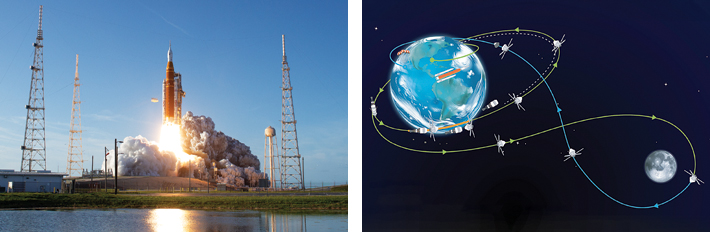
As dusk settled over Florida’s Space Coast on the evening of April 1, 2026, thousands gathered along the shoreline and around Kennedy Space Center, their eyes fixed on the illuminated silhouette of the Space Launch System standing against the darkening sky. Then, with a flash that turned night briefly into day, the rocket came alive. Fire billowed from its base, the air trembled under the force of nearly 8.8 million pounds of thrust, and slowly, almost majestically, the vehicle began its ascent. In that instant, history moved forward. With the launch of Artemis II, NASA sent humans beyond low Earth orbit for the first time since Apollo 17 in 1972, reopening a route that had remained dormant for 54 years.
THE MISSION BEHIND THE MOMENT
Artemis II was not designed as a landing mission. No crew member would set foot on the lunar surface. Instead, the flight was structured as the most critical proving mission in NASA’s new deep-space architecture — a systematic, end-to-end test of the Orion spacecraft and its ability to support astronauts in the deep space environment. Life-support systems, communications, guidance, navigation, propulsion, radiation performance and re-entry capability were all being evaluated under real operational conditions that no simulation can fully replicate.
At the centre of this mission stood the Space Launch System (SLS), NASA’s most powerful launch vehicle ever flown. Built using shuttle-derived RS-25 engines combined with advanced solid rocket boosters and a new upper stage, it represented the backbone of America’s Moon-to-Mars architecture — a statement of both engineering ambition and industrial commitment.
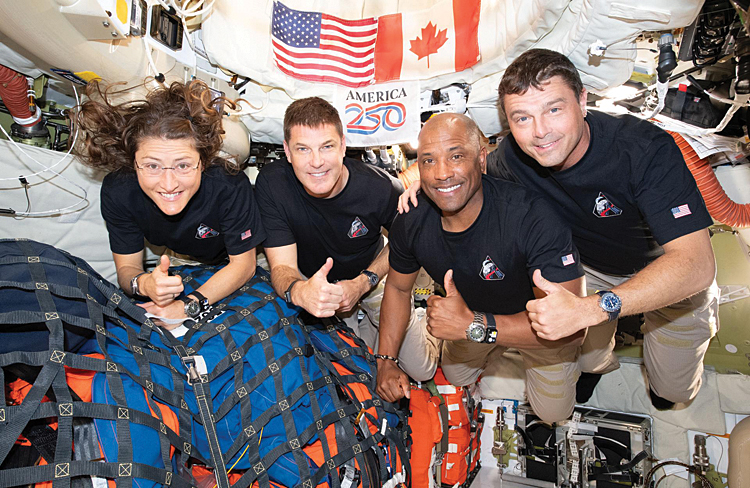
Carrying this machine into history were four astronauts: Commander Reid Wiseman, a former US Navy test pilot and former NASA Chief Astronaut who had previously logged 165 days aboard the International Space Station; Pilot Victor Glover, a US Navy aviator who had served on the SpaceX Crew-1 mission and, on Artemis II, became the first Black astronaut to travel toward the Moon; Mission Specialist Christina Koch, who holds the record for the longest single spaceflight by a woman at 328 days and became the first woman to travel to lunar space; and Mission Specialist Jeremy Hansen, a Colonel in the Royal Canadian Air Force and the first Canadian — and first non-American — ever assigned to a lunar mission.
WHERE NO HUMAN HAD GONE BEFORE
Over the days that followed launch, the Orion spacecraft, named Integrity by its crew, fulfilled objectives methodically as it arced toward the Moon on a free-return trajectory. Then, on April 6, the mission crossed a threshold that no amount of mission planning had diminished in significance.
Artemis II surpassed 2,52,756 miles from Earth — beyond the record long held by Apollo 13, whose crew had reached approximately 2,48,655 miles during their emergency return trajectory around the Moon in 1970. For more than five decades, while spaceflight advanced dramatically through the Shuttle era and the International Space Station, human missions remained confined to Earth’s orbital neighbourhood. The Apollo 13 distance stood as a marker of both achievement and the limits of ambition.
Artemis II dismantled that marker by design. The Orion spacecraft crossed the historic threshold as it swept around the far side of the Moon, officially completing the farthest human voyage ever undertaken. For the crew onboard, it was the greatest physical separation from Earth ever experienced by human beings. For NASA and the aerospace industry, it was something equally important: decisive validation of spacecraft autonomy, deep-space navigation, communications architecture and lifesupport resilience at unprecedented range.
Distance in spaceflight is never merely a numerical achievement. Every additional mile from Earth introduces greater operational complexity — from communications delays and cosmic radiation exposure to crew endurance and autonomous mission decision-making. The farther a spacecraft travels, the less immediate support it can receive from the ground, making onboard systems reliability, and crew preparedness critical. This is why the Artemis II distance record carries importance far beyond the headline figure. It demonstrates that humans can operate safely and effectively at the ranges that will define all future lunar and planetary missions.
That day also carried a distinctly human moment. Following their historic flyby, the crew held a live conversation with the US President from the far side of the Moon — a call that underscored not only the mission’s technical achievement but the degree to which deep-space communication systems had been validated in real time.
THE LONG ROAD HOME
The return journey began immediately after Orion completed its sweep around the far side of the Moon and exited the lunar sphere of influence — the point at which the Moon’s gravity yields to Earth’s pull. From that point, the spacecraft entered the most critical leg of the entire mission. The outward journey had demonstrated propulsion, navigation and deep-space communications. The trip home would test the systems that matter most to crew survival: thermal protection, re-entry guidance, parachute deployment and coordinated recovery operations.
Inside Integrity, the crew transitioned from exploration mode to return procedures. NASA’s mission updates confirmed that the astronauts spent the final days of flight conducting cabin checks, reviewing re-entry protocols with mission control and securing onboard equipment for descent. By Flight Day 9, formal splashdown preparations were underway, and on Flight Day 10 the Orion spacecraft executed its final return-trajectory correction burn — an eight-second thruster firing that placed the vehicle precisely on course for Earth. NASA confirmed that the mission had consumed less than half of the fuel aboard the European Service Module, a significant margin that speaks to the precision of the mission’s navigation planning throughout.
RE-ENTRY: THE ULTIMATE TEST OF THE ARCHITECTURE
As Orion descended toward Earth, the mission entered its most technically demanding phase. Returning from lunar space is fundamentally different from re-entry from low Earth orbit. The spacecraft approached Earth at more than 24,000 mph — over 30 times the speed of sound — while its heat shield endured temperatures approaching 5,000 degrees Fahrenheit during atmospheric entry. The crew was expected to experience up to 3.9 Gs in the planned entry profile.
During peak heating, the spacecraft passed through a planned communications blackout as plasma built around the capsule and for several minutes, there was silence in Mission Control at Johnson Space Center. Then communications were restored and the drogue parachutes deployed, the three main parachutes unfurled at approximately 6,000 feet.
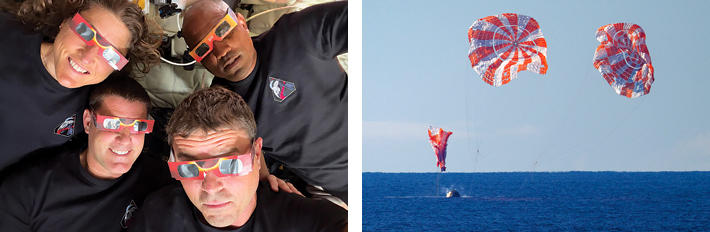
The Orion spacecraft splashed down safely in the Pacific Ocean off the coast of San Diego on April 10, 2026, completing a total journey of 6,94,481 miles. The recovery team — working alongside the Department of Defense and the USS John P. Murtha — moved swiftly to secure the capsule. Navy divers approached Orion, opened the hatch and assisted the crew onto the inflatable “front porch” before helicopter transfer to the recovery ship.
EVERY OBJECTIVE MET
The splashdown marked far more than the end of a single mission. It marked the successful completion of every primary objective set out for Artemis II. NASA’s goals for the flight had been defined with precision: validate Orion’s life-support systems in deep space, test crew interfaces and operational procedures, verify navigation and communications at lunar distance, and prove the spacecraft’s ability to safely return astronauts from beyond Earth orbit. By the time Integrity was secured on deck, those objectives had been met in full.
In NASA’s post-splashdown remarks, Commander Wiseman reflected on the journey’s significance, noting that the mission had demonstrated the complete operational cycle — outward journey, deep-space systems performance and safe return — with the confidence that only an actual crewed mission can provide. NASA’s mission leadership described the successful completion as the foundational step for all future missions under the Moon-to-Mars roadmap, reinforcing that Artemis II was the essential bridge to Artemis III and future lunar surface operations.
For the aerospace industry, the implications run deeper still. The mission has now provided NASA and its entire contractor ecosystem with real-world performance data across every critical phase of a deep-space crewed flight. Propulsion, habitation, communications, re-entry, parachute systems and recovery operations have all been tested under live conditions. Every subsystem advances into the next phase of programme maturity with the confidence that only an actual mission can provide — and that no amount of simulation expenditure could have purchased.
THE NEXT CHAPTER OPENS
If Artemis II reopened the road to the Moon, and its record-setting distance redefined the scale of modern exploration, then its successful splashdown has achieved something equally important — it has proved that humanity can once again travel into deep space and come home safely.
The deeper narrative of Artemis II was never solely about reaching the Moon’s vicinity. It was about building the operational confidence needed for the next era. With China accelerating its own lunar ambitions, including plans for crewed missions and long-term surface infrastructure, Artemis II also serves as a declaration that the United States and its international partners intend to lead the next phase of cislunar operations. This is no longer the Cold War-era race to plant a flag. The competition now is about long-term presence — communications networks, logistics systems, scientific infrastructure and eventual resource utilisation, particularly at the Moon’s South Pole, where deposits of water ice could support future habitation and fuel generation.
The road ahead leads directly to Artemis III, which will test rendezvous and docking with commercial lunar landing systems in Earth orbit, and then to Artemis IV, the planned crewed lunar surface landing later this decade. Every lesson from Artemis II — on crew endurance, spacecraft reliability, thermal management and deep-space operations — feeds directly into those missions. And beyond the Moon, the systems and procedures validated by Artemis II are the same foundational elements required for Mars.
Apollo proved humanity could reach the Moon. Artemis II has proved humanity can do it again — deliberately, safely, and as the first step in a programme designed not for one triumphant moment, but for permanence. And this time, the journey has only just begun.